Embracing the Great Outdoors for Your Fitness Routine
When it comes to staying fit and healthy, you don’t always need a gym membership or fancy equipment. In fact, some of the most effective workouts can be done using just your body weight and the natural environment around you. Parks, with their open spaces, benches, and various structures, provide an excellent setting for a full-body workout. So, what bodyweight exercises can be performed in a park? Let’s dive into a comprehensive list of exercises that will help you make the most of your local green space and get fit in the fresh air.
The Benefits of Outdoor Bodyweight Training
Before we jump into the specific exercises, it’s worth understanding why outdoor bodyweight training is so beneficial. First and foremost, it’s incredibly accessible. You don’t need to pay for a gym membership or invest in expensive equipment. All you need is a bit of space and your own body. Additionally, exercising outdoors has been shown to have numerous mental health benefits, including reduced stress levels and improved mood. The varied terrain and natural obstacles in parks can also add an extra challenge to your workouts, keeping them fresh and exciting. Plus, the vitamin D boost from sunlight exposure is an added bonus for your overall health.
Upper Body Powerhouses
When it comes to upper body exercises you can perform in a park, there are plenty of options to choose from. These exercises will target your chest, shoulders, arms, and back, helping you build strength and definition.
Push-Ups: The Classic Chest Builder
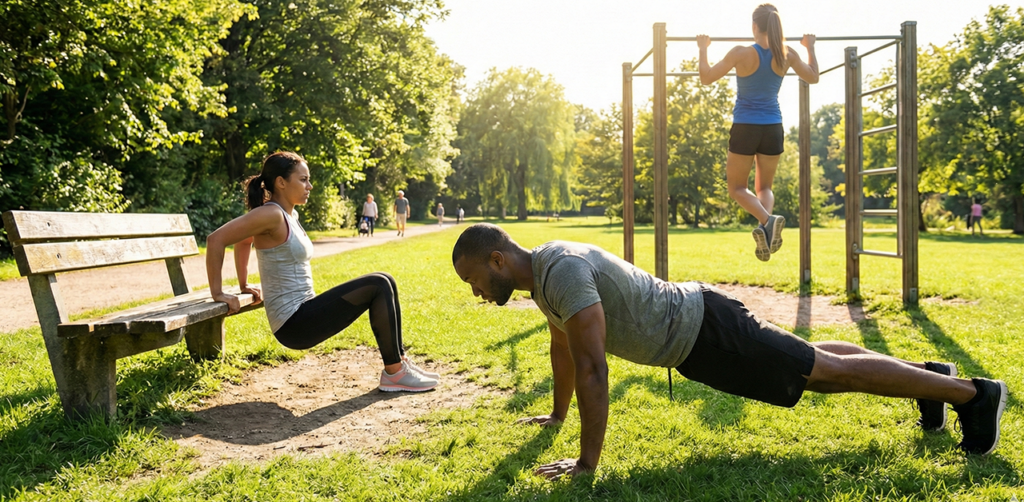
Push-ups are a staple of bodyweight training and for good reason. They’re an excellent way to build chest, shoulder, and tricep strength. To perform a push-up:
- Start in a plank position with your hands slightly wider than shoulder-width apart
- Lower your body until your chest nearly touches the ground
- Push back up to the starting position
For an added challenge, try decline push-ups by placing your feet on a park bench or low wall.
Dips: Tricep Toners
Dips are fantastic for targeting your triceps and chest. Most parks have benches or picnic tables that are perfect for this exercise. Here’s how to do them:
- Sit on the edge of a bench with your hands gripping the edge on either side of your hips
- Slide your bottom off the bench, supporting your weight with your arms
- Lower your body by bending your elbows, then push back up
Pull-Ups: The Ultimate Back Builder
If your park has a sturdy branch, monkey bars, or a pull-up bar, you’re in luck. Pull-ups are one of the best exercises for building back and bicep strength. To perform a pull-up:
- Grip the bar with your palms facing away from you, hands slightly wider than shoulder-width
- Hang with your arms fully extended
- Pull yourself up until your chin clears the bar, then lower back down
If full pull-ups are too challenging, try negative pull-ups by jumping to the top position and lowering yourself slowly.
Lower Body Burners
Your park workout wouldn’t be complete without some lower body exercises. These movements will target your quads, hamstrings, glutes, and calves, helping you build leg strength and improve your overall athleticism.
Squats: The King of Lower Body Exercises
Squats are a fundamental movement that targets multiple muscle groups in your lower body. Here’s how to perform a bodyweight squat:
- Stand with your feet shoulder-width apart
- Lower your body as if you’re sitting back into a chair, keeping your chest up and your weight in your heels
- Go as low as you can while maintaining good form, then push back up to the starting position
For an extra challenge, try jump squats by explosively jumping at the top of each rep.
Lunges: Stride Your Way to Stronger Legs
Lunges are excellent for building unilateral leg strength and improving balance. To perform a forward lunge:
- Stand with your feet hip-width apart
- Take a large step forward with one foot
- Lower your body until both knees are bent at 90-degree angles
- Push back up to the starting position and repeat with the other leg
Mix it up with reverse lunges or walking lunges across an open area of the park.
Step-Ups: Stair Master Alternative
If your park has stairs or a sturdy bench, step-ups are a great exercise to include in your routine. They target your quads, glutes, and calves while also improving balance and coordination. Here’s how to do them:
- Stand facing a step or bench
- Step up onto the platform with one foot, driving through your heel
- Bring your other foot up to meet the first
- Step back down and repeat, alternating lead legs
Core Crushers
A strong core is essential for overall fitness and can help improve your performance in other exercises. These core-focused movements will help you build a solid midsection.
Planks: Stability Builders
Planks are an isometric exercise that targets your entire core, including your abs, obliques, and lower back. To perform a plank:
- Start in a push-up position, but with your forearms on the ground instead of your hands
- Keep your body in a straight line from your head to your heels
- Hold this position for as long as you can maintain good form
Challenge yourself with side planks or plank reaches for added difficulty.
Russian Twists: Oblique Obliterators
Russian twists are great for targeting your obliques and improving rotational strength. Here’s how to do them:
- Sit on the ground with your knees bent and feet flat
- Lean back slightly, keeping your back straight
- Lift your feet off the ground and balance on your sit bones
- Twist your torso from side to side, touching the ground on each side
For an extra challenge, hold a rock or water bottle as you twist.
Mountain Climbers: Cardio and Core Combo
Mountain climbers are a dynamic exercise that combines core strength with cardiovascular benefits. To perform mountain climbers:
- Start in a high plank position
- Bring one knee towards your chest, then quickly switch legs
- Continue alternating legs in a running motion
Full-Body Blasters
These exercises engage multiple muscle groups simultaneously, providing an efficient full-body workout and boosting your heart rate for added cardiovascular benefits.
Burpees: The Ultimate Full-Body Exercise
Burpees are notorious for their ability to challenge your entire body and cardiovascular system. Here’s how to perform a burpee:
- Start in a standing position
- Drop into a squat and place your hands on the ground
- Kick your feet back into a plank position
- Perform a push-up
- Jump your feet back to your hands
- Explode up into a jump with your arms overhead
Bear Crawls: Primal Movement Pattern
Bear crawls are an excellent full-body exercise that improves coordination and engages your core, shoulders, and legs. To do a bear crawl:
- Start on all fours with your hands under your shoulders and knees under your hips
- Lift your knees slightly off the ground
- Move forward by simultaneously moving your right hand and left foot, then left hand and right foot
- Keep your back flat and core engaged throughout the movement
Inchworms: Flexibility and Strength Combined
Inchworms are a great way to improve flexibility while also working your core, arms, and legs. Here’s how to perform an inchworm:
- Start standing with your feet hip-width apart
- Bend at the waist and place your hands on the ground in front of you
- Walk your hands out until you’re in a plank position
- Perform a push-up
- Walk your feet back up to your hands
- Stand up and repeat
Incorporating Bodyweight Exercises into Your Park Workout
Now that you have a comprehensive list of bodyweight exercises you can perform in a park, it’s time to put them together into a workout. Here’s a sample routine you can try:
- Warm-up: 5-10 minutes of light jogging or brisk walking
- Circuit 1 (3 rounds):
– 10 push-ups
– 15 bodyweight squats
– 10 dips
– 20 mountain climbers (each leg) - Circuit 2 (3 rounds):
– 10 pull-ups (or negative pull-ups)
– 12 lunges (each leg)
– 30-second plank
– 20 Russian twists - Circuit 3 (3 rounds):
– 8 burpees
– 20 step-ups (10 each leg)
– 30-second bear crawl
– 10 inchworms - Cool-down: 5-10 minutes of light jogging or walking, followed by stretching
Remember to adjust the number of repetitions and rounds based on your fitness level. As you get stronger, you can increase the difficulty by adding more reps, sets, or incorporating more challenging variations of each exercise.
Safety Considerations for Outdoor Workouts
While exercising in a park can be a fantastic way to stay fit, it’s important to keep safety in mind. Here are some tips to ensure your outdoor workout is both effective and safe:
- Check the weather forecast before heading out and dress appropriately
- Bring water to stay hydrated, especially on hot days
- Wear sunscreen to protect your skin from harmful UV rays
- Inspect any equipment or structures you plan to use for stability and safety
- Be aware of your surroundings and choose a well-lit area if exercising early in the morning or late in the evening
- Start with easier variations of exercises and progress gradually to avoid injury
- Listen to your body and take breaks when needed
By following these safety guidelines, you can enjoy all the benefits of outdoor bodyweight training while minimizing the risk of injury or discomfort.
Maximizing Your Park Workout Experience
To get the most out of your park workouts, consider these additional tips:
- Vary your routine: Mix up the exercises and the order in which you do them to keep your workouts challenging and prevent boredom
- Use natural features: Incorporate hills for sprints, stairs for step-ups, and trees for pull-ups to add variety to your workout
- Invite friends: Working out with others can make the experience more enjoyable and help keep you accountable
- Track your progress: Keep a log of your workouts to monitor improvements in strength and endurance over time
- Set goals: Whether it’s mastering a new exercise or increasing the number of reps you can do, having goals can help keep you motivated
By implementing these strategies, you can create a rewarding and effective outdoor fitness routine that rivals any gym workout.
Remember, the key to success with bodyweight exercises in a park setting is consistency and progression. Start with exercises that challenge you but are still manageable, and gradually increase the difficulty as you get stronger. With dedication and regular practice, you’ll be amazed at the results you can achieve using nothing more than your body weight and the great outdoors. So, next time you’re looking for a workout, skip the gym and head to your local park – your body (and mind) will thank you for it!
Give us a call today at 1-877-777-6086 or fill out our contact form to become a retail
distributor of our top-of-the-line safety lights.