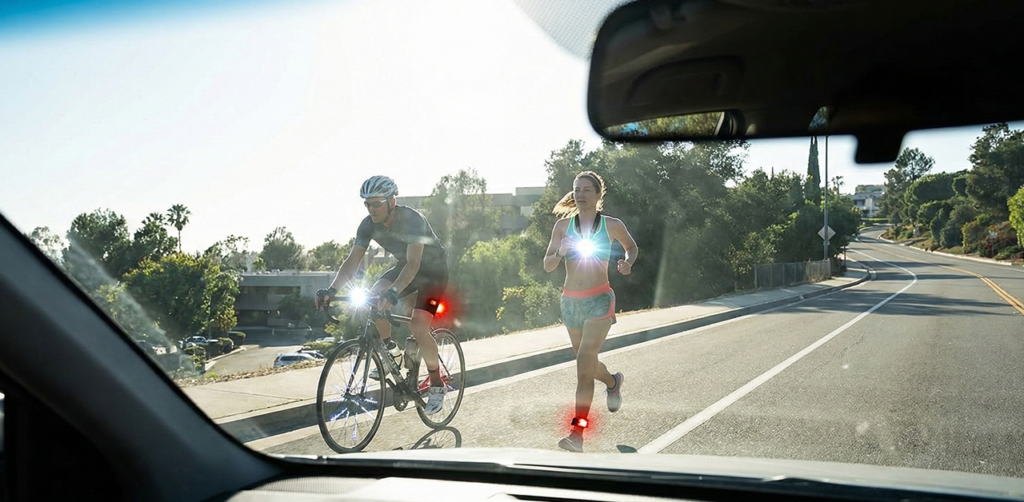
You might think that visibility concerns only matter when darkness falls, but the statistics tell a dramatically different story. Daytime accidents involving runners and cyclists occur with alarming frequency, even in what appears to be perfect lighting conditions. The human eye processes visual information in complex ways, and during daylight hours, drivers face countless distractions, environmental factors, and optical challenges that make it surprisingly difficult to spot active individuals sharing the road. Understanding how visibility lights reduce daytime accidents for runners and cyclists begins with recognizing that being seen isn’t just about the absence of darkness—it’s about standing out in an increasingly cluttered visual landscape that bombards drivers with information every second they’re behind the wheel.
The concept of “looked-but-failed-to-see” accidents represents one of the most significant challenges for runners and cyclists during daytime hours. These incidents occur when a driver looks directly at a cyclist or runner but fails to consciously register their presence. The brain receives the visual input, but it doesn’t process it as important or threatening information. This cognitive filtering happens because the human visual system is designed to prioritize certain types of movement, contrast, and patterns over others. When you’re wearing standard athletic clothing that blends with the environment, you become part of the background noise that a driver’s brain automatically filters out, especially during those microseconds when they’re checking mirrors, adjusting controls, or managing the dozens of other tasks that modern driving demands.
The Science Behind Daytime Visibility Challenges
Your visibility during daylight hours faces obstacles that many fitness enthusiasts never consider until it’s too late. Bright sunlight creates glare on windshields, making it exponentially harder for drivers to detect objects outside their vehicles. Morning and afternoon sun angles position themselves at eye level for drivers, creating temporary blindness as they navigate roads where you’re running or cycling. Even on overcast days, the diffused light can make it challenging for your silhouette to stand out against complex backgrounds like tree lines, building facades, or the varied terrain that makes your favorite routes so enjoyable. Research has demonstrated that the human eye requires significantly more contrast to detect objects in bright conditions compared to low-light environments, which seems counterintuitive but explains why so many daytime collisions occur.
The phenomenon of motion camouflage further complicates your safety during daytime activities. When you’re running or cycling at certain speeds and angles relative to a moving vehicle, your relative motion can make you appear stationary or nearly invisible to the driver’s peripheral vision. The brain relies heavily on motion detection to identify potential threats or objects requiring attention, but when that motion becomes ambiguous or matches the background environment’s movement patterns, you effectively disappear from conscious awareness. This biological quirk of human perception has evolved over millions of years and worked perfectly fine for avoiding predators in natural environments, but it creates serious hazards in modern traffic scenarios where vehicles approach at high speeds.
Understanding how visibility lights reduce daytime accidents for runners and cyclists requires acknowledging the limitations of reflective materials during daylight hours. Those reflective strips on your shoes and jacket work wonderfully when headlights shine directly on them, but during the day, they offer minimal benefit. Reflective materials need a light source to bounce back toward the observer, and ambient daylight doesn’t provide the directed illumination necessary for these materials to perform effectively. This gap in protection during daytime hours is precisely where active lighting solutions make their most significant impact. By generating their own light rather than relying on external sources, visibility lights create contrast and draw attention regardless of ambient lighting conditions.
How Active Lighting Technology Works During Daylight
The mechanics of how visibility lights reduce daytime accidents for runners and cyclists centers on their ability to create what vision scientists call “conspicuity.” This term refers to how easily and quickly something catches attention in a visual field. Modern LED visibility lights don’t just make you brighter—they make you fundamentally different from your surroundings. The wavelengths of light they emit, particularly in the amber, red, and bright white spectrum, trigger immediate attention responses in the human brain. These colors signal warning, movement, and urgency in ways that our evolutionary programming recognizes instinctively, cutting through the cognitive filtering that might otherwise cause a driver to overlook you.
Flashing or pulsing light patterns provide even greater protection than steady illumination because the human visual system is extraordinarily sensitive to changes in the environment. Your brain has dedicated neural pathways specifically designed to detect flashing or intermittent light sources, prioritizing them over static visual elements. When you activate a visibility light with a strobe or pulse pattern, you’re essentially hijacking these ancient survival mechanisms that helped our ancestors spot dangers in their peripheral vision. A driver might not consciously notice steady objects in their field of view, but a pulsing light triggers an automatic attention response that’s nearly impossible to ignore, even when they’re distracted or fatigued.
The positioning and number of visibility lights you use dramatically affects their protective capability. Mounting lights at different heights on your body creates what’s called “biological motion” visibility—the pattern helps drivers instantly recognize that they’re seeing a human being rather than a stationary object or animal. When lights are positioned on your ankles or shoes, the up-and-down motion of running or the circular motion of pedaling creates distinctive patterns that the brain recognizes as human locomotion from remarkable distances. This recognition happens in milliseconds, giving drivers crucial extra time to adjust their speed, change lanes, or increase their following distance. Research conducted by transportation safety organizations has demonstrated that cyclists and runners using multiple active lights are detected at distances up to three times greater than those relying solely on reflective materials or high-visibility clothing.
Types of Visibility Lights and Their Applications
Clip-on LED lights represent the most versatile and accessible option for fitness enthusiasts who want to enhance their daytime safety. These compact devices attach to clothing, hydration packs, arm bands, or anywhere you need additional visibility without adding significant weight or bulk. Many models offer multiple flash patterns, allowing you to select the setting that provides maximum visibility for your specific environment and activity. You can position these lights strategically on both your front and back, ensuring that you’re visible to traffic approaching from any direction. The convenience factor matters tremendously when you’re trying to maintain consistent safety habits—if your visibility equipment is complicated or uncomfortable, you’re less likely to use it regularly.
Wearable light systems integrated into vests, belts, and specialized athletic wear take visibility to the next level by distributing illumination across larger surface areas of your body. These systems often incorporate both steady and flashing lights positioned to create maximum contrast against your surroundings. Some advanced models include accelerometers that automatically adjust flash patterns based on your speed and movement, creating more urgent warning signals when you’re moving at higher velocities. The advantage of integrated systems lies in their stability and consistent positioning—unlike clip-on lights that might shift during vigorous activity, built-in lighting maintains optimal positioning throughout your entire workout, ensuring that drivers receive clear visual signals regardless of how you’re moving.
Bicycle-specific lighting systems have evolved far beyond the simple front headlight and rear flasher combination. Modern daytime running lights for cyclists utilize specially designed optics that spread illumination across wider angles, making you visible to drivers approaching from side streets and driveways. Spoke-mounted lights create eye-catching wheel patterns that clearly identify you as a cyclist and make it easier for drivers to judge your speed and trajectory. Frame-mounted accent lighting increases your overall visibility profile, making your bicycle appear larger and more noticeable in traffic. When considering how visibility lights reduce daytime accidents for runners and cyclists, the comprehensive approach of multiple light sources working together provides exponentially greater protection than any single light could offer alone.
Strategic Placement for Maximum Protection
The science of optimal light placement considers both the biomechanics of your activity and the psychology of driver attention. For runners, ankle-mounted lights provide exceptional visibility because the vertical movement of your stride creates a distinctive bobbing pattern that drivers recognize as a pedestrian from impressive distances. This motion signature works even in peripheral vision, alerting drivers to your presence before they might otherwise notice you. Additionally, lights positioned lower on your body remain visible even when cars, bushes, or other obstacles might block a driver’s view of your upper body. You’re creating multiple opportunities for detection, which dramatically improves your safety margins.
Upper body lighting plays an equally critical role in your visibility strategy. Chest or shoulder-mounted lights position illumination at approximately the same height as vehicle headlights, creating a subconscious association that helps drivers process your presence more quickly. When you combine upper and lower body lights, you create what safety researchers call “bio-motion signature enhancement”—the vertical spacing between lights helps drivers instantly categorize you as a human being requiring caution and space. This immediate recognition triggers more appropriate driver responses compared to situations where they might mistake you for a mailbox, signpost, or other roadside object that doesn’t require defensive driving adjustments.
For cyclists, the strategic placement of visibility lights must account for your larger profile and different motion patterns compared to runners. Helmet-mounted lights provide excellent visibility because they position illumination at the highest point of your profile and turn with your head as you check for traffic or navigate turns. Rear-facing lights mounted to your seat post or helmet create crucial visibility for vehicles approaching from behind, which represent the most significant threat to cyclist safety. Side-illumination mounted on your pedals, cranks, or wheel hubs ensures that drivers pulling out from side streets or driveways can see you approaching, preventing the dangerous “right hook” and intersection collisions that account for a disproportionate number of cycling accidents.
Real-World Impact on Accident Prevention
Statistical analysis from transportation safety agencies reveals compelling evidence about how visibility lights reduce daytime accidents for runners and cyclists in measurable ways. Studies conducted across multiple countries have demonstrated accident reduction rates ranging from 19% to 47% when active participants use daytime running lights compared to control groups without supplemental lighting. These aren’t marginal improvements—they represent hundreds of prevented injuries and fatalities annually. The data becomes even more impressive when you examine specific accident scenarios, with rear-end collisions showing reduction rates exceeding 50% when cyclists use flashing rear lights even during daylight hours.
The time advantage that visibility lights provide translates directly into accident prevention because driving safety is fundamentally a game of seconds and fractions of seconds. When a driver detects you even one second earlier, they gain approximately 60 to 100 feet of additional reaction distance at typical urban speeds. This extra distance provides room for gradual, controlled responses rather than emergency maneuvers that might fail or create additional hazards. You’ve effectively expanded your safety bubble, creating space that accommodates human reaction times, vehicle braking distances, and the inevitable imperfections in driver attention that characterize real-world traffic conditions. Every additional foot of detection distance reduces collision severity if an impact does occur, and frequently provides enough room to avoid the collision entirely.
Insurance claims data and emergency room statistics support laboratory findings and controlled studies. Hospital trauma centers in areas where visibility light adoption has increased report measurable decreases in pedestrian and cyclist admissions during daylight hours. These real-world outcomes validate what the research predicts—that active lighting provides substantial protection even when the sun is shining. The economic impact extends beyond the obvious human costs, with reduced insurance claims, lower municipal accident-response costs, and decreased healthcare expenditures creating societal benefits that far exceed the minimal investment in quality visibility lights. When you make the decision to use visibility lighting, you’re not just protecting yourself—you’re contributing to safer road conditions for everyone who shares those spaces.
Overcoming Common Objections and Misconceptions
Many fitness enthusiasts resist adopting daytime visibility lights because they underestimate the risks or overestimate how visible they already are in regular athletic clothing. You might think that your bright neon running shirt provides adequate visibility, but research consistently demonstrates that color alone offers insufficient protection in complex traffic environments. While high-visibility colors like fluorescent yellow or orange certainly help, they lack the attention-grabbing properties of active lighting. Your fluorescent shirt competes with dozens or hundreds of other colored objects in a driver’s visual field—signs, buildings, other vehicles, landscaping—whereas a flashing light creates a unique stimulus that demands attention. The difference isn’t subtle; it’s the difference between being one element among many and being the element that can’t be ignored.
Some athletes worry that wearing visibility lights during the day looks excessive or unnecessary, creating social pressure to forego protective equipment. This concern, while understandable, prioritizes appearance over safety in ways that few fitness enthusiasts would accept in other contexts. You wouldn’t skip your bike helmet because it messes up your hair, and the same logic should apply to visibility lighting. As more runners and cyclists adopt active lighting for daytime activities, it’s rapidly becoming the standard rather than the exception, particularly among serious athletes who understand the statistics. Early adopters of safety technology always face social friction, but the visible presence of these lights on more athletes helps normalize their use and potentially saves lives by example, encouraging others to enhance their own visibility.
Battery life and device management concerns sometimes prevent athletes from consistently using visibility lights, but modern LED technology has largely eliminated these practical obstacles. Today’s high-quality visibility lights operate for dozens of hours on a single charge or battery, easily outlasting even the longest training sessions most fitness enthusiasts undertake. Many models include USB rechargeable batteries that you can top off overnight, making them as convenient as charging your phone or fitness tracker. The minimal time investment required to maintain your visibility lights pales in comparison to the protection they provide, and developing consistent habits around checking and charging your lights becomes second nature within a few weeks. You already manage multiple pieces of technology in your daily routine—adding visibility lights to that ecosystem requires minimal additional effort.
Choosing the Right Visibility Lights for Your Activities
Your selection of visibility lights should reflect the specific demands of your preferred activities and training environments. Road runners who frequently train on routes with significant vehicle traffic benefit most from 360-degree visibility solutions that include both forward and rear-facing lights plus side-illumination. Trail runners might prioritize lighter weight systems since traffic encounters occur less frequently, though visibility remains important at trailheads, road crossings, and multi-use paths where cyclists and other users travel at higher speeds. Understanding how visibility lights reduce daytime accidents for runners and cyclists in your specific context allows you to make informed choices about which products deserve space in your gear collection.
Cyclists face more complex decisions because bicycles offer multiple mounting locations and typically accommodate heavier, more powerful lighting systems than body-worn options. Commuter cyclists who ride during peak traffic hours should invest in comprehensive lighting packages that include powerful front lights, multiple rear flashers, and supplemental side visibility through wheel lights or frame-mounted accent lighting. Recreational cyclists who primarily ride on dedicated bike paths or low-traffic routes might opt for simpler setups, though basic front and rear lights remain essential even in relatively protected environments. Mountain bikers and off-road cyclists need durable, weather-resistant lights that can withstand vibration, impacts, and exposure to mud, water, and trail debris while still providing visibility during those inevitable road sections that connect trail systems.
Budget considerations legitimately influence gear decisions, but visibility lights offer exceptional value compared to their protective benefit. Entry-level options that provide basic daytime visibility start at prices comparable to specialty running socks or basic cycling accessories. Mid-range systems with rechargeable batteries, multiple flash patterns, and weather-resistant construction cost less than premium running shoes yet potentially prevent injuries that would sideline you for months. Elite visibility systems with integrated designs, automatic features, and maximum illumination power represent investments similar to other serious safety equipment like quality helmets or protective padding. Viewed through the lens of cost-per-use over their typical multi-year lifespans, even premium visibility lights cost mere pennies per workout while providing benefits that literally cannot be overstated.
Integration with Existing Safety Practices
Visibility lights work best when incorporated into comprehensive safety strategies that address multiple risk factors simultaneously. Your lighting should complement rather than replace other protective measures like reflective elements, high-visibility clothing, and defensive positioning on roads and paths. The concept of layered safety creates redundancy that protects you even when individual elements underperform—if a driver somehow misses your flashing lights, they might still notice your reflective vest or bright clothing. This approach mirrors how you likely think about other aspects of training safety, from gradual mileage increases that prevent overuse injuries to proper hydration strategies that protect against heat illness. No single measure provides complete protection, but multiple overlapping strategies create robust safety margins.
Defensive positioning and route selection interact significantly with your visibility lighting strategy. Even with excellent lights, you should avoid positions on the road that give drivers minimal time to react to your presence. Running or cycling against traffic flow when possible allows you to see approaching vehicles and make eye contact with drivers, confirming that they’ve detected you. Choosing routes with wider shoulders, bike lanes, or separated paths reduces your exposure to close-passing vehicles regardless of your visibility level. When these preferred options aren’t available, your lights become even more critical, making you detectable from maximum distances and providing drivers with every possible advantage in identifying and avoiding you. The goal is creating situations where everything works in your favor rather than hoping that any single element will be sufficient.
Teaching Children and Family Members About Visibility
As a parent encouraging healthy, active lifestyles for your children, understanding how visibility lights reduce daytime accidents for runners and cyclists becomes doubly important. Kids on bicycles or accompanying you on family runs face the same visibility challenges as adults but with additional vulnerabilities. Their smaller stature makes them even more difficult for drivers to see, particularly when sight lines are blocked by parked cars, landscaping, or other obstacles. Young people often lack the road awareness and defensive positioning instincts that adults develop through experience, making them dependent on being seen rather than actively managing their visibility through strategic behavior. Equipping your children with proper visibility lights from their earliest rides and runs establishes safety habits that will protect them throughout their lives.
The educational component matters as much as the equipment itself. Take time to explain to your children why visibility lights are important, using age-appropriate language that helps them understand the challenges drivers face in seeing smaller road users. You might demonstrate how much more visible they are with lights activated by having them observe from a distance as you turn lights on and off, creating a visual comparison that makes the abstract concept concrete. This hands-on learning reinforces the importance of the equipment and increases the likelihood that they’ll use it consistently, even when you’re not directly supervising their activities. Building their awareness of how drivers perceive cyclists and runners helps develop broader safety consciousness that extends beyond just using lights.
Making visibility equipment appealing to younger users sometimes requires creative approaches that balance safety with personal expression. Many manufacturers now offer lights in various colors, with some models allowing kids to select their preferred flash patterns or illumination colors. Allowing children to choose their own lights within appropriate safety parameters gives them ownership of their equipment and increases consistent use. You might establish family rules that bikes don’t leave the garage without lights attached, or that evening family runs always include everyone wearing their visibility gear. These consistent expectations become ingrained habits that protect your children during independent activities as they grow older and exercise without parental supervision. The patterns you establish now create safety-conscious adults who understand that visibility equipment is as fundamental as helmets and other protective gear.
Weather Conditions and Environmental Factors
Understanding how visibility lights reduce daytime accidents for runners and cyclists requires acknowledging that “daytime” encompasses wildly variable visibility conditions. Fog, rain, and snow can reduce visibility to near-nighttime levels even at midday, making active lighting absolutely critical rather than merely beneficial. Water droplets in the atmosphere scatter light in complex ways that make it extraordinarily difficult for drivers to detect objects at any distance. Your silhouette disappears into the gray haze, and even high-visibility clothing loses effectiveness when everything becomes monochromatic. In these conditions, the active light generation from LED visibility lights becomes your primary—and sometimes only—reliable method of detection by motor vehicle operators.
Seasonal variations in sun angle and ambient light quality also affect your visibility throughout the year. Winter months bring low sun angles that create extended periods of challenging glare conditions during what would normally be prime afternoon training hours. The combination of bright sun and reflective surfaces like snow creates visual environments where contrasts flatten and distances become difficult to judge. Summer brings its own challenges with heat shimmer creating visual distortions on hot pavement and intense overhead sun creating shadows that can obscure runners and cyclists in certain positions. Quality visibility lights perform consistently across all these variable conditions, providing reliable protection regardless of seasonal factors that affect natural visibility.
Environmental features of your typical routes influence optimal visibility light configurations. Urban environments with abundant artificial lighting, signage, and visual clutter require more powerful lights or distinctive flash patterns to stand out against the competitive background. Rural areas often provide clearer sight lines but higher vehicle speeds, making early detection from maximum distances especially important. Wooded routes create dappled lighting conditions with constantly shifting patterns of sun and shadow that can make you appear and disappear from a driver’s view as you move through different patches. Analyzing your specific training environments helps you select lights with appropriate brightness levels, beam patterns, and mounting positions that address the unique challenges of the areas where you actually run or ride.
Advanced Features and Emerging Technologies
The rapid evolution of LED and battery technology continues to improve visibility light performance while reducing size, weight, and cost. Modern high-output LEDs produce extraordinary illumination from remarkably small packages, allowing manufacturers to create visibility lights that were impossible just a few years ago. Battery energy density improvements mean that today’s lights run longer on smaller batteries or operate for equivalent durations while weighing significantly less than previous generations. These technological advances remove barriers that might have prevented adoption in the past, making there fewer legitimate excuses for not utilizing proper visibility equipment during daytime activities.
Smart lighting systems represent the cutting edge of visibility technology, incorporating sensors and connectivity that adapt to conditions automatically. Some advanced systems include ambient light sensors that adjust brightness and flash patterns based on current visibility conditions, providing just enough illumination to be noticed without wasting battery power. Accelerometer-equipped lights modify their behavior based on your speed and movement patterns, creating more urgent signals when you’re traveling faster or making sudden direction changes that might surprise nearby drivers. GPS-enabled visibility systems can activate automatically when you enter high-traffic areas or roads with poor visibility records, ensuring protection exactly when and where you need it most without requiring you to remember manual activation.