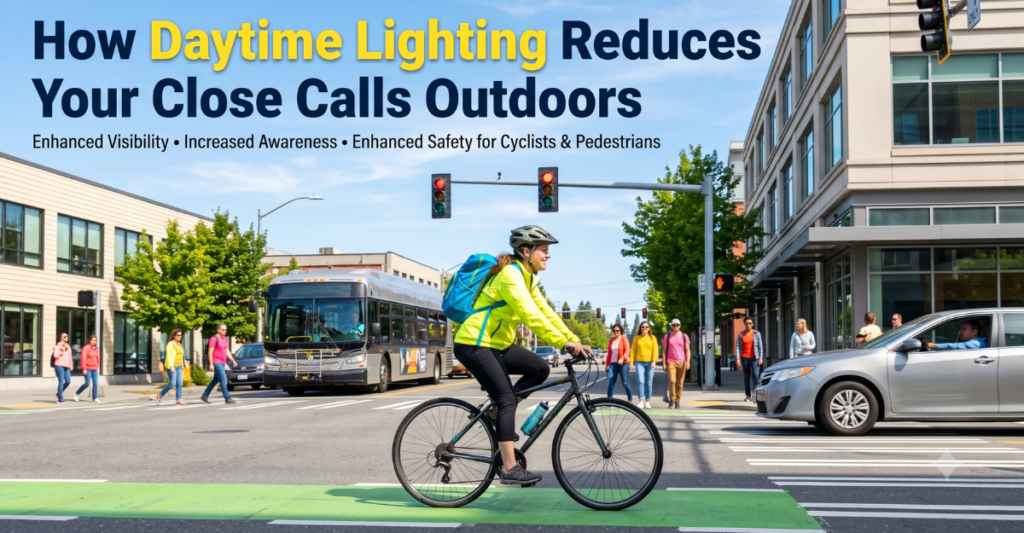
The early morning jogger who narrowly avoids a collision with a cyclist. The weekend trail runner who almost stumbles over an unseen rock. The soccer mom rushing to get in a quick workout before the school pickup, barely noticing the car backing out of a driveway. These scenarios happen more frequently than you’d think, and they all share a common denominator: visibility challenges that put outdoor athletes at risk. Understanding how daytime lighting reduces close calls for outdoor athletes isn’t just about avoiding accidents—it’s about transforming your outdoor exercise experience into something safer, more confident, and ultimately more enjoyable.
You might assume that daylight automatically means safety. After all, the sun is up, the world is bright, and surely everyone can see everyone else, right? Wrong. The reality of outdoor athletic activities is far more nuanced, with countless variables affecting how visible you are to drivers, other athletes, and potential hazards in your path. From the angle of the sun creating blinding glare to the visual clutter of urban environments making it difficult for drivers to spot pedestrians, daytime visibility presents unique challenges that many fitness enthusiasts overlook until it’s almost too late.
The Science Behind Daytime Visibility and Why It Matters
When you step outside for your morning run or afternoon bike ride, your eyes quickly adjust to the ambient light conditions, creating a false sense of security about how well others can see you. Research conducted by transportation safety organizations has revealed something surprising: daytime visibility accidents account for a significant percentage of pedestrian and cyclist injuries, despite the seemingly favorable lighting conditions. The human eye is remarkably sophisticated, but it’s also easily fooled by contrast issues, motion blindness, and attention overload.
Consider how your visual system processes information during daylight hours. Your retina contains two types of photoreceptor cells: rods and cones. While rods excel in low-light conditions, cones dominate during daytime, providing detailed color vision and sharp acuity. However, this doesn’t guarantee that drivers will notice you on the roadside. The concept of “looked but failed to see” explains many daytime accidents where drivers swear they looked in your direction but genuinely didn’t register your presence. This phenomenon occurs because the brain filters out information it deems unimportant, and a runner or cyclist blending into the background can easily fall into this category.
The physics of light also plays a crucial role in understanding how daytime lighting reduces close calls for outdoor athletes. When you wear materials that actively enhance your visibility through reflection or fluorescence, you’re fundamentally changing the equation. Reflective materials work by bouncing light back toward its source with minimal scattering, creating a bright appearance that catches the eye. Fluorescent materials, on the other hand, absorb ultraviolet light invisible to the human eye and re-emit it as visible light, making them appear unnaturally bright even in full daylight. This combination of optical properties creates what safety researchers call “conspicuity”—the quality of being noticed and remembered.
Understanding the Daytime Danger Zones Every Athlete Faces
Your morning run might take you through tree-lined streets where dappled sunlight creates constantly shifting patterns of light and shadow. These environments present particular challenges because the human visual system struggles with rapid transitions between bright and dark areas. Drivers emerging from shaded areas into bright sunlight experience temporary blindness as their pupils contract, potentially lasting several seconds—plenty of time for them to miss seeing you entirely. Similarly, when you’re running in shadows while the road ahead is bathed in sunshine, you become nearly invisible to approaching vehicles.
Urban and suburban environments create their own visibility challenges through what experts call “visual clutter.” Storefronts, parked cars, street signs, other pedestrians, and countless other visual elements compete for a driver’s attention. In this chaotic visual landscape, a runner wearing muted colors simply disappears into the background noise. Studies tracking eye movements of drivers in busy areas have shown that they tend to focus on potential threats like other vehicles while pedestrians and cyclists receive far less visual attention, especially when those athletes don’t stand out from their surroundings.
Weather conditions that seem perfectly fine for outdoor exercise can dramatically reduce visibility between you and others sharing the road or trail. Light fog, morning mist, or even the haze from humidity can scatter light in ways that reduce contrast, making it harder for drivers to judge distances and spot people. Rain creates additional problems by reducing visibility through windshields, creating distracting reflections, and demanding more of a driver’s attention for vehicle control. Understanding these situational visibility challenges helps you appreciate why simply exercising during daylight hours isn’t enough to keep you safe.
The Psychology of Driver Awareness and Athlete Safety
You need to understand that drivers aren’t actively looking for athletes and pedestrians—they’re primarily watching for other vehicles. This fundamental aspect of driver psychology explains why so many close calls occur even in broad daylight. The human brain uses prediction and pattern recognition to process the overwhelming amount of visual information encountered while driving. When something falls outside expected patterns, like a runner appearing from between parked cars, the driver’s brain may not register the threat until it’s almost too late.
The phenomenon known as “inattentional blindness” means that drivers can look directly at you without actually seeing you if their attention is focused elsewhere. Research has demonstrated this effect dramatically through experiments where subjects watching videos fail to notice unexpected elements—like someone in a gorilla suit walking through the scene—because their attention is directed toward a specific task. When drivers are focused on navigation, traffic signals, or their own thoughts, your presence on the roadside may not register consciously, even if their eyes pass over you multiple times.
How Strategic Use of Daytime Lighting Technology Prevents Accidents
The advancement of visibility technology has revolutionized how daytime lighting reduces close calls for outdoor athletes through materials and devices that actively command attention. Modern fluorescent fabrics don’t just reflect existing light; they glow with an intensity that seems almost unnatural, triggering the driver’s brain to pay attention. This biological response to unnaturally bright colors evolved over millions of years as a warning system—many poisonous creatures display brilliant colors to advertise their danger, and our brains are hardwired to notice and remember these signals.
Reflective technology has evolved far beyond the simple strips of silver tape that adorned runners’ shoes in decades past. Today’s reflective materials use microscopic glass beads or prismatic structures that return light directly to its source with extraordinary efficiency. When a car’s headlights strike these materials—even in daylight conditions where the headlights aren’t particularly bright—the reflection creates a distinctive sparkle that catches the driver’s eye. This effect works even in full sunshine because the reflected light creates a contrast against the surrounding environment that triggers visual attention.
Active lighting systems represent the cutting edge of athlete visibility technology. LED-powered vests, armbands, and shoe clips provide their own light source, eliminating dependence on ambient conditions or reflective properties. While these devices truly shine in low-light conditions, they remain effective during daylight hours by creating motion and flash patterns that attract attention. The human visual system is exquisitely sensitive to movement and changes in brightness, making flashing LEDs visible from remarkable distances even when the sun is high in the sky.
Choosing the Right Visibility Equipment for Your Activities
Your specific outdoor activities demand different approaches to visibility enhancement. Road runners face different challenges than trail runners, cyclists need different solutions than pedestrians, and team sports require considerations that solo athletes can ignore. Understanding these distinctions helps you select visibility equipment that actually reduces your close calls rather than simply checking a safety box.
For road running and walking, fluorescent colors in the yellow-green spectrum provide maximum visibility during daylight hours because they contrast sharply with most natural and urban backgrounds. Research has identified this specific color range—often called “safety yellow” or “fluorescent chartreuse”—as providing the best visibility across various lighting conditions. Your visibility vest or jacket should feature large panels of this color on both front and back, ensuring visibility from multiple angles. Adding reflective trim in key locations maximizes your conspicuity during the transition periods of dawn and dusk when lighting conditions change rapidly.
Cyclists require visibility solutions that account for their higher speeds and different positioning relative to traffic. A fluorescent jersey helps, but the research consistently shows that motion visibility provides superior protection. Reflective elements placed on moving parts of your bike and body—pedals, ankles, wheels, moving arms—create a distinctive biological motion pattern that drivers’ brains instantly recognize as human. This recognition happens at a subconscious level, triggering faster and more appropriate responses from drivers who might otherwise misjudge your speed or trajectory.
The Role of Contrast and Color in Daytime Safety
Understanding color theory isn’t just for artists—it’s essential knowledge for any outdoor athlete serious about safety. The visibility of any object depends not on its absolute brightness but on its contrast against the background. This principle explains why a white shirt that seems blindingly bright in your closet can make you nearly invisible when running along a concrete sidewalk or past white houses. The human visual system detects edges and boundaries, and without sufficient contrast, those boundaries blur into irrelevance.
Fluorescent yellow-green stands out as the optimal choice for daytime visibility because it rarely appears in natural or built environments, creating automatic contrast in nearly any setting. Forest runners might worry that this color would clash against green foliage, but the specific wavelength of fluorescent safety colors differs dramatically from natural greens, ensuring visibility even in heavy vegetation. Urban runners benefit even more, as this color contrasts sharply with the grays, browns, and muted tones that dominate cityscapes.
The season affects which colors provide optimal visibility, a consideration that many athletes overlook. Spring and summer environments filled with green vegetation make fluorescent yellow-green ideal, while fall’s golden and orange tones might reduce the effectiveness of these colors. Winter landscapes dominated by gray skies, brown vegetation, and white snow create yet another visibility equation. Some serious outdoor athletes maintain different visibility gear for different seasons, recognizing that how daytime lighting reduces close calls for outdoor athletes changes with the backdrop against which you’re trying to stand out.
Common Mistakes That Reduce Your Daytime Visibility
You probably make several visibility errors without realizing it, habits that significantly increase your risk during outdoor workouts. Many fitness enthusiasts invest in high-quality fluorescent or reflective gear but then cover it with a jacket or backpack, negating its protective value. Your visibility equipment only works when it’s actually visible, so think carefully about layering and positioning to ensure your high-visibility elements remain unobstructed throughout your workout.
Another common mistake involves assuming that you’re visible simply because you can see drivers clearly. This assumption reverses the actual visibility equation. The fact that you can see an approaching car says nothing about whether the driver can see you. Professional driver safety training emphasizes this point repeatedly: if you can see a driver’s face, it doesn’t mean they can see you. They may be looking right past you, their attention focused elsewhere, or the angle and lighting may make you effectively invisible from their perspective despite your clear view of them.
Teaching Kids and Family Members About Daytime Visibility
As a parent concerned with family fitness and safety, you carry the responsibility of instilling good visibility habits in your children. Kids naturally assume that if they can see something, it can see them—a cognitive bias that persists into early adulthood. Teaching children about visibility requires concrete demonstrations that show how easily people can miss seeing others in plain sight. Simple experiments, like having them try to spot someone in regular clothing versus high-visibility gear from various distances and angles, create lasting lessons about the importance of conspicuity.
Making visibility gear appealing to kids requires creativity and positive messaging. Rather than framing fluorescent vests and reflective accessories as safety equipment they must wear, position these items as athletic gear that serious athletes use to perform better. Many professional runners, cyclists, and triathletes wear high-visibility clothing not just for safety but as part of their athletic identity. Helping children see themselves as real athletes who use professional-grade equipment can transform their attitude toward visibility gear from reluctant compliance to enthusiastic adoption.
Family bike rides, group runs, and outdoor play sessions provide perfect opportunities to practice visibility awareness as a group activity rather than a chore. Make games out of spotting each other from various distances, experimenting with different colors and lighting conditions. These playful explorations teach genuine safety lessons while building family bonds and creating positive associations with outdoor fitness activities. Your children will internalize these lessons far more effectively through hands-on experience than through lectures about staying safe.
Building Visibility Habits That Last a Lifetime
Creating lasting change in your visibility practices requires building systems and habits that don’t depend on conscious willpower. Instead of deciding each morning whether to wear your high-visibility vest, make it a non-negotiable part of your workout gear that you put on as automatically as your running shoes. This habit stacking approach—linking a new behavior to an existing habit—has proven far more effective than relying on motivation or memory.
Your storage and organization systems should make visibility gear the path of least resistance. Hang your fluorescent vest on the same hook as your running jacket, store your reflective armbands with your workout clothes, and keep extra visibility accessories in obvious locations. When the visible choice is also the easiest choice, you’ll consistently make safer decisions without exhausting mental energy on the decision itself. This principle applies equally to your family members—make their visibility gear as convenient and accessible as their athletic equipment.
Environmental Factors That Affect Daytime Visibility
The time of day dramatically impacts visibility even during daylight hours, with early morning and late afternoon presenting particular challenges. These transition periods create what photographers call “golden hour” lighting—beautiful for pictures but potentially dangerous for athletes. When the sun sits low on the horizon, it creates long shadows, reduces overall illumination levels, and can shine directly into drivers’ eyes, creating glare that blinds them to your presence even when you’re clearly visible under normal conditions.
Understanding sun angles throughout the year helps you anticipate visibility challenges before you encounter them. Winter sun remains low in the sky even at midday in northern latitudes, creating potential glare issues for larger portions of the day. Summer sun reaches high overhead, reducing glare problems but creating different visibility challenges as its intense brightness reduces the contrast between you and your surroundings. Your awareness of these patterns allows you to adjust your visibility strategies seasonally, perhaps wearing even more conspicuous gear during winter months when sun angles create maximum risk.
Weather conditions that seem perfectly safe for exercise can create significant visibility problems that aren’t immediately obvious. Light rain reduces visibility through vehicle windshields while simultaneously reducing the effectiveness of some reflective materials when wet. Fog and mist scatter light in ways that reduce contrast and make distance judgment difficult for drivers. Even beautiful sunny days can create visibility problems when haze or humidity reduces atmospheric clarity, making you harder to spot from a distance despite perfect overhead lighting.
Urban vs. Rural Visibility Challenges
Running or cycling in urban environments presents a completely different set of visibility challenges compared to rural settings. City streets offer abundant light but also overwhelming visual complexity that makes standing out extraordinarily difficult. Drivers in urban areas face constant sensory overload as they process traffic signals, other vehicles, pedestrians, signs, storefronts, and countless other visual elements. In this context, understanding how daytime lighting reduces close calls for outdoor athletes means recognizing that you need to create almost shocking contrast to break through the visual noise and command attention.
Rural roads might seem safer due to lower traffic volume, but they present their own serious visibility challenges. Higher vehicle speeds mean drivers have less time to react when they finally notice you. The lack of sidewalks forces you to share the road directly with vehicles. Wide-open sightlines can create a false sense of security for both you and drivers, who may not accurately judge closing speeds when they can see each other from great distances. The relative rarity of pedestrians and cyclists in rural areas also works against you—drivers aren’t expecting to see you, making them less likely to notice your presence even when you’re directly in their line of sight.
The Technology Revolution in Athlete Visibility
Recent years have brought remarkable innovations in visibility technology that go far beyond simple reflective tape. Modern materials incorporate nanotechnology to create surfaces that return light with unprecedented efficiency, making you visible from longer distances under more challenging conditions. Some new fabrics combine fluorescent properties with reflective elements, providing optimal visibility across the full range of lighting conditions from bright sunshine to twilight.
Smart visibility systems represent the cutting edge of athlete safety technology, incorporating sensors, adaptive lighting, and even communication systems. Some advanced cycling jackets now include built-in turn signals that you control with handlebar-mounted buttons, communicating your intentions to drivers just as vehicle turn signals do. Other systems use ambient light sensors to automatically adjust the brightness and flash patterns of built-in LEDs, providing optimal visibility without requiring manual adjustments as lighting conditions change throughout your workout.
The integration of visibility technology with fitness tracking devices opens new possibilities for safety and convenience. Imagine a running vest that automatically activates its lights when your fitness watch detects you’ve started a workout, then adjusts visibility settings based on GPS data about your location and time-of-day patterns about traffic danger. While these integrated systems are still emerging, they represent the future direction of athlete safety technology—seamless protection that works automatically without requiring thought or effort.
Cost-Effective Visibility Solutions for Every Budget
Enhancing your visibility doesn’t require expensive gear or complicated technology. Simple reflective armbands cost just a few dollars but dramatically improve how easily drivers can spot you. A fluorescent safety vest purchased at any hardware store provides excellent visibility for less than the price of a typical workout shirt. The key is actually using these affordable options consistently rather than leaving them in your drawer because they’re not as stylish as your regular athletic wear.
DIY visibility enhancements offer another budget-friendly approach to improving your safety during outdoor workouts. Reflective tape designed for mailboxes and address signs adheres to nearly any surface, allowing you to add visibility elements to existing gear, shoes, and equipment. A few strategically placed strips of tape on your shoes, backpack, or water bottle create moving reflective elements that catch drivers’ eyes. Some athletes even use reflective spray paint designed for safety applications to add visibility to older gear that lacks modern safety features.
Creating a Complete Daytime Visibility Strategy
Effective visibility isn’t about a single piece of gear—it’s about creating multiple layers of conspicuity that work together to ensure drivers notice you under any conditions. This layered approach recognizes that no single solution works perfectly in every situation. Your fluorescent shirt might blend into a background of yellow flowers, your reflective vest might be partially obscured by your arm position, or your LED armband might be on the side away from approaching traffic. Multiple visibility elements ensure that at least some aspects of your safety system remain effective regardless of specific circumstances.
Your complete visibility strategy should address you from every angle—front, back, and sides. A fluorescent shirt handles forward and backward visibility, but drivers approaching from side streets might not see these elements until it’s too late. Reflective or fluorescent elements on your arms, legs, or sides ensure 360-degree conspicuity. This complete coverage is particularly important at intersections, where vehicles may approach from multiple directions simultaneously and where the majority of vehicle-pedestrian accidents occur.
Consistency in your visibility practices matters more than having the absolute latest or most expensive gear. The best visibility system is the one you actually use every single time you head outdoors, not the top-of-the-line smart vest that stays in your closet because it’s too complicated or uncomfortable. Finding visibility solutions that integrate seamlessly into your existing workout routine ensures you’ll maintain these safety practices long-term, providing protection for thousands of workouts over many years of outdoor athletic activity.
Maintenance and Care for Your Visibility Gear
Even the best visibility equipment loses effectiveness over time without proper care and maintenance. Fluorescent fabrics fade when exposed to sunlight and repeated washing, gradually losing their attention-grabbing brightness. Most fluorescent materials maintain good visibility for one to two years of regular use before requiring replacement. Checking your visibility gear regularly under different lighting conditions helps you identify when colors have faded enough to reduce their protective value, signaling time for replacement before your safety is compromised.
Reflective materials face different degradation challenges. The glass beads or prismatic structures that make these materials effective can become dirty, scratched, or separated from their backing over time. Dirt and dust accumulation is particularly problematic because it blocks light from reaching the reflective surface, dramatically reducing visibility. Regular cleaning with gentle soap and water maintains reflective effectiveness, but you need to be careful—harsh chemicals or abrasive scrubbing can damage the reflective coating permanently. Following manufacturer care instructions ensures your reflective gear maintains its protective properties throughout its useful life.
The Psychology of Athlete Visibility and Risk Perception
Understanding your own psychological biases about visibility helps you make better safety decisions. Most athletes significantly overestimate how visible they are to drivers, a phenomenon psychologists call optimism bias. You know you’re on the road, you’re watching for vehicles, and you feel exposed and vulnerable—all factors that create a psychological sense of being highly visible even when you’re actually quite difficult to spot from a driver’s perspective. This illusion of visibility creates complacency about safety measures, leading many athletes to skip high-visibility gear because they feel they’re already conspicuous enough.
Give us a call today at 1-877-777-6086 or fill out our contact form to become a retail
distributor of our top-of-the-line safety lights.