You don’t need a gym membership, fancy machines, or expensive equipment to transform your fitness level and feel stronger than ever. The beauty of bodyweight training is that your own body provides all the resistance you need to build muscle, burn calories, and improve your overall health. Whether you’re a busy parent juggling work and family responsibilities, an athlete looking to supplement your training, or someone who simply prefers the convenience of working out at home, easy at-home workouts with no equipment can deliver remarkable results when done consistently.
The truth is, some of the most effective exercises have been around for centuries and require nothing but your body and a small space. Push-ups, squats, planks, and lunges have stood the test of time because they work multiple muscle groups simultaneously, improve functional strength, and can be modified to match any fitness level. What’s more, these movements mirror the natural ways your body moves throughout the day, making them incredibly practical for real-world activities like lifting groceries, playing with your kids, or tackling physical tasks at work.
Why Equipment-Free Workouts Are Perfect for Your Lifestyle
When you commit to easy at-home workouts with no equipment, you eliminate the most common excuses that prevent people from exercising regularly. There’s no commute to the gym eating into your already limited time. You don’t need to wait for machines to become available or feel self-conscious about your form in front of others. Your living room, bedroom, backyard, or even a hotel room becomes your personal fitness studio, ready whenever you are.
The financial benefits alone make bodyweight training an attractive option for families on a budget. Instead of paying monthly gym fees that can range from fifty to over a hundred dollars, you’re investing zero dollars in equipment while still achieving professional-level results. This is particularly appealing if you’re raising children and trying to model healthy behaviors without breaking the bank. Your kids can even join you for many of these exercises, turning fitness time into quality family bonding time.
Beyond convenience and cost savings, equipment-free workouts offer unparalleled flexibility in terms of intensity and progression. You can make any exercise easier or harder simply by adjusting your body position, changing the tempo, or modifying the range of motion. A push-up can be done against a wall for beginners, on your knees for intermediate exercisers, or with elevated feet for advanced athletes. This scalability means you’ll never outgrow these fundamental movements.
Essential Bodyweight Exercises Every Home Workout Should Include
The foundation of any effective no-equipment workout routine consists of compound movements that engage multiple joints and muscle groups simultaneously. These exercises give you the most bang for your buck, burning more calories and building functional strength that translates to everyday activities. Let’s explore the movements that should form the core of your training program.
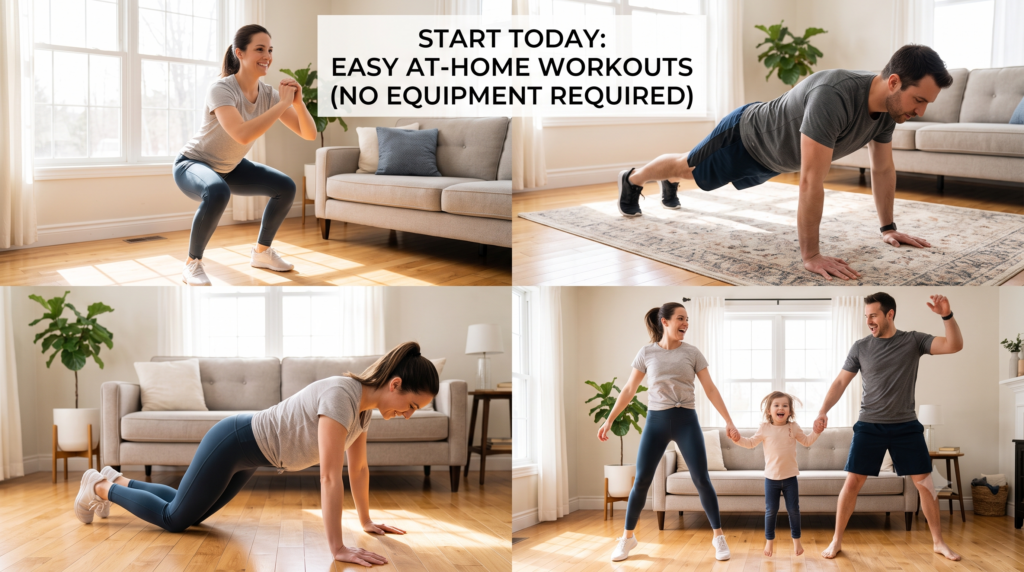
Push-ups remain the gold standard for upper body strength development without equipment. This classic exercise targets your chest, shoulders, triceps, and core while also engaging your legs and glutes for stability. The standard push-up begins in a plank position with your hands slightly wider than shoulder-width apart, your body forming a straight line from head to heels. Lower yourself until your chest nearly touches the ground, then press back up to the starting position. If traditional push-ups are too challenging initially, start with incline push-ups against a sturdy counter or wall, gradually progressing to the floor as you build strength.
Squats are the king of lower body exercises, working your quadriceps, hamstrings, glutes, and calves in one powerful movement. Stand with your feet shoulder-width apart, toes pointed slightly outward. Push your hips back as if sitting into a chair, lowering until your thighs are at least parallel to the ground while keeping your chest up and your weight distributed evenly across your feet. Drive through your heels to return to standing. Squats not only build leg strength but also improve mobility, balance, and core stability—all crucial for aging athletes and active parents who need to keep up with their children.
Planks have earned their reputation as one of the most effective core strengthening exercises available. Position yourself face-down with your forearms on the ground, elbows directly beneath your shoulders, and your body elevated in a straight line from head to heels. Engage your abs, glutes, and quads while avoiding any sagging in your hips or hiking of your backside. Hold this position while breathing steadily, starting with 20-30 seconds and gradually increasing your hold time as your core strength improves. The plank teaches you to maintain spinal stability under tension, which protects your back during all other exercises and daily activities.
Lunges challenge your balance, coordination, and unilateral leg strength while improving hip mobility. Step forward with one leg, lowering your hips until both knees are bent at approximately 90-degree angles. Your front knee should track over your ankle, not extending past your toes, while your rear knee hovers just above the ground. Push through your front heel to return to standing, then repeat on the opposite leg. Lunges are particularly valuable for runners and athletes because they address strength imbalances between your legs and improve stability during single-leg activities.
Creating Your Weekly Workout Schedule
Consistency beats intensity when it comes to long-term fitness success, which is why establishing a realistic weekly schedule for your easy at-home workouts with no equipment is essential. You don’t need to exercise for hours each day to see results. In fact, shorter, more frequent sessions often prove more effective for busy individuals than lengthy workouts that feel overwhelming to schedule.
A practical approach for beginners involves three to four workout sessions per week, each lasting 20-30 minutes. This frequency provides adequate stimulus for your muscles to adapt and grow stronger while allowing sufficient recovery time between sessions. You might schedule workouts for Monday, Wednesday, Friday, and Saturday, leaving Tuesday, Thursday, and Sunday for rest or light activity like walking or gentle stretching. As your fitness improves and exercise becomes a ingrained habit, you can increase frequency, duration, or intensity based on your goals and available time.
For those with more experience or specific athletic goals, a five to six day workout split allows you to target different muscle groups or movement patterns on different days. You could designate Monday and Thursday for upper body exercises like push-ups and variations, Tuesday and Friday for lower body movements including squats and lunges, and Wednesday and Saturday for core-focused training and full-body circuits. This approach prevents overtraining any single muscle group while maintaining high weekly training frequency. The key is finding a schedule that meshes with your family obligations, work commitments, and energy levels rather than following a rigid program that creates additional stress.
Designing Effective Circuit Workouts at Home
Circuit training represents one of the most time-efficient methods for combining strength building and cardiovascular conditioning in a single session. This training style involves performing a series of exercises back-to-back with minimal rest between movements, then taking a longer break before repeating the circuit multiple times. The continuous nature of circuit training elevates your heart rate, burning significant calories while the varied exercises ensure comprehensive muscle engagement.
A simple beginner circuit might include five exercises: bodyweight squats, incline push-ups, reverse lunges, plank holds, and glute bridges. Perform each exercise for 30 seconds, then rest for 15 seconds before moving to the next movement. After completing all five exercises, rest for 60-90 seconds, then repeat the entire circuit two to three more times. This workout takes approximately 15-20 minutes but delivers a full-body training stimulus that challenges both your muscular and cardiovascular systems.
Intermediate and advanced exercisers can increase the challenge by extending work intervals to 45-60 seconds, reducing rest periods to 10 seconds or less between exercises, or incorporating more complex movement variations. You might substitute regular squats for jump squats, replace incline push-ups with decline push-ups or plyometric versions, and add single-leg variations of basic exercises. The progression possibilities with easy at-home workouts with no equipment are virtually limitless when you understand how to manipulate variables like volume, intensity, rest periods, and exercise complexity.
Upper Body Workout Variations Without Equipment
Many people mistakenly believe that building upper body strength requires weights or resistance bands, but your body provides ample resistance for developing impressive strength and muscle definition in your arms, shoulders, chest, and back. The key lies in understanding leverage, angles, and body positioning to progressively challenge your muscles.
Beyond standard push-ups, consider incorporating diamond push-ups which place your hands close together beneath your chest, forming a diamond shape with your index fingers and thumbs. This variation intensifies triceps activation while still working your chest and shoulders. Wide-grip push-ups with your hands positioned significantly wider than shoulder-width emphasize chest development. Pike push-ups with your hips elevated and body forming an inverted V-shape shift emphasis to your shoulders, serving as an excellent progression toward eventual handstand push-ups.
Tricep dips using a sturdy chair, bench, or low table provide focused arm training. Sit on the edge of your chosen surface, place your hands beside your hips, and walk your feet forward until your backside clears the edge. Lower yourself by bending your elbows to approximately 90 degrees, keeping your back close to the surface, then press back up by straightening your arms. This exercise effectively isolates your triceps—the muscles on the back of your upper arms—while also engaging your shoulders and chest as stabilizers.
Don’t neglect your back muscles, which are crucial for maintaining good posture and balancing out all the pushing movements. Superman holds strengthen your entire posterior chain from your upper back down to your glutes. Lie face-down with your arms extended overhead, then simultaneously lift your arms, chest, and legs off the ground, holding this position while squeezing your shoulder blades together. Inverted rows using a sturdy table or low bar allow you to pull your bodyweight, working your back muscles, biceps, and grip strength in a horizontal pulling pattern that counterbalances all your pressing exercises.
Lower Body Training That Builds Serious Strength
Your legs contain the largest muscle groups in your body, which means training them burns maximum calories while building functional strength for sports, daily activities, and injury prevention. The beauty of lower body easy at-home workouts with no equipment is that your legs are already accustomed to supporting your entire bodyweight throughout the day, so bodyweight exercises provide immediate challenge.
Bulgarian split squats elevate the difficulty of standard lunges by placing your rear foot on an elevated surface like a chair or couch. This position increases the range of motion and places greater demand on your front leg, building single-leg strength, balance, and stability. Step forward from your elevated rear foot until you’re in a split stance, then lower yourself until your front thigh reaches parallel to the ground. The Bulgarian split squat is often rated as one of the most effective leg-building exercises available, regardless of equipment.
Single-leg deadlifts challenge your hamstrings, glutes, balance, and coordination simultaneously. Stand on one leg with a slight bend in the knee, then hinge forward at the hips while extending your free leg behind you for counterbalance. Reach toward the ground with your hands while maintaining a neutral spine, then return to standing by driving through your planted foot and squeezing your glutes. This movement pattern is especially valuable for runners and athletes who need unilateral strength and stability.
Add explosive power to your leg training with jump squats and jumping lunges. These plyometric variations involve performing the standard movement, then explosively jumping at the top of the motion before landing softly and immediately transitioning into the next repetition. Plyometric training develops fast-twitch muscle fibers, improves athletic performance, and significantly increases the calorie-burning effect of your workouts. However, these high-impact movements require adequate base strength and should be approached progressively to avoid injury.
Core Training Beyond Basic Crunches
A strong core does far more than create visible abs—it stabilizes your spine during all movements, transfers force between your upper and lower body during athletic activities, and protects your back during everyday tasks. Effective core training involves much more than endless crunches and should target all the muscles of your midsection from multiple angles and in various movement patterns.
Mountain climbers combine core stability with cardiovascular conditioning and hip flexor engagement. Begin in a push-up position, then drive one knee toward your chest while keeping your hips level and your core tight. Quickly switch legs, bringing the opposite knee forward while extending the first leg back. Continue alternating legs at a controlled but challenging pace, maintaining the plank position throughout the movement. Mountain climbers serve double duty as both a core exercise and a conditioning tool that elevates your heart rate.
Bicycle crunches effectively target your obliques—the muscles on the sides of your waist—while also working your rectus abdominis. Lie on your back with your hands behind your head and your legs lifted with knees bent. Bring your right elbow toward your left knee while extending your right leg, then switch sides in a pedaling motion. Focus on rotating your torso rather than simply moving your elbows, and avoid pulling on your neck with your hands.
Dead bugs might sound simple but provide exceptional core stability training while teaching you to maintain a neutral spine position. Lie on your back with your arms extended toward the ceiling and your knees bent at 90 degrees with shins parallel to the ground. Slowly extend your right arm overhead while straightening your left leg, lowering both toward the ground without allowing your lower back to arch off the floor. Return to the starting position and repeat on the opposite side. This exercise directly translates to maintaining core stability during running, lifting, and other dynamic activities.
Mobility and Flexibility Work for Complete Fitness
Strength training represents only one component of comprehensive fitness, and neglecting mobility work can lead to movement limitations, increased injury risk, and decreased exercise performance. Including flexibility and mobility exercises in your easy at-home workouts with no equipment routine ensures your muscles and joints can move through their full range of motion, which becomes increasingly important as we age.
Hip circles and leg swings serve as excellent dynamic warm-up movements that prepare your lower body for exercise while gradually improving hip mobility over time. Stand on one leg and swing the other leg forward and backward in a controlled motion, then switch to side-to-side swings. For hip circles, lift one knee to hip height and make circular motions with your knee, completing several rotations in each direction before switching legs. These movements lubricate your hip joints and activate the stabilizing muscles around your hips.
Deep squat holds improve ankle, knee, and hip mobility simultaneously while also building isometric strength. Squat down as deeply as possible while keeping your heels on the ground and your torso relatively upright, then simply hold this position for 30 seconds to two minutes. If you initially cannot achieve a full-depth squat with good form, hold onto a door frame or sturdy object for assistance. Regular practice of deep squat holds can restore the natural squatting ability that many adults have lost due to sedentary lifestyles.
Upper body mobility matters too, particularly for your shoulders and thoracic spine. Wall slides improve shoulder mobility and scapular control by having you stand with your back against a wall, arms raised in a goalpost position. Slowly slide your arms overhead while maintaining contact between your arms, hands, and the wall, then return to the starting position. Thread the needle stretches open your upper back and shoulders. Start on hands and knees, then reach one arm underneath your body, lowering your shoulder to the ground while looking in the direction you’re reaching. Hold for several breaths before switching sides.
Workout Modifications for Different Fitness Levels
One of the greatest advantages of easy at-home workouts with no equipment is the ability to scale exercises to match your current fitness level while providing clear progression pathways as you improve. Beginners, intermediates, and advanced exercisers can all perform variations of the same movements within a single workout session, making these routines perfect for families exercising together or for individuals whose strength varies between muscle groups.
For beginners or those returning to exercise after a break, regression strategies make movements more accessible. Performing push-ups against a wall or elevated surface dramatically reduces the percentage of bodyweight you’re pressing, allowing you to build strength gradually. Reducing range of motion—such as performing partial squats initially—lets you learn movement patterns safely before progressing to full depth. Taking longer rest periods between exercises or circuits gives your cardiovascular system time to adapt to the new demands you’re placing on it.
Intermediate exercisers who have mastered basic movement patterns can increase challenge through several methods. Slowing down the tempo, particularly the lowering phase of exercises, increases time under tension and builds strength effectively. Adding pauses at difficult portions of movements—like holding the bottom of a squat for three seconds—intensifies the exercise without changing the fundamental pattern. Increasing total volume by performing more repetitions or additional circuits extends your workout capacity and endurance.
Advanced individuals seeking maximum challenge from bodyweight training can employ progressions that dramatically increase difficulty. Single-arm and single-leg variations of standard exercises essentially double the resistance by having one limb handle the work normally distributed between two. Plyometric exercises add explosive power requirements. Combining movements—like adding a push-up between each burpee repetition—creates complex challenges that demand exceptional strength, coordination, and conditioning.
Staying Motivated Without a Gym Environment
While exercising at home offers tremendous convenience, it also presents unique motivational challenges that gym environments naturally solve through social accountability, dedicated workout space, and the psychological separation between home and training mode. Developing strategies to maintain motivation and consistency with your at-home routine is crucial for long-term success with easy at-home workouts with no equipment.
Creating a designated workout space, even if it’s just a cleared area in your bedroom or living room, helps establish psychological boundaries that signal it’s time to exercise. This space doesn’t need to be permanent—you might roll out a yoga mat or move furniture aside—but having a consistent location triggers the mental shift from daily life mode to workout mode. Over time, this association strengthens, making it easier to get started when you enter your workout space.
Establishing a pre-workout routine builds momentum and reduces the mental friction that often prevents us from starting exercise sessions. This might involve changing into workout clothes even if you’re staying home, cueing up a motivating playlist, or having a specific warm-up sequence you perform before every workout. These rituals signal to your brain that it’s time to train, creating behavioral patterns that become automatic over time rather than requiring conscious willpower to initiate.
Tracking your progress provides tangible evidence that your efforts are producing results, which powerfully reinforces adherence to your program. Keep a simple workout log noting the exercises you performed, the number of repetitions, and how you felt. Take progress photos monthly and simple measurements of your waist, hips, chest, and arms. You might also track performance metrics like how many push-ups you can complete without stopping or how long you can hold a plank. Reviewing these records during moments of low motivation reminds you how far you’ve come and reignites your commitment to continuing forward.
Incorporating Family Members Into Your Workouts
For busy parents, one of the greatest benefits of easy at-home workouts with no equipment is the opportunity to model healthy behaviors for your children while spending quality time together. Rather than viewing exercise as something that takes you away from your family, you can transform it into a shared activity that everyone enjoys and benefits from. Kids naturally love moving their bodies, and structured exercise sessions can provide an outlet for their energy while teaching them that fitness is a normal, enjoyable part of life.
Young children can participate in simplified versions of most bodyweight exercises, making it easy to work out alongside them. Kids often find exercises with animal names particularly engaging—bear crawls, crab walks, frog jumps, and inchworms all provide legitimate training benefits while appealing to children’s imaginations. You might create obstacle courses using pillows, furniture, and tape on the floor that incorporate various movements. Time challenges—”How many jumping jacks can we all do in 30 seconds?”—introduce friendly competition that motivates kids to push themselves.
Teenagers often respond well to more structured workout formats that treat them like the young adults they’re becoming. They can perform the same exercises as you with appropriate modifications based on their individual strength levels. Circuit training works particularly well for this age group because the variety prevents boredom and the fast pace matches their energy levels. Consider letting older kids choose music for the workout or select exercises for the family to perform, giving them ownership of the fitness experience.
Beyond the immediate physical benefits, exercising as a family creates bonding experiences and shared memories. The laughter when someone loses balance during a challenging movement, the mutual encouragement when someone is struggling through their final repetitions, and the collective sense of accomplishment after completing a tough workout all strengthen family connections. These moments teach children that challenges are meant to be embraced rather than avoided and that supporting others through difficult tasks is what families do.
Nutrition Strategies to Support Your Training
No discussion of fitness is complete without addressing nutrition, which provides the fuel for your workouts and the building blocks your body uses to recover and grow stronger. While detailed nutrition planning exceeds the scope of workout programming, understanding basic principles ensures your easy at-home workouts with no equipment produce maximum results rather than being undermined by poor eating habits.
Protein intake deserves special attention for anyone following a regular exercise routine because protein provides the amino acids your muscles need to repair and rebuild after training. Aim for roughly 0.7 to 1 gram of protein per pound of bodyweight daily, distributed across multiple meals rather than consumed all at once.