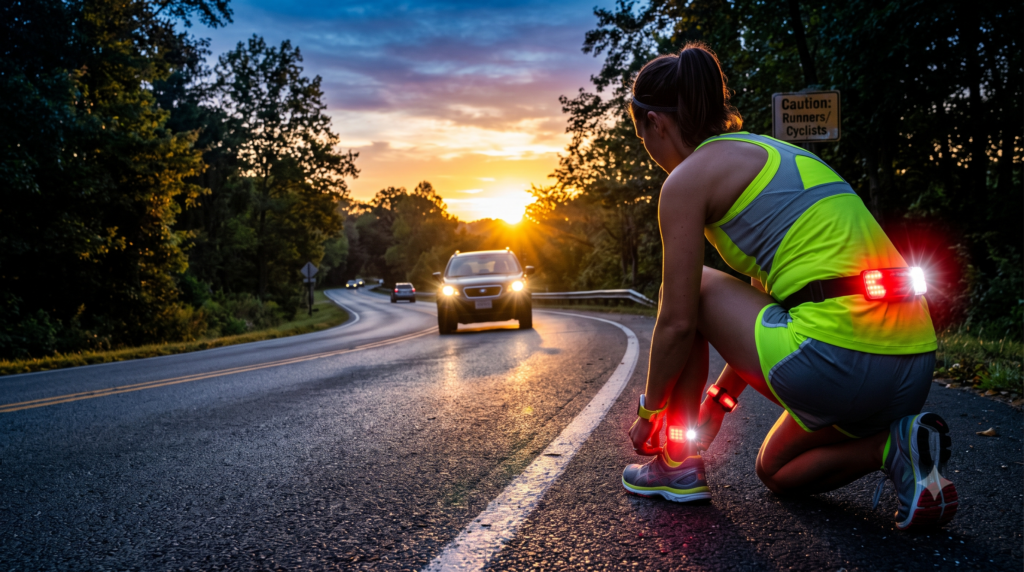
You lace up your running shoes at dawn, ready to squeeze in those precious miles before the kids wake up or your workday begins. The sun is just starting to peek over the horizon, casting that beautiful golden glow that makes early morning runs so magical. But here’s something most runners don’t consider: this transitional lighting—neither fully dark nor completely bright—creates one of the most dangerous times for pedestrians and runners on the road. Understanding why wearing safety lights in daylight can save your life isn’t just about being cautious; it’s about recognizing the science behind visibility and making informed decisions that protect you and your family.
The Visibility Paradox of Daylight Hours
When most people think about safety lights, they immediately associate them with nighttime activity. After all, darkness means you need light, right? However, the reality of human perception and road safety tells a much more nuanced story. During daylight hours, particularly during dawn and dusk, your visibility to motorists decreases dramatically due to factors you might never have considered.
The human eye struggles more than you’d think during transitional lighting periods. When drivers are navigating through areas with mixed shadow and light, their eyes constantly adjust between bright spots and darker areas. This continuous adjustment creates blind spots and delays in reaction time. You might feel perfectly visible in what seems like adequate daylight, but to a driver whose eyes are adjusting from a dark tree-lined street to a sunny intersection, you’re practically invisible until it’s potentially too late.
Research from traffic safety organizations has consistently shown that the majority of pedestrian and cyclist accidents occur during daylight hours, not at night as commonly assumed. This counterintuitive finding highlights a critical gap in how we think about visibility. While fewer people are out exercising at night, those who are tend to take visibility seriously. But during the day? Most runners and cyclists assume they’re automatically visible, leading to a false sense of security that puts them at genuine risk.
How Your Brain Tricks You Into Feeling Safe
Your perception of your own visibility is fundamentally flawed, and that’s not your fault—it’s simply how human psychology works. When you’re out for your morning run and you can see everything around you clearly, your brain makes an automatic assumption: if you can see well, others can see you well too. This cognitive bias is called the “illusion of attention,” and it’s one of the most dangerous misconceptions active people carry with them every single day.
Consider this scenario that happens constantly on roads everywhere: you’re running on the shoulder of a road wearing gray or black athletic wear (the most popular colors for fitness apparel). A driver approaches from behind, but they’re thinking about their upcoming meeting, adjusting the radio, or glancing at their passenger. Their brain is processing hundreds of inputs per second, and objects that don’t stand out simply get filtered into the background. Your dark silhouette against pavement, grass, or mixed backgrounds blends in perfectly with the environment. The driver’s subconscious mind categorizes you as “not a threat” or “not present” because you don’t trigger their attention systems.
The contrast principle in visual perception explains why wearing safety lights in daylight can save your life even when conditions seem perfectly bright. Human attention is drawn to contrast, movement, and light. While you’re definitely moving, your body’s movement might not be distinct enough against a busy visual environment. Static backgrounds, other vehicles, street signs, and countless visual elements compete for a driver’s attention. A flashing or steady safety light, however, creates a contrast that bypasses conscious thought and immediately signals “pay attention” to the driver’s brain.
The Science Behind Daytime Visibility Technology
Modern safety lights designed for daylight use aren’t the same as traditional reflectors or nighttime lights. They’re specifically engineered to emit wavelengths and patterns that remain visible even in bright sunlight. Understanding how these devices work helps you appreciate why they’re so effective and why investing in quality daytime safety lights is crucial for anyone who exercises outdoors.
Daytime running lights on vehicles have become standard precisely because automotive engineers recognized that visibility during daylight determines safety outcomes. These lights use high-intensity LEDs that produce enough luminance to stand out against bright backgrounds. The same technology has been adapted for personal safety devices worn by runners, cyclists, and pedestrians. When you wear a properly designed daytime safety light, you’re making yourself visible from distances of up to 1,500 feet—that’s nearly a third of a mile. This extended visibility gives drivers significantly more time to recognize your presence and adjust their path accordingly.
The color of light matters tremendously. While red lights are traditional for rear-facing visibility, studies have shown that certain wavelengths in the blue and amber spectrum can be even more effective during daylight hours. These colors create stronger contrast against natural backgrounds and catch the human eye more readily. Some advanced safety lights alternate between colors or use specific flash patterns that research has proven to capture attention more effectively than steady lights. The human brain is hardwired to notice rhythmic changes in the environment, which is why a pulsing light at 2-3 flashes per second creates an almost involuntary attention response in drivers.
Real-World Scenarios Where Daylight Safety Lights Matter Most
Let’s talk about the specific situations where visibility becomes critically important, even when you think the lighting is perfectly adequate. If you’re a parent who runs with a jogging stroller, you’re responsible not just for your own safety but for your child’s as well. The stroller’s lower profile makes it even harder for drivers to spot, especially when approaching from side streets or making turns. Adding multiple safety lights to both your body and the stroller creates redundant visibility that dramatically reduces risk.
Early morning runs present unique challenges that many fitness enthusiasts underestimate. Yes, the sun is rising and it’s technically daytime, but drivers are dealing with sun glare, foggy windshields, and the drowsiness that comes with early commutes. Their attention and reaction times are compromised. When the sun sits low on the horizon, it creates blinding conditions where drivers literally cannot see objects directly in front of them if those objects don’t produce their own light. A runner wearing all black or navy blue essentially disappears into a dark silhouette that’s indistinguishable from the environment. Adding even a single flashing LED light transforms you into an immediately identifiable presence that drivers can navigate around safely.
The same principle applies during late afternoon and evening runs. If you’re squeezing in exercise after work, you’re sharing the road with tired commuters, delivery drivers rushing to complete their routes, and distracted drivers heading home. The setting sun creates similar glare conditions to sunrise, and the fading light means colors lose their vibrancy and contrast. What looked like a bright yellow shirt in your closet becomes a dull, barely visible object on the roadside. Safety lights maintain their intensity regardless of ambient lighting conditions, ensuring consistent visibility.
Weather Conditions Amplify the Need for Visibility
You’re dedicated to your fitness routine, which means you run in various weather conditions. Rain, fog, overcast skies, and even bright sunny days each present distinct visibility challenges. Understanding why wearing safety lights in daylight can save your life becomes especially clear when you consider how weather affects driver vision and road conditions.
Rainy conditions reduce visibility in multiple ways simultaneously. Water on windshields, even with wipers running, creates visual distortion. Spray from other vehicles fills the air with a mist that diffuses light and reduces clarity. Roads become reflective surfaces that confuse depth perception and make it harder to distinguish objects. During daytime rain, the sky darkens, but it’s not dark enough for automatic headlights to activate on many vehicles, meaning drivers have reduced visibility while you’re even harder to see. A bright safety light cuts through all of these obstacles, creating a clear signal that weather conditions cannot diminish.
Fog might seem like an obviously dangerous condition, but morning fog during daylight hours is often underestimated. You can probably see reasonably well when you’re in the fog—maybe 30 to 50 feet ahead. However, drivers in vehicles moving at 40 or 50 miles per hour need much more distance to react and stop safely. Without a light source, you appear suddenly out of the fog bank, giving drivers minimal time to respond. With safety lights, your presence is announced well before you become visible as a human form, allowing drivers to slow down and pass safely.
Even on bright, clear, beautiful days, certain conditions reduce your visibility. Intense sunshine creates harsh shadows and causes drivers to wear sunglasses or use sun visors, both of which limit peripheral vision. The dappled light under tree canopies creates a camouflage effect that makes stationary or moving objects blend into the background. Glare off of wet pavement after a morning rain, reflections off of car windows and glass buildings, and the general brightness that causes eyes to squint and pupils to constrict all contribute to reduced driver attention to pedestrians who don’t actively signal their presence.
Practical Benefits Beyond Collision Prevention
While preventing vehicle collisions is the primary reason to use daytime safety lights, the benefits extend into several other important areas of personal safety. When you’re visible, you’re less likely to experience close calls that, while not resulting in impact, still create dangerous situations. Drivers who see you from a distance can change lanes smoothly rather than swerving at the last moment. This predictable traffic flow reduces stress for everyone and creates a safer environment for all road users.
Your visibility also affects how other pedestrians and cyclists interact with you. When you’re running or cycling on shared paths, other users can spot you approaching from much greater distances. This advance notice allows them to make room, control their dogs, gather their children, or simply be prepared for your passage. The social dynamics of shared spaces improve when everyone can see each other clearly, reducing conflicts and creating more pleasant experiences for everyone involved.
There’s also a psychological benefit that shouldn’t be overlooked. When you know you’re highly visible, you exercise with greater confidence and less anxiety. That mental burden of constantly worrying whether cars see you, that tension in your shoulders when you hear an engine approaching from behind—these stress factors diminish significantly when you’re wearing effective safety lights. You can focus on your workout, your pace, your breathing, and your enjoyment of the activity rather than spending mental energy on safety concerns.
Choosing the Right Safety Lights for Daytime Use
Not all safety lights are created equal, and understanding what makes an effective daytime light will help you make informed purchasing decisions. The market is flooded with options ranging from cheap clip-on flashers to sophisticated systems with multiple light patterns and rechargeable batteries. Knowing what features matter most will ensure you get genuine protection rather than just a false sense of security.
Lumens measure the total amount of visible light emitted by a source, and for daytime visibility, you need substantially more lumens than for nighttime use. Look for safety lights that specifically advertise daytime visibility and provide at least 100-200 lumens. Many traditional bike lights and runner’s lights max out at 20-50 lumens, which is adequate for nighttime but insufficient to stand out during daylight. The extra investment in higher-lumen lights pays dividends in actual visibility when it matters most.
Mounting options and placement significantly affect how well your safety lights perform. The most effective approach uses multiple lights positioned at different heights and locations on your body. Consider this strategic placement:
- One light clipped to your chest or shoulder facing forward
- One light attached to your lower back or waistband facing rearward
- Ankle lights that create motion visibility
- Arm bands with integrated lights for additional side visibility
The goal is 360-degree visibility so that drivers approaching from any angle can identify your presence. A single light, even a very bright one, only protects you from one direction. Multiple lights create redundancy that ensures you’re never in someone’s blind spot without any visible signal.
Battery life and reliability are crucial factors that often get overlooked until you’re halfway through a run and your light dies. Rechargeable lights offer convenience and environmental benefits, but make sure you develop a charging routine that ensures they’re always ready when you need them. Many runners charge their lights along with their GPS watches or phones as part of their post-run routine. Alternatively, lights with replaceable batteries mean you can always have spares on hand, though the ongoing cost and waste are downsides to consider.
Building a Visibility Habit That Protects Your Family
If you’re a parent who runs, cycles, or walks with your children, you’re teaching them habits that will last a lifetime. Kids learn far more from what we do than what we say, so modeling proper safety behavior has impacts that extend well beyond your own protection. When your children see you consistently using safety lights, checking them before each outing, and treating visibility as a non-negotiable aspect of outdoor activity, they internalize these practices.
Start conversations with your children about why visibility matters. Explain in age-appropriate terms how drivers’ eyes work, why bright colors and lights help people see each other, and how being safe means being seen. When they understand the reasoning behind safety equipment rather than just seeing it as rules imposed by parents, they’re more likely to adopt these practices independently as they grow older. This education becomes especially critical as they begin walking to friends’ houses, riding bikes in the neighborhood, or eventually driving themselves.
Creating a family visibility station near your door makes it easy to grab safety equipment every single time someone heads out. Stock it with:
- Safety lights for each family member in their favorite colors
- Reflective vests or bands in multiple sizes
- Extra batteries or charging cables
- Reflective stickers for bikes, strollers, and scooters
Making safety equipment easily accessible removes barriers to consistent use. When you have to hunt through closets or dig through drawers to find your safety light, you’re more likely to skip it, especially when you’re rushing to fit in a quick workout before the morning chaos begins. A dedicated, well-stocked station means you simply grab and go, making visibility an automatic part of every outdoor excursion.
The Economics of Investing in Visibility
Some people hesitate to invest in quality safety lighting because they view it as an unnecessary expense. Let’s put the costs in perspective. A high-quality set of daytime-visible safety lights might cost between $40 and $100 depending on the features you choose. This one-time investment (with occasional battery replacements) protects you during hundreds or thousands of runs, walks, or rides. Compare that cost to a single emergency room visit, which in the United States averages several thousand dollars even for minor injuries, or the life-altering consequences of a serious collision.
Beyond the direct financial implications of accidents, consider the value of uninterrupted training. If you’re working toward a race goal, preparing for a fitness event, or simply maintaining a healthy routine that improves your quality of life, an injury from a preventable accident derails everything. The weeks or months of recovery, the loss of fitness, the frustration of having to rebuild your endurance and strength—these setbacks carry real costs in terms of your health goals and overall wellbeing. Investing in visibility protects not just your physical safety but also your fitness investments and long-term health trajectory.
For tradespeople who work outdoors or commute on foot or bike to job sites, safety lighting isn’t just personal protection—it’s professional necessity. An injury that prevents you from working affects your income, your family’s financial security, and your ability to fulfill work obligations. Many insurance companies now recognize the value of personal safety equipment and may offer discounts on health or liability insurance for individuals who take documented safety precautions. The modest cost of proper visibility equipment becomes not just reasonable but financially prudent when viewed through this broader lens.
Technological Advances Making Daytime Lights More Effective
The personal safety lighting industry has evolved dramatically in recent years, driven by LED technology improvements, better understanding of visibility science, and increased awareness of pedestrian safety issues. Today’s options would have seemed like science fiction just a decade ago, offering features and performance that significantly enhance protection compared to earlier generations of safety equipment.
Smart connectivity represents one of the most interesting developments. Some modern safety lights connect to your smartphone via Bluetooth, allowing you to control flash patterns, monitor battery life, and even integrate with fitness apps to automatically activate when you start a workout. While not essential, these features increase the likelihood that you’ll use your lights consistently. When your lights automatically activate when your running app starts, you never have to remember to turn them on manually—the system handles it for you.
Motion-responsive lights take visibility to another level by intensifying their output when they detect acceleration or deceleration. These adaptive lights shine brightest exactly when driver attention is most critical—when you’re changing pace or direction. The variable intensity creates additional visual interest that captures attention even more effectively than steady or regularly pulsing lights. For runners who do interval training or cyclists who frequently change speeds in traffic, this technology provides an extra margin of safety during the most vulnerable moments.
Solar-charging capabilities have made their way into some safety light designs, addressing one of the most common reasons people don’t use their lights consistently—dead batteries. Lights with small solar panels can trickle-charge throughout the day, ensuring they’re always ready for your evening run or early morning workout. While solar charging alone typically isn’t sufficient to power high-lumen daytime lights during use, it significantly extends battery life and reduces the frequency of active charging needed.
Community Impact and Cultural Shifts
When you wear safety lights during daylight hours, you’re not just protecting yourself—you’re contributing to a broader cultural shift around outdoor safety. Every time a driver sees a runner or cyclist with proper visibility equipment, it reinforces the importance of these practices and increases overall awareness. Over time, this collective behavior change makes roads safer for everyone.
Communities that have embraced visibility as a standard practice for all outdoor activities have documented measurable decreases in pedestrian accidents. When wearing safety lights becomes normalized rather than seen as excessive caution, more people adopt the practice. This critical mass of visible pedestrians and cyclists actually changes driver behavior. Motorists in these communities develop heightened awareness and better scanning habits because they’ve been conditioned to look for and respond to safety lights. The cumulative effect creates a positive feedback loop where individual actions generate community-wide safety benefits.
Running clubs, cycling groups, and fitness organizations increasingly require or strongly encourage members to use daytime safety lights during group activities. This organizational endorsement helps overcome the social awkwardness some people feel about “standing out” or looking overly cautious. When everyone in your running group wears lights, it becomes the norm rather than the exception. If you’re involved in coaching youth sports or leading community fitness initiatives, you have an opportunity to influence dozens or hundreds of people toward better safety practices. The ripple effects of this leadership extend far beyond your immediate circle as those individuals model the behavior for their own families and friends.
Addressing Common Objections and Misconceptions
Despite the clear benefits, some people resist wearing safety lights during daylight hours. Let’s address the most common objections honestly and provide perspective that might help you or others overcome this resistance. The most frequent objection is simple: “I can see fine, so drivers must be able to see me.” We’ve already explored why this assumption is dangerously flawed, but it bears repeating because this cognitive bias is so strong. Your ability to see has no relationship to others’ ability to see you, especially when you’re a relatively small, low-contrast object in a complex visual environment.
Another common resistance comes from concerns about appearance or not wanting to seem paranoid. This is worth examining because safety decisions should never be driven by vanity or worry about others’ opinions. Modern safety lights are compact, lightweight, and often quite sleek in design. Many can be integrated into your clothing or gear so subtly that they’re barely noticeable when not illuminated. More importantly, the few seconds of attention your safety light might draw from fellow exercisers pales in comparison to the life-saving attention it draws from drivers. If someone judges you for taking your safety seriously, that reflects their priorities, not your judgment.
Some athletes worry that carrying extra gear, even something as small as a clip-on light, will affect their performance or running economy. The reality is that modern safety lights weigh just a few ounces and can be positioned in ways that don’t interfere with natural movement. Compare this minimal weight to the water bottle, phone, or keys you likely already carry, and it becomes clear that performance impact is negligible. Even elite athletes competing in races often wear bib numbers, timing chips, and other equipment without measurable effects on their times. A small safety light won’t slow you down, but getting hit by a car certainly will.
Integration With Other Safety Practices
Safety lights work best when combined with other visibility and protective strategies, creating multiple layers of defense. While we’re focusing on why wearing safety lights in daylight can save your life, understanding how they fit into a comprehensive safety approach gives you the complete picture. Think of safety as a system rather than a single solution—each element reinforces the others to maximize your protection.
Reflective clothing and accessories complement active lighting by providing passive visibility. While reflective materials are less effective during daylight than at night, they still enhance your visibility, especially in mixed lighting conditions. High-visibility colors—neon yellow, orange, and lime green—increase daytime visibility substantially compared to darker colors. The combination of bright colors, reflective accents, and active lighting creates redundancy that ensures you’re visible regardless of conditions or viewing angles. This layered approach means that even if one element fails (a battery dies, for instance), you maintain some level of visibility.
Route selection plays a crucial role in safety that complements your visibility equipment. Choosing paths with wide shoulders, dedicated bike lanes, or separated trails reduces your exposure to vehicle traffic. However, even the best routes typically require crossing streets or brief sections of shared roadway. Your safety lights ensure maximum protection during these higher-risk segments. When you must share roads with vehicles, position yourself predictably, follow traffic laws, and make your movements clear and consistent. Your lights help drivers see you; your behavior helps them predict what you’ll do next.