When you’re juggling work responsibilities, family commitments, and trying to maintain some semblance of a personal life, finding time to exercise can feel impossible. That’s exactly why full-body workouts for beginners have become such a game-changer for people just like you. Instead of spending hours at the gym focusing on individual muscle groups across multiple sessions each week, you can target everything in one efficient workout that takes 30 to 45 minutes.
Full-body training offers something that split routines simply can’t match: flexibility. You don’t need to stress about missing “leg day” or “arm day” because every session works your entire body. If your daughter has a soccer game on Wednesday or your son needs help with a school project, you can adjust your workout schedule without derailing your entire fitness plan. This adaptability makes it significantly easier to stay consistent, which is the real secret to achieving lasting results.
Beyond the time-saving benefits, full-body workouts for beginners create a balanced foundation of strength and coordination. You’re teaching your muscles to work together as integrated systems rather than isolated parts. This functional approach translates directly into real-world activities—whether you’re lifting groceries, playing with your kids at the park, or tackling a weekend home improvement project. Your body becomes stronger in ways that actually matter in daily life.
Understanding the Science Behind Full-Body Training
Your body doesn’t naturally work in isolation, so why would you train it that way? When you perform compound movements that engage multiple muscle groups simultaneously, you’re mimicking the way your body functions in real-world scenarios. Think about picking up your toddler from the floor—you’re using your legs, core, back, and arms all at once. Full-body workouts for beginners prepare you for these authentic movement patterns by building integrated strength.
The metabolic benefits of full-body training are substantial and worth understanding. When you engage large muscle groups throughout your entire body, you create a significantly higher caloric burn both during and after your workout. This phenomenon, known as excess post-exercise oxygen consumption (EPOC), means your metabolism remains elevated for hours after you’ve finished exercising. For busy parents trying to manage weight while handling a packed schedule, this metabolic advantage can make a real difference over time.
Hormonal responses also favor full-body approaches, particularly for beginners. Compound exercises that recruit major muscle groups stimulate greater production of growth hormone and testosterone—natural substances that support muscle development and fat loss. You’re not just working harder; you’re working smarter by triggering your body’s own optimization systems. These hormonal cascades help you build muscle more efficiently while simultaneously supporting recovery and overall well-being.
Essential Equipment You’ll Need to Get Started
Starting a fitness journey shouldn’t require a second mortgage or converting your garage into a professional gym. Full-body workouts for beginners can be incredibly effective with minimal equipment, making them accessible regardless of your budget or available space. In fact, some of the most transformative workouts require nothing more than your own bodyweight and a small area in your living room.
If you’re working out at home, consider investing in these fundamental items:
- A quality exercise mat: Protects your joints during floor exercises and provides cushioning for yoga poses or stretching routines
- Resistance bands: Incredibly versatile, affordable, and perfect for adding progressive resistance as you get stronger
- A set of dumbbells: Start with a lighter pair (5-10 pounds) and a medium pair (15-20 pounds) to cover various exercises
- A stability ball: Excellent for core work and adding an instability element that engages stabilizing muscles
- A pull-up bar or resistance anchor: Allows you to incorporate pulling movements that balance out pushing exercises
Don’t let equipment limitations become an excuse for inaction. Your body provides substantial resistance all by itself—push-ups, squats, lunges, planks, and burpees require zero equipment yet deliver remarkable results. Many beginners actually benefit from mastering bodyweight movements first before adding external resistance. This approach builds proper movement patterns and body awareness that will serve you well as you progress to more advanced variations and heavier weights.
The Core Movements Every Beginner Should Master
Before you dive into complicated workout routines, you need to establish competency in fundamental movement patterns. These foundational exercises form the building blocks of virtually every effective full-body workout for beginners, and mastering them ensures you’re building strength on a solid technical foundation rather than reinforcing poor habits that could lead to injury down the road.
The Squat: Your Lower Body Foundation
Squats are perhaps the most functional exercise you’ll ever perform because you do them constantly in daily life without even realizing it. Every time you sit down or stand up, you’re essentially doing a squat. The difference is that in a workout setting, you’re performing them with intention, control, and proper form. Start by practicing bodyweight squats until the movement feels natural and comfortable.
Position your feet roughly shoulder-width apart with toes pointed slightly outward. As you descend, imagine sitting back into a chair rather than dropping straight down. Your knees should track over your toes without caving inward, and your chest should remain proud and lifted throughout the movement. Focus on keeping your weight distributed across your entire foot rather than shifting forward onto your toes or backward onto your heels.
Depth matters, but not at the expense of form. Ideally, you want to descend until your thighs are parallel to the floor or slightly below, but only if you can maintain a neutral spine and stable knee position. If you find yourself rounding your lower back or your knees collapsing inward, reduce your range of motion and work on mobility separately. Progress takes time, and there’s no shame in starting with partial squats while you build the flexibility and strength to go deeper.
The Push-Up: Upper Body Essential
Push-ups develop your chest, shoulders, triceps, and core simultaneously, making them an incredibly efficient exercise for full-body workouts for beginners. They also require zero equipment and can be performed virtually anywhere. However, many beginners struggle with standard push-ups initially, and that’s completely normal and expected.
Start with an elevated variation by placing your hands on a sturdy bench, couch, or counter. The higher your hands are elevated, the easier the movement becomes. Begin in a plank position with your hands slightly wider than shoulder-width, your body forming a straight line from head to heels. Lower yourself by bending your elbows, keeping them at roughly a 45-degree angle from your body rather than flaring them out to 90 degrees.
Descend until your chest nearly touches the surface, then press back up to the starting position. Maintain tension in your core throughout the movement—imagine someone might punch you in the stomach at any moment, and you’re bracing for it. This core engagement prevents your hips from sagging or piking upward. As elevated push-ups become easier, gradually lower the height until you can perform them from the floor with excellent form.
The Hip Hinge: Protecting Your Back
Learning to hip hinge properly is crucial for performing deadlifts, kettlebell swings, and countless other exercises safely. This movement pattern also protects your back during daily activities like lifting boxes, picking up children, or working in the garden. The hip hinge involves bending at your hips while maintaining a neutral spine rather than rounding your back.
Stand with your feet hip-width apart and place your hands on your hips or hold a lightweight object. Initiate the movement by pushing your hips backward as if trying to close a car door with your butt. Your knees will bend slightly, but the primary movement comes from your hips, not your knees. Keep your spine neutral—imagine balancing a broomstick along your back that touches your head, upper back, and tailbone throughout the movement.
You should feel tension developing in your hamstrings and glutes as you hinge forward. Only descend as far as you can while maintaining perfect spinal position. For many beginners, this might only be a slight forward lean initially. Over time, as your hip mobility and hamstring flexibility improve, you’ll be able to hinge deeper while keeping your back safe and strong.
The Plank: Core Stability Cornerstone
Core strength underpins virtually every movement you make, and the plank builds this essential foundation without putting stress on your spine like crunches or sit-ups can. A proper plank engages not just your abdominals but your entire core cylinder, including your obliques, transverse abdominis, and lower back muscles.
Begin on your forearms and toes, with your elbows directly beneath your shoulders. Your body should form a straight line from your head to your heels—avoid letting your hips sag toward the floor or pike upward toward the ceiling. Engage your core by drawing your belly button toward your spine, squeeze your glutes, and maintain tension in your quads by slightly pulling your kneecaps upward.
Quality trumps quantity with planks. Holding a mediocre position for two minutes is far less beneficial than holding a perfect position for thirty seconds. Start with shorter holds that you can maintain with excellent form, then gradually increase your duration as you get stronger. If standard planks prove too challenging initially, modify by dropping to your knees while maintaining the same straight-line body position from knees to head.
Your First Full-Body Workout Routine
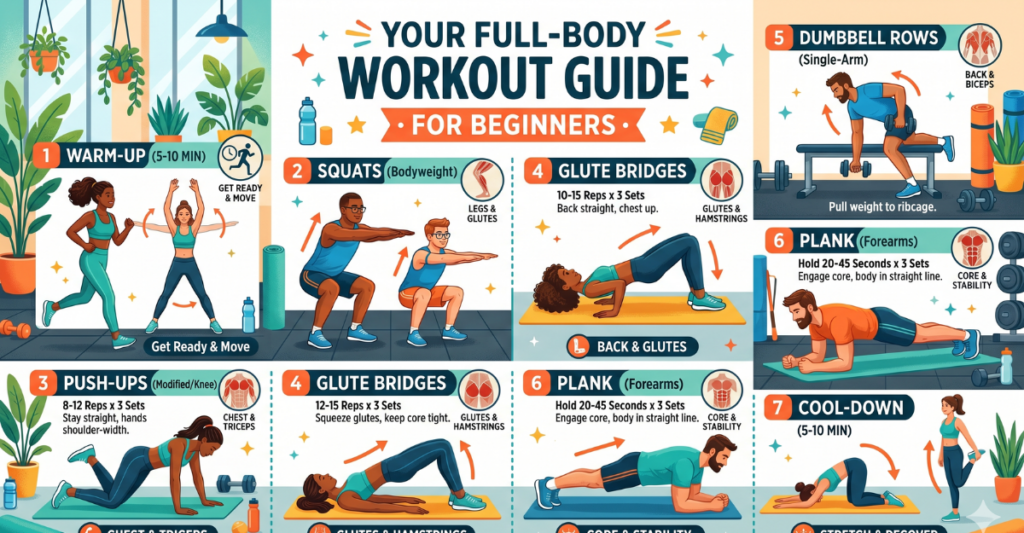
Now that you understand the fundamental movements, let’s put them together into a practical workout you can start performing immediately. This routine works your entire body, requires minimal equipment, and can be completed in about 30 minutes. Full-body workouts for beginners should focus on building competency and confidence rather than pushing to absolute exhaustion.
Begin with a proper warm-up that prepares your body for work. Spend five minutes performing dynamic movements like arm circles, leg swings, bodyweight squats, and light jogging in place or walking. Your warm-up should gradually elevate your heart rate and move your joints through their full range of motion. Never skip this crucial preparation phase—it reduces injury risk and actually improves your workout performance.
Beginner Full-Body Circuit
Perform each exercise for the prescribed repetitions, then move immediately to the next exercise. After completing all exercises, rest for two to three minutes, then repeat the entire circuit. Start with two complete rounds, then progress to three rounds as you build fitness:
- Bodyweight Squats: 12-15 repetitions, focusing on controlled descent and powerful ascent
- Elevated Push-Ups: 8-12 repetitions at an appropriate height that challenges you while maintaining form
- Alternating Reverse Lunges: 10 repetitions per leg, stepping backward and lowering until your back knee nearly touches the ground
- Dumbbell Rows: 10-12 repetitions per arm, supporting yourself with one hand on a bench or chair
- Plank Hold: 20-30 seconds with perfect form and full-body tension
- Glute Bridges: 15 repetitions, squeezing your glutes hard at the top of each rep
This structure ensures you’re hitting all major muscle groups while alternating between pushing and pulling movements. You’re working your legs, chest, back, shoulders, arms, and core within a single efficient session. The circuit format keeps your heart rate elevated, adding a cardiovascular component that burns calories while building strength.
Progressive Overload: The Key to Continuous Improvement
Simply showing up and repeating the same workout week after week will eventually stop producing results. Your body is remarkably adaptable and will accommodate to whatever demands you place on it. To keep improving, you need to implement progressive overload—systematically increasing the difficulty of your full-body workouts for beginners over time.
Progressive overload doesn’t necessarily mean adding weight, though that’s certainly one option. You can increase difficulty by adding more repetitions, performing more sets, reducing rest periods between exercises, or progressing to more challenging exercise variations. For example, once elevated push-ups become easy, you might progress to knee push-ups, then to standard push-ups from the floor, and eventually to decline push-ups with your feet elevated.
Track your workouts in a simple notebook or smartphone app. Record the exercises you performed, the number of sets and repetitions, any weight used, and how the workout felt. This documentation allows you to see your progress over weeks and months, which provides tremendous motivation during times when improvement feels slow. You’ll be amazed looking back at where you started compared to where you are just two or three months later.
Scheduling Your Workouts for Maximum Results
Consistency beats intensity when you’re building a sustainable fitness practice. Rather than attempting overly ambitious workout schedules that you’ll inevitably abandon, start with a realistic commitment you can maintain even during your busiest weeks. For most beginners, three full-body sessions per week provides an excellent balance between stimulus and recovery.
Schedule your workouts on non-consecutive days to allow adequate recovery between sessions. A Monday-Wednesday-Friday structure works well for many people, leaving weekends free for family activities and active recovery. Remember that your muscles don’t grow during your workouts—they grow during recovery when you’re resting and eating well. Pushing too hard without adequate rest leads to overtraining, increased injury risk, and eventual burnout.
Consider your workout timing based on when you have the most energy and fewest interruptions. Some people thrive on early morning workouts before the household wakes up, while others prefer lunchtime or evening sessions. There’s no universally optimal time to exercise; the best time is whenever you’re most likely to actually do it consistently. Experiment with different schedules during your first month to discover what works best with your energy levels and daily responsibilities.
Common Mistakes That Sabotage Beginner Success
The enthusiasm that comes with starting a new fitness journey can sometimes work against you if it leads to unsustainable practices or poor decisions. Many beginners make predictable mistakes that hinder their progress or lead to premature burnout. Understanding these pitfalls helps you avoid them and stay on track toward your goals.
Doing Too Much Too Soon
The single most common mistake beginners make is attempting to transform themselves overnight through excessive training volume. You might feel inspired to work out six days per week for 90 minutes each session, but this approach rarely lasts more than a few weeks before exhaustion, soreness, or life circumstances force you to quit. Full-body workouts for beginners should build gradually, starting with modest commitments you can sustain indefinitely.
Your body needs time to adapt to new physical demands. Tendons, ligaments, and connective tissues strengthen more slowly than muscles do. When you progress too quickly, you create a mismatch where your muscles are strong enough to lift heavier weights, but your joints and connective tissues haven’t caught up yet. This imbalance significantly increases injury risk.
Start conservatively and add volume gradually. If you can only commit to two workouts weekly right now, that’s infinitely better than planning for five sessions and completing none. Build your fitness habit first, then expand its scope as your capacity grows and your schedule allows.
Neglecting Proper Form for More Reps
Ego can be a dangerous force in fitness. There’s a temptation to push for more repetitions or heavier weights even when your form starts deteriorating. However, sloppy repetitions don’t build strength efficiently—they build bad movement patterns and increase injury risk dramatically. Every repetition should be performed with intention and control.
If you can’t maintain proper form throughout an entire set, you’re either using too much weight, performing too many repetitions, or you’re too fatigued to continue safely. There’s no shame in stopping a set early or using lighter resistance. In fact, demonstrating this kind of judgment shows maturity and will serve you well over a long fitness journey.
Consider video recording yourself occasionally to check your form. What feels correct doesn’t always look correct, and visual feedback provides valuable information that helps you refine your technique. Position your phone so you can see yourself from the side and front angles, then compare your movement to demonstration videos from qualified coaches.
Ignoring Recovery and Nutrition
Your workout is just one piece of the fitness puzzle—what you do during the other 23 hours of the day matters enormously. Sleep, nutrition, hydration, and stress management all significantly impact your results from full-body workouts for beginners. You can’t out-train poor recovery habits, no matter how perfect your exercise program might be.
Prioritize seven to nine hours of quality sleep each night. During sleep, your body releases growth hormone, repairs damaged muscle tissue, and consolidates the neurological adaptations that improve your movement patterns. Chronic sleep deprivation undermines all of these processes while increasing hunger hormones that make weight management more difficult.
Nutrition doesn’t need to be complicated, but it does need to be adequate. Ensure you’re consuming enough protein to support muscle recovery—aim for roughly 0.7 to 1 gram per pound of body weight daily, distributed across your meals. Include plenty of vegetables for micronutrients, adequate carbohydrates to fuel your workouts, and sufficient healthy fats to support hormone production. Stay consistently hydrated throughout the day, not just during workouts.
Adapting Workouts for Your Personal Circumstances
Life rarely cooperates perfectly with your fitness plans. Some weeks you’ll have abundant energy and time, while other weeks you’ll be managing illness, work deadlines, or family emergencies. Learning to adapt your full-body workouts for beginners to accommodate real-life circumstances makes the difference between sustainable long-term fitness and repeated cycles of starting and stopping.
When you’re pressed for time, focus on compound movements that deliver the most benefit per minute invested. A quick 15-minute session of squats, push-ups, and planks is far more valuable than skipping your workout entirely because you can’t find a full hour. Release perfectionism and embrace the concept that something is always better than nothing.
If you’re dealing with minor aches or fatigue, consider reducing intensity rather than skipping your workout completely. Perform the same exercises with lighter weights, fewer sets, or reduced range of motion. This approach maintains your habit and keeps blood flowing to your muscles, which actually aids recovery. However, distinguish between productive discomfort and pain that signals injury—sharp or worsening pain requires rest and potentially professional evaluation.
Parents with young children face unique challenges finding uninterrupted workout time. Consider involving your kids in your fitness routine rather than viewing them as obstacles. Young children often enjoy “working out” alongside parents, even if that just means doing their own version of exercises nearby. Older kids might benefit from learning proper exercise techniques themselves. Alternatively, wake up 30 minutes earlier or exercise during nap times when possible.
Measuring Progress Beyond the Scale
Weight on the scale tells an incomplete and often misleading story about your fitness progress. Many beginners become discouraged when the scale doesn’t move quickly, not realizing they’re simultaneously losing fat and gaining muscle in ways that dramatically improve their health and appearance without necessarily changing their total weight significantly.
Track multiple indicators of progress to get a complete picture:
- Performance improvements: Can you do more repetitions, lift heavier weights, or maintain a plank longer than when you started?
- How your clothes fit: Are your pants looser around your waist while shirts fit more snugly across your shoulders?
- Energy levels: Do you have more stamina for daily activities and feel less exhausted at the end of the day?
- Sleep quality: Are you falling asleep faster and sleeping more soundly through the night?
- Mood and stress: Do you feel more emotionally balanced and better equipped to handle life’s challenges?
- Body measurements: Take monthly measurements of your waist, hips, chest, arms, and thighs to track changes
Progress photos provide compelling evidence of transformation that the scale simply cannot capture. Take front, side, and back photos in consistent lighting and clothing every four weeks. You see yourself daily, which makes it difficult to notice gradual changes. Photos provide objective documentation of your transformation over time.
Building a Sustainable Long-Term Practice
The ultimate goal isn’t just completing a few weeks of full-body workouts for beginners—it’s building a sustainable fitness practice that becomes a permanent part of your lifestyle. This transformation requires shifting your identity from someone who occasionally exercises to someone who is a person who exercises regularly. This identity shift happens gradually through consistent action over time.
Focus on process goals rather than outcome goals. Instead of setting a goal to “lose 30 pounds,” commit to completing three workouts per week and eating a protein-rich breakfast daily. Process goals are entirely within your control and build the habits that eventually create your desired outcomes. You can’t directly control whether you lose 30 pounds, but you can absolutely control whether you show up for your scheduled workouts.
Give us a call today at 1-877-777-6086 or fill out our contact form to become a retail
distributor of our top-of-the-line safety lights.