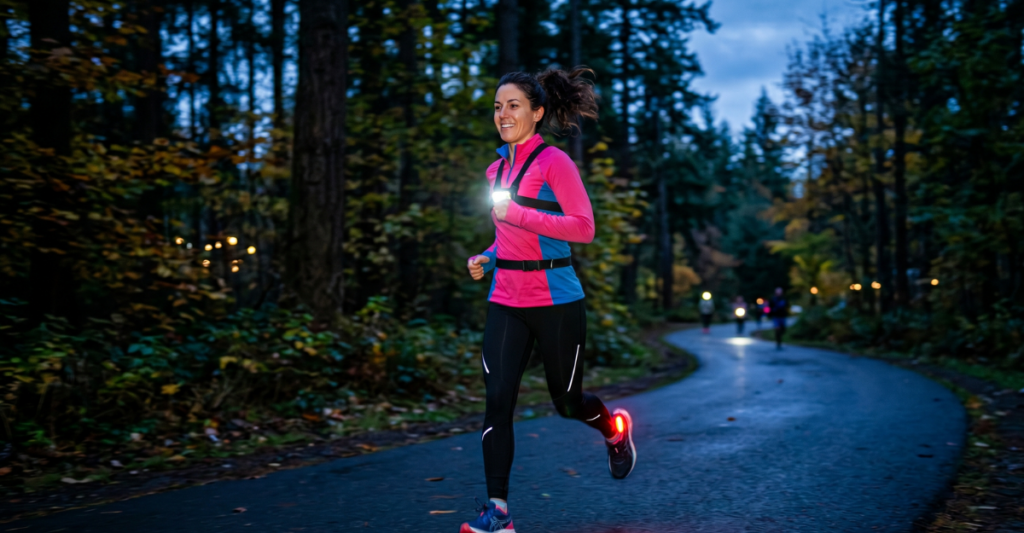
When darkness falls and your running schedule doesn’t align perfectly with daylight hours, you face a critical decision: skip your workout or venture out into the low-light conditions that can put your safety at risk. For dedicated runners who refuse to let early mornings, late evenings, or shortened winter days derail their training plans, LED safety lights for outdoor athletes have become an essential piece of gear that ranks right alongside quality running shoes and moisture-wicking apparel.
The statistics paint a sobering picture of why visibility matters so profoundly for runners. According to the National Highway Traffic Safety Administration, pedestrian fatalities occur most frequently during times of reduced visibility, with a significant percentage happening in the early morning and evening hours when many fitness enthusiasts squeeze in their runs around work and family commitments. You deserve to pursue your passion for running without compromising your safety, and modern LED technology has evolved to provide solutions that are lightweight, comfortable, and remarkably effective at making you visible to motorists, cyclists, and other pathway users.
Understanding the Critical Importance of Visibility During Your Runs
Your eyes might adjust to low-light conditions as you run, allowing you to see the path ahead with reasonable clarity. However, this adaptation creates a dangerous false sense of security because what matters most isn’t how well you can see—it’s how well others can see you. Drivers navigating in dawn or dusk conditions, when the human eye struggles most with depth perception and contrast, may not spot a runner dressed in dark athletic wear until it’s too late to react safely. Research from the University of Wisconsin’s Traffic Operations and Safety Laboratory demonstrates that wearing reflective materials increases driver detection distance from approximately 100 feet to over 500 feet, providing precious additional seconds for drivers to slow down or change lanes.
The challenge intensifies when you consider the modern driving environment, where distracted driving has become epidemic despite increased awareness campaigns and legal restrictions. You’re competing for driver attention against smartphones, navigation systems, climate controls, and countless other distractions that pull eyes away from the road. LED safety lights for outdoor athletes cut through this competition by providing active illumination rather than passive reflection, creating a bright, attention-grabbing signal that penetrates the peripheral vision even when drivers aren’t looking directly at you.
Beyond vehicular traffic, visibility serves other important safety functions for runners. Other pathway users—cyclists moving at high speeds, fellow runners, dog walkers with long leashes, and even wildlife in some areas—need to detect your presence to avoid collisions. You also want to be visible to friends or family members who might be keeping an eye out for you during your run, especially if you’re training in areas with limited cell phone reception or running solo in locations where help might not be immediately available if you experience an injury or medical emergency.
How LED Technology Revolutionizes Runner Safety
The emergence of LED technology has fundamentally transformed safety lighting for runners, replacing bulky, battery-hungry incandescent options with sleek, efficient, and remarkably bright alternatives. LEDs (Light Emitting Diodes) produce intense illumination while consuming minimal power, which translates to longer battery life and lighter weight—two factors that matter enormously when you’re trying to maintain your running form over multiple miles. Modern LEDs can operate for dozens of hours on small watch-style batteries or rechargeable lithium-ion cells, ensuring your lights won’t die mid-run and leave you vulnerable.
The brightness of LED safety lights for outdoor athletes is measured in lumens, with most running-specific products ranging from 20 lumens for basic visibility markers to over 200 lumens for serious illumination. You don’t necessarily need the brightest option available; rather, you want lights that match your specific running conditions. Urban runners with street lighting might prioritize compact, lightweight visibility markers, while trail runners navigating completely dark paths need more substantial illumination to both see obstacles and be seen by others. The beauty of LED technology is that manufacturers can now pack impressive brightness into incredibly small form factors, giving you options that would have been impossible just a decade ago.
LED lights also offer various color options, each with distinct visibility characteristics. Red lights are traditional for rear-facing visibility, signaling to approaching traffic that they’re catching up to you. White or bright blue LEDs work well for front-facing applications, making you visible to oncoming traffic. Some research suggests that certain color combinations or flashing patterns draw more attention than steady illumination, as the human brain is neurologically wired to notice movement and change. Many modern safety lights incorporate multiple colors and programmable flashing patterns, allowing you to customize your visibility setup based on your specific running environment and conditions.
Types of LED Safety Lights Perfect for Runners
Clip-on lights represent perhaps the most versatile category of LED safety lights for outdoor athletes, attaching easily to waistbands, pockets, hydration packs, or virtually any other piece of running gear. These compact units typically weigh less than an ounce and feature strong clips or magnetic attachments that stay secure even during vigorous movement. You can position clip-on lights strategically around your body to create 360-degree visibility, with lights at your front, back, and sides ensuring drivers can see you from any angle. The major advantage of clip-on lights is their adaptability—you can move them between different pieces of clothing or gear, use multiples for enhanced visibility, and quickly remove them when you transition to daytime running.
Headlamps serve a dual purpose for runners, providing both forward illumination to light your path and making you visible to oncoming traffic or other pathway users. You’ll find headlamps particularly valuable for trail running, where uneven terrain, roots, rocks, and other obstacles require clear visibility to navigate safely. Modern running-specific headlamps have evolved far beyond the heavy, bouncing models that once plagued runners, with many current options weighing less than three ounces and featuring secure, bounce-free strap systems that keep the light stable even during hard efforts. Many headlamps include rear-facing red LEDs, giving you front and back visibility from a single device.
Arm and leg bands equipped with LED lights create moving points of illumination that research suggests are particularly effective at capturing driver attention. The biomechanical motion of your arms and legs as you run creates a distinctive pattern that the human brain quickly identifies as a pedestrian in motion, rather than a stationary sign or marker. These bands typically feature multiple LEDs arranged around the circumference, ensuring visibility from all angles regardless of how your arms and legs are positioned at any given moment. You can wear them on your biceps, forearms, wrists, thighs, calves, or ankles, with lower leg placement often recommended for maximum effectiveness since headlight beams naturally illuminate this area.
Innovative LED-Integrated Apparel and Accessories
The latest evolution in runner safety involves LED safety lights for outdoor athletes integrated directly into clothing and accessories, eliminating the need to remember separate lights or fumble with attachments. LED-integrated vests have become increasingly popular, featuring arrays of lights built into the vest fabric along with reflective materials for comprehensive visibility. These vests distribute weight evenly across your torso, making them comfortable for long runs while providing extensive coverage that makes you visible from considerable distances. Many models include rechargeable batteries that power the lights for multiple runs between charges, with USB charging ports that make it convenient to top up the battery from your computer, car, or portable power bank.
Hats and visors with integrated LED lights position illumination at head height, where it’s more likely to catch driver attention than lights positioned at waist or leg level. Your head naturally turns when you’re checking for traffic or looking at intersections, which means a head-mounted light helps signal your awareness and intentions to drivers. Some designs incorporate lights into the bill or brim of the hat, projecting light forward to illuminate your path while also making you visible to others, while other styles feature rear-facing LEDs that create a bright tail-light visible to traffic approaching from behind.
Running shoes with LED lights might sound like they’re designed for children, but several companies have developed sophisticated LED-integrated footwear specifically for adult athletes. These shoes typically feature lights in the heel or along the sole that activate with each footstrike, creating a rhythmic flashing pattern that’s highly visible and immediately identifiable as a runner in motion. The lights are sealed against moisture and engineered to withstand the repetitive impact forces of running, with batteries that last for hundreds of miles of running. While LED shoes might feel gimmicky at first consideration, the low positioning of these lights puts them directly in the path of vehicle headlights, where they reflect and amplify particularly effectively.
Choosing the Right LED Safety Lights for Your Running Style
Your specific running habits and environment should drive your selection of LED safety lights for outdoor athletes, as different scenarios demand different lighting approaches. Urban runners who primarily stick to well-lit sidewalks and bike paths need less intense illumination than trail runners navigating unlit paths, but they often benefit from lights that provide excellent omnidirectional visibility to ensure safety at busy intersections and crosswalks. Consider the typical traffic patterns you encounter—are you mostly dealing with cars traveling at high speeds, or slower-moving vehicles in residential areas? High-speed roadways demand maximum visibility to give drivers adequate reaction time, while urban environments might prioritize compact, comfortable lights that you’ll actually wear consistently rather than leaving at home because they’re cumbersome.
Trail runners face a different set of requirements, needing forward-facing illumination powerful enough to reveal obstacles, navigation hazards, and wildlife while also maintaining awareness lights that signal their presence to other trail users. You’ll want to evaluate lumens carefully for trail running applications, recognizing that inadequate illumination can lead to stumbles, rolled ankles, or missed trail markers that send you off course. Many serious trail runners employ a combination of a powerful headlamp providing 150-200 lumens of forward illumination paired with clip-on or band-style marker lights ensuring 360-degree visibility. This layered approach addresses both the need to see and the need to be seen, covering all safety bases during challenging trail conditions.
Weather resistance represents another crucial selection criterion, particularly for runners in areas with frequent precipitation or high humidity. You need LED safety lights for outdoor athletes rated for water resistance at minimum, with serious consideration of fully waterproof options if you run in heavy rain or snow. Look for IPX ratings—the international standard for moisture protection—with IPX4 providing splash resistance, IPX5 handling rain and spray, and IPX7 or higher offering protection even if the light is temporarily submerged. Moisture intrusion can quickly destroy electronic components or cause corrosion that degrades performance over time, so investing in properly sealed lights saves money and frustration in the long run.
Battery Options and Runtime Considerations
Understanding battery technologies and runtime expectations helps you select lights that match your training volume and charging preferences. Disposable battery lights, typically using coin-cell or AAA batteries, offer the advantage of field-replaceability—you can carry spare batteries and swap them during ultra-distance efforts or multi-day running events. These lights tend to be lighter weight since they don’t include the charging circuitry required for rechargeable models. However, the ongoing cost of replacement batteries adds up over time, and disposing of batteries creates environmental waste that environmentally conscious runners might want to avoid.
Rechargeable LED safety lights for outdoor athletes have become increasingly popular as lithium-ion battery technology has advanced. Modern rechargeable lights often feature USB charging ports that make it convenient to restore power from the same cables and chargers you already use for phones and other devices. You’ll appreciate the convenience of simply plugging in your lights after a run rather than hunting for replacement batteries, and the long-term cost savings are substantial if you run frequently in low-light conditions. The main consideration with rechargeable lights is ensuring you maintain charging discipline—there’s nothing more frustrating than grabbing your lights for an early morning run only to discover they’re dead because you forgot to charge them after your previous workout.
Runtime specifications from manufacturers should be viewed as estimates rather than guarantees, as actual performance depends on multiple factors including temperature, LED brightness settings, and battery age. Cold weather significantly reduces battery performance across all chemistries, so you might see 30-50% reduction in runtime during winter running compared to summer conditions. Many lights offer multiple brightness modes, allowing you to extend runtime by using lower settings when conditions permit. You might run with lights on steady mode during the darkest portions of your route, then switch to flashing mode as you transition to better-lit areas, conserving battery while maintaining visibility. Smart runners carry backup lighting—either spare batteries, a second light, or a minimal emergency light—ensuring you’re never left completely without visibility if your primary light fails unexpectedly.
Strategic Placement and Layering of Safety Lights
Simply wearing LED safety lights for outdoor athletes isn’t enough; you need to position them strategically to maximize effectiveness. Research on driver perception and response times indicates that multiple points of light distributed vertically and horizontally across your body create the most recognizable human form, helping drivers instantly identify you as a pedestrian rather than misinterpreting your lights as a motorcycle, bicycle, or other object. Consider placing lights at different heights—perhaps a chest-level clip-on light, waistband light, and ankle band—to create this distinctive vertical distribution that triggers rapid recognition.
Front and rear visibility both matter, but statistics show that rear-end collisions represent a significant danger for runners traveling along roadways. Prioritize at least one bright rear-facing light positioned at a height where it won’t be blocked by hydration packs or other gear you’re carrying. Red LEDs are traditional for rear markers because drivers are conditioned to interpret red lights as objects moving away from them, but bright white or blue LEDs in flashing mode can also be highly effective at grabbing attention. Some runners employ both a steady red rear light supplemented by a flashing white light, combining the intuitive color signaling with the attention-grabbing flash pattern.
Side visibility often gets overlooked but proves critical at intersections and when crossing streets, as vehicles approaching from perpendicular angles need to detect your presence. Arm bands provide excellent side visibility since your arms swing through a wide range of motion, creating moving light points visible from both sides. Alternatively, vest-style lights with LEDs distributed around the torso perimeter ensure side visibility without requiring separate attachments. Think about your typical running routes and identify the angles from which vehicles might approach—if you frequently cross streets or navigate complex intersections, investing in comprehensive 360-degree visibility becomes especially important.
Integrating Lights with Reflective Materials for Maximum Safety
LED safety lights for outdoor athletes work synergistically with reflective materials, creating a comprehensive visibility strategy more effective than either technology alone. Reflective materials work by bouncing light from vehicle headlights back toward the driver, making you visible when headlights illuminate you. However, reflective materials only work when light strikes them at appropriate angles, which means they might not make you visible to drivers whose headlights haven’t yet reached you or in situations where headlight beams don’t directly hit your reflective elements. LED lights provide active illumination independent of external light sources, ensuring visibility even when reflective materials aren’t optimally positioned.
The combination of active LED illumination and passive reflective materials creates redundancy that significantly enhances safety. You might wear a reflective vest with integrated LED lights, reflective shoes with LED ankle bands, or reflective arm sleeves paired with LED armbands. This layered approach ensures that if one visibility element fails—perhaps an LED battery dies, or a reflective surface becomes obscured by mud—you maintain alternative visibility. The colors and patterns also work together, with the steady or predictable pattern of reflective materials complementing the attention-grabbing flash or brightness of LEDs to create a comprehensive visual signature.
Strategic color choices enhance the effectiveness of your visibility setup. Research suggests that fluorescent colors during twilight conditions (when some ambient light remains) combined with white or bright-colored LED lights creates maximum visibility. As conditions darken completely, the color of reflective materials matters less since they simply reflect whatever light hits them, but the color of your LED lights continues to communicate information—red suggesting rear-facing orientation, white or blue indicating front-facing direction, and multiple colors signaling a complex object (like a person) rather than a simple marker.
Maintenance and Care for Long-Lasting Performance
Proper maintenance extends the lifespan and reliability of your LED safety lights for outdoor athletes, ensuring they perform when you need them most. Regular cleaning prevents dirt, sweat, and debris from accumulating around LED elements, battery compartments, and mounting mechanisms. You can typically clean most lights with a damp cloth and mild soap, taking care to ensure they’re completely dry before storage. Pay particular attention to battery compartments and charging ports, where moisture can cause corrosion that interferes with electrical connections. If your lights are waterproof, occasional rinsing under running water can flush out accumulated salt from sweat or road salt in winter conditions.
Battery care significantly impacts performance and longevity, particularly for rechargeable lights. Lithium-ion batteries, while remarkably durable, benefit from being stored at partial charge rather than fully charged or completely depleted for extended periods. If you’re storing lights during summer when you don’t need them, charge them to approximately 50-60% capacity before storage and check them every few months to ensure they haven’t self-discharged completely. For disposable battery lights, remove batteries if you won’t be using the lights for several weeks or months, as batteries can leak and destroy electronic components even when the light isn’t in use.
Periodic testing ensures your lights work when needed rather than discovering failures at 5:30 AM when you’re heading out for a run. Many runners develop a pre-run ritual that includes testing all lights, checking battery levels on rechargeable units, and verifying that mounting systems are clean and functional. This quick check takes less than a minute but can prevent safety compromises or mid-run equipment failures. Keep spare batteries for disposable-battery lights in your running gear storage, and maintain a charging routine for rechargeable lights—many runners plug in their lights immediately after each run, ensuring they’re always ready for the next workout.
Teaching Safety Light Habits to Young Athletes
If you’re a parent of young runners or coaching youth athletes, instilling proper habits around LED safety lights for outdoor athletes sets the foundation for a lifetime of safe running practices. Children and teenagers often feel invincible and may resist wearing safety equipment they perceive as unnecessary or uncool. You can address this resistance by involving young athletes in selecting their own lights—letting them choose colors, patterns, or styles they find appealing increases the likelihood they’ll actually use the equipment. Many companies now offer lights in fun colors or with interesting flash patterns that appeal to younger users while still providing serious safety benefits.
Leading by example proves far more effective than lecturing when teaching safety habits to young athletes. When your kids see you consistently using safety lights for your own runs, they internalize that this equipment represents normal, non-negotiable running gear rather than optional accessories. You can establish family rules that anyone running or cycling in low-light conditions must wear appropriate safety lights, with no exceptions—this removes the decision-making burden from young athletes and establishes clear expectations. As children develop into teenagers and gain more independence with their training, these ingrained habits continue protecting them even when you’re not directly supervising their workouts.
Consider making safety light checks part of your pre-run routine when running with young athletes, similar to checking that everyone has properly tied shoes and appropriate clothing for weather conditions. This normalization helps young runners develop the automatic equipment checks that will serve them throughout their athletic careers. You might also discuss real-world scenarios and near-misses where safety lights prevented accidents, making the abstract concept of visibility more concrete and meaningful. Avoid fear-based approaches that might discourage young athletes from running; instead, frame safety lights as tools that enable them to run confidently in more conditions and situations.
Budget Considerations and Getting the Best Value
LED safety lights for outdoor athletes span a wide price range, from basic clip-on units costing less than ten dollars to sophisticated rechargeable systems exceeding a hundred dollars. You don’t necessarily need the most expensive options to achieve excellent visibility, but the cheapest lights often prove to be false economy if they fail quickly, provide inadequate brightness, or become so uncomfortable that you stop wearing them. The sweet spot for most runners falls in the mid-range category, where lights provide reliable performance, adequate brightness, and reasonable durability without premium pricing for features you might not need.
When evaluating value, consider the total cost of ownership rather than just the initial purchase price. A twenty-dollar rechargeable light that lasts for several years costs less over time than a five-dollar disposable-battery light that requires fifteen dollars worth of replacement batteries annually. Similarly, slightly more expensive lights with better weather sealing might outlast cheaper alternatives that fail when moisture intrudes. Calculate your expected usage—if you run in low-light conditions five days per week year-round, investing in higher-quality lights makes more sense than if you only occasionally need them for a few winter weeks.
Many runners find that owning multiple lights in different price categories serves their needs well. You might invest in a premium rechargeable vest or headlamp system for regular use, while keeping inexpensive backup lights in your car, office, or travel bag for unexpected situations. This tiered approach ensures you always have appropriate lighting available while avoiding the expense of purchasing top-tier equipment for every possible scenario. Watch for sales during seasonal transitions—many retailers discount safety lights heavily in spring when demand drops, allowing you to stock up for the following fall and winter at substantial savings.
Environmental Conditions That Affect LED Light Performance
Understanding how different environmental conditions impact your LED safety lights for outdoor athletes helps you prepare appropriately for various running scenarios. Fog and heavy rain significantly reduce visibility distances for all lighting technologies, scattering light and reducing how far drivers can see your lights. In these conditions, brighter lights and closer positioning of multiple lights become especially important. You might need to adjust your routes to avoid high-speed roadways during heavy fog, as even the best lights have reduced effective range when visibility is severely compromised. Flashing modes often work.
Give us a call today at 1-877-777-6086 or fill out our contact form to become a retail
distributor of our top-of-the-line safety lights.