There’s a unique freedom that comes with cycling at night.
The roads are quieter. The air is cooler. The distractions of the day disappear, leaving just you, your bike, and the rhythm of the ride. For many cyclists, nighttime riding isn’t just an alternative—it’s a preferred experience.
But unlike daytime cycling, riding after dark introduces a completely different set of challenges.
At night, visibility drops dramatically. Drivers have less reaction time. Road hazards become harder to detect. And your margin for error shrinks.
The difference between a safe ride and a dangerous one often comes down to one thing:
How visible and prepared you are.
This guide will walk you through everything you need to know to cycle safely at night—from visibility strategies to gear, mindset, and real-world habits that can keep you protected on every ride.
Why Cyclists Choose to Ride at Night
Before we talk about safety, let’s understand why night cycling is so popular.
For many people, it’s simply about time. Work, family, and daily responsibilities leave little room for daytime rides, making nighttime the only option.
Others are drawn to the experience itself.
Night rides can feel:
- Calmer
- More focused
- Less crowded
- Mentally refreshing
In hot climates, it’s also much more comfortable to ride after sunset.
But while the experience is appealing, the environment is less forgiving.
The Real Risks of Cycling at Night
Cycling at night isn’t inherently dangerous—but it does amplify certain risks.
1. Reduced Visibility to Drivers
Drivers rely heavily on sight. At night, their ability to see cyclists is significantly reduced—especially if the cyclist lacks proper lighting.
2. Limited Road Awareness
You may not see:
- Potholes
- Debris
- Uneven pavement
- Road markings
until it’s too late.
3. Slower Reaction Times
Both cyclists and drivers have less time to react in low-light conditions.
4. Increased Driver Fatigue
Nighttime drivers may be tired, distracted, or less alert.
5. False Sense of Security
Quiet roads can lead cyclists to lower their guard—which is when mistakes happen.
Visibility: The Most Important Factor
If you take one thing from this article, let it be this:
Visibility is your responsibility.
You cannot assume that drivers will see you. You must actively make yourself visible.
Active vs Passive Visibility
Passive Visibility (Reflective Gear)
Reflective materials bounce light back to its source—like headlights.
Best for:
- Being seen from a distance
- Highlighting movement
Active Visibility (Lights)
Lights emit their own light, making you visible regardless of external conditions.
Best for:
- Constant visibility
- Drawing attention
- Seeing the road
Essential Lighting Setup for Night Cycling
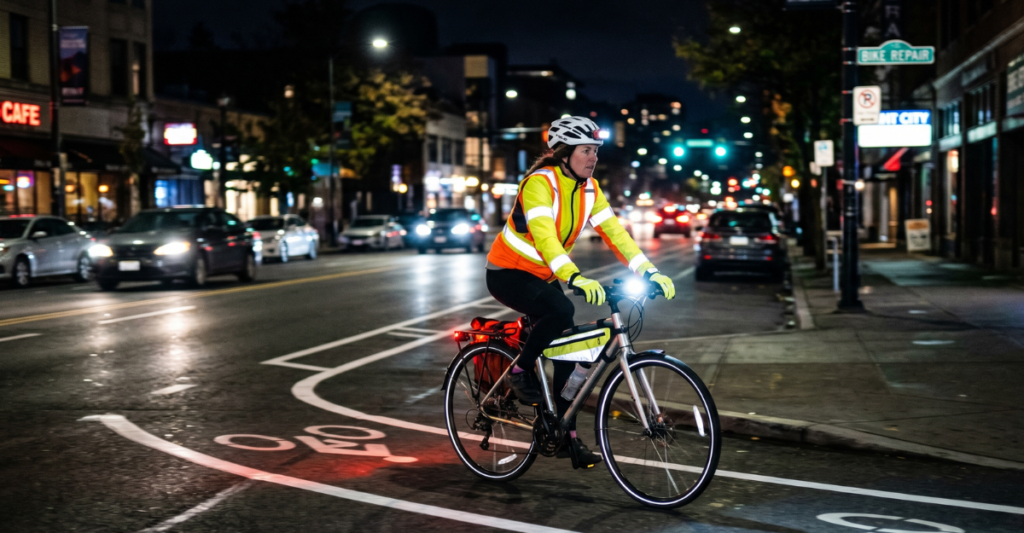
A proper lighting setup is non-negotiable.
Front Light (White)
- Illuminates your path
- Makes you visible to oncoming traffic
Choose one with strong brightness (lumens) for darker areas.
Rear Light (Red)
- Alerts drivers behind you
- Should be visible from long distances
Flashing modes increase attention.
Side Visibility
Many accidents happen at intersections.
Add:
- Wheel lights
- Frame lights
- Reflective strips
Helmet or Body Lights
Lights placed higher (like on your helmet or chest) improve visibility and angle.
Reflective Gear: Small Details, Big Impact
Reflective gear works best when it highlights movement.
Focus on:
- Ankles
- Knees
- Arms
Moving reflective points catch attention faster than static ones.
Choosing the Right Route at Night
Route selection can dramatically reduce risk.
Stick to Familiar Roads
Avoid surprises. Know where you’re going.
Choose Well-Lit Areas
Street lighting improves both your visibility and your awareness.
Avoid High-Speed Roads
Even if traffic is lighter, speed increases danger.
Use Bike Lanes When Available
They provide a buffer between you and traffic.
Riding Technique Matters More at Night
Your riding style should adapt to nighttime conditions.
Slow Down
Give yourself more time to react.
Increase Following Distance
Whether behind cars or other cyclists.
Avoid Sudden Movements
Be predictable. Signal clearly.
Brake Earlier
Stopping distances can increase in low visibility.
Situational Awareness: Your Best Defense
At night, awareness becomes your superpower.
Limit Distractions
Avoid headphones or keep volume very low.
Scan Constantly
Look ahead, to the sides, and behind.
Make Eye Contact
When possible, ensure drivers see you.
What to Wear for Night Cycling
Your clothing choices matter.
Bright Colors
Even at night, lighter colors are more visible than dark ones.
Reflective Elements
Look for:
- Jackets
- Vests
- Shoes
Weather-Appropriate Gear
Stay comfortable to maintain focus
Weather Conditions and Night Riding
Nighttime weather can be unpredictable.
Rain
- Reduces traction
- Reflects lights, causing glare
Fog
- Drastically limits visibility
Cold
- Affects reaction time
Adjust your riding accordingly.
Cycling Alone vs With Others
Riding Alone
- Share your route
- Carry a phone
- Use tracking apps
Group Riding
- Increases visibility
- Improves safety
- Adds accountability
Mental Focus and Confidence
Confidence at night doesn’t come from ignoring risks—it comes from managing them.
When you:
- Use proper lighting
- Stay visible
- Ride predictably
- Stay aware
You gain control over your environment.
Common Mistakes Cyclists Make at Night
Avoid these:
- Using weak or no lights
- Wearing all-black clothing
- Riding too fast
- Ignoring intersections
- Overestimating visibility
How SafetyLightMe Supports Night Cyclists
SafetyLightMe is built for people who move when others stop.
Cyclists, runners, night workers—it’s all about one thing:
Visibility = Safety
With the right lighting solutions, you don’t just ride—you ride with confidence.
The Future of Night Cycling Safety
Technology is improving rapidly:
- Smarter lights
- Automatic brightness adjustment
- Better battery life
- More compact designs
Safety is becoming more accessible than ever.
Cycling at night isn’t about avoiding risk—it’s about managing it.
With the right approach, nighttime riding can be:
- Safe
- Enjoyable
- Empowering
Remember:
- Be visible
- Be predictable
- Stay aware
And most importantly:
Don’t just ride—be seen.
Give us a call today at 1-877-777-6086 or fill out our contact form to become a retail
distributor of our top-of-the-line safety lights.