When Your Dog’s Schedule Doesn’t Match Daylight Hours
You love your dog. Your dog needs walks. But daylight doesn’t always cooperate with your schedule. Early morning walks happen before sunrise when you need to leave for work. Evening walks occur after dark when you finally get home. Winter months compress daylight so severely that weekend walks might be your only chance to walk in natural light. Your dog doesn’t care about the sun’s schedule, they need exercise, stimulation, and bathroom breaks regardless of whether it’s light or dark outside.
So you walk in the dark, navigating neighborhood streets, parks, and trails with your faithful companion. You tell yourself it’s fine. You know the route. Your dog knows the route. What could go wrong?
The statistics tell a different story. Pedestrian accidents spike after dark, and dog walkers face additional risks that solo walkers don’t encounter. Dogs pull unexpectedly. They stop suddenly to investigate scents. They dart toward other animals or interesting sounds. These unpredictable movements put you in vehicle paths at moments when drivers already struggle to see you. Add typical dog walking attire, dark clothing in shades that blend with nighttime environments, and you’ve created a visibility nightmare.
Drivers expect to see people walking predictably on sidewalks. They don’t expect the sudden movements that come with walking dogs. They definitely don’t see you until it’s almost too late when you’re wearing dark clothing with no reflective elements or active lighting.
The Reality of After-Dark Dog Walking Dangers
Every dog owner has experienced the close call. The car that seemed to appear from nowhere, passing closer than comfortable. The driver who clearly didn’t see you until their headlights finally caught you at the last moment. The vehicle that turned right without noticing you crossing the intersection with your dog.
These incidents aren’t random bad luck. They’re predictable outcomes of a visibility problem that affects every after-dark dog walker.
Driver Expectations and Recognition Patterns: Drivers scan for expected patterns. A person walking steadily in a straight line registers quickly because it matches what drivers anticipate. A dog walker presents a different profile. You stop. You start. You move laterally when your dog pulls toward something interesting. You might be bent over cleaning up after your pet or untangling a leash. These atypical movements and postures don’t register in driver recognition patterns, making you effectively invisible even when you’re technically within their field of view.
The problem compounds when drivers are distracted, tired, or dealing with environmental challenges like rain, fog, or glare from other headlights. The cognitive load of driving in challenging conditions means drivers rely even more heavily on movement patterns they expect. When you deviate from those patterns, you disappear from their awareness.
The Added Risk of Leashed Dogs: Your dog creates additional unpredictability that increases danger. Dogs investigate the environment constantly, pulling toward interesting scents, sounds, or sights. This pulling can put you closer to traffic suddenly. A squirrel darting across the street might cause your dog to lunge unexpectedly, pulling you off the curb and into vehicle paths.
Retractable leashes, popular for giving dogs freedom to explore, create extended danger zones. When your dog ranges 15 to 20 feet from you on a retractable leash, drivers see even less. They might notice you but completely miss that a dog on an extended leash is actually in their path. The result is near-misses or actual contact with your pet even though you seemed safely distant.
Multi-Dog Complexity: Walking multiple dogs multiplies unpredictability exponentially. Two dogs might pull in different directions. They might tangle their leashes, requiring you to stop suddenly in unexpected places. The visual profile of multiple dogs and a handler creates confusion for drivers trying to track your group’s movement. What they see doesn’t match expected patterns, reducing recognition and increasing danger.
Environmental and Seasonal Factors: Winter darkness comes early and persists through typical evening dog walking hours. Rain, snow, and fog reduce visibility for both you and drivers. Wet roads create glare from headlights that blinds drivers temporarily. These environmental factors that already challenge visibility are exactly when working professionals must walk their dogs, before work starts and after it ends.
Urban and suburban lighting provides false security. Streetlights illuminate some areas while creating deep shadows in others. Drivers experience temporary blindness when moving from lit areas into shadows. Your position in these transitional zones makes you particularly invisible, creating danger exactly where you thought you were safest.
Why Traditional Reflective Gear Isn’t Enough
Most responsible dog owners already use some reflective elements. Maybe you have a reflective vest. Perhaps your dog wears a reflective collar. These precautions are better than nothing, but they’re far from adequate for the actual dangers you face.
Reflective Material Limitations: Reflective materials only work when light hits them directly. A car approaching from behind illuminates your reflective vest well. But a car approaching from the side sees nothing until their headlights sweep directly across you, often too late for adequate response time. A car ahead of you sees no reflection at all until you’re caught in their headlights, and by then, distance has closed significantly.
The angular limitation of reflective materials creates blind spots in your visibility coverage. You might be well-lit from one direction while completely invisible from another. Drivers approaching from your blind angles don’t see you until geometric chance happens to align their headlights with your reflective surfaces.
Passive vs. Active Visibility: Reflective gear is passive, waiting for light to find it. Active lighting changes the equation completely. You become a light source visible from all directions, at much greater distances, under all conditions. Drivers see you before their headlights would illuminate reflective materials. They see you from angles where reflective gear would show nothing.
The psychological impact differs too. Drivers process active lights as warning signals that demand attention. Reflective materials, when they do catch light, often register as ambiguous visual information that doesn’t trigger the same alertness. A moving light source commands attention in ways that passive reflection cannot match.
Weather Degradation: Rain, snow, and road spray coat reflective materials, dramatically reducing their effectiveness. The moisture layer scatters reflected light, making it dimmer and less visible. Active lighting continues working at full effectiveness regardless of weather conditions. The LED lights used in safety products shine through rain, snow, and road spray without performance degradation.
How Safety Light Products Transform Dog Walking Safety
Safety Light Me’s clip-on safety lights create active visibility that protects you and your dog during after-dark walks. These aren’t decorative accessories, they’re serious safety equipment that makes you unmistakably visible to drivers from all directions and at distances that matter.
360-Degree Visibility: The rotating clip mechanism allows the light to maintain optimal orientation regardless of your body position. When you bend to pick up after your dog, the light adjusts automatically, staying visible to approaching traffic. When you turn corners or change direction, the light remains pointed where it needs to be for maximum visibility.
This omnidirectional visibility eliminates the blind spots inherent in reflective materials. Drivers approaching from any angle see your light clearly. Side streets, driveways, and parking lots where vehicles emerge unexpectedly become less dangerous because you’re visible before geometric alignment would illuminate reflective gear.
Extended Visibility Distance: Active LED lights are visible at distances exceeding 500 feet under normal conditions. This extended visibility range gives drivers adequate time to recognize your presence, assess your movement, and adjust their path or speed appropriately. Compare this to reflective materials that might only become visible at 100 to 200 feet, leaving minimal reaction time.
The distance advantage becomes critical at higher speeds. A car traveling 35 mph covers 51 feet per second. At 500 feet visibility distance, the driver has nearly 10 seconds to recognize and respond to your presence. At 150 feet, they have less than 3 seconds. That difference between “plenty of time” and “barely enough time” can prevent tragedies.
Weather-Proof Performance: LED safety lights maintain full brightness in rain, snow, fog, and other challenging conditions. The electronics are sealed against moisture, and the light output doesn’t diminish when wet. This reliable performance means your visibility doesn’t degrade exactly when you need it most, during the worst weather conditions.
The lights continue functioning in cold temperatures that affect some electronics. Winter evening walks in freezing temperatures don’t reduce light output or battery performance. This consistent operation across all weather conditions provides reliability you can depend on year-round.
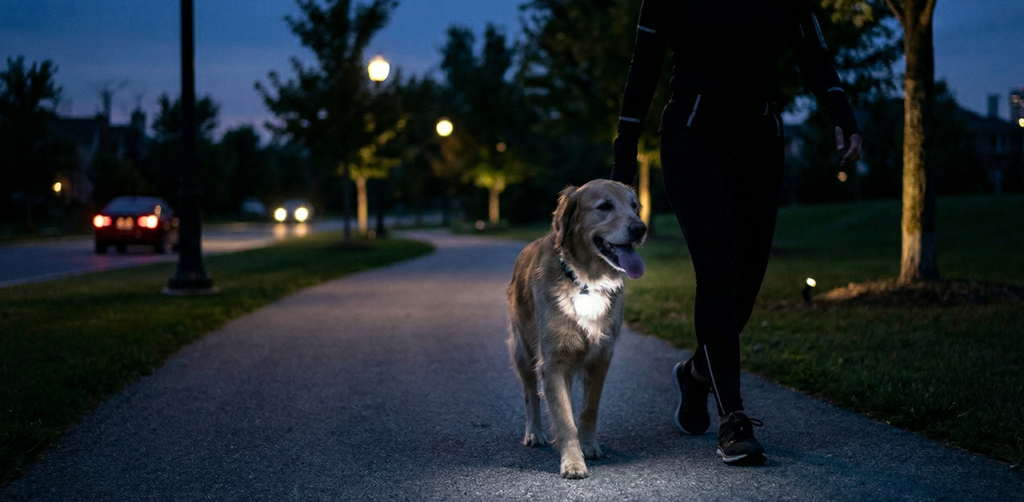
Multiple Light Placement Strategy: Using safety lights on both you and your dog creates a visible profile that helps drivers understand your group’s extent and movement. A light on your body marks your position. A light on your dog’s harness or collar marks their position. Drivers see both lights, understand they represent a group, and allow appropriate clearance.
This multi-light approach especially helps with retractable leashes and multiple dogs. The light on your dog shows drivers exactly where your pet is, even when they’re ranging at the end of a long leash. Drivers don’t just see you, they see your entire group’s position and movement pattern.
Strategic Light Placement for Maximum Protection
Where you place safety lights significantly impacts their effectiveness. Strategic positioning creates optimal visibility while ensuring lights don’t interfere with your movement or your dog’s comfort.
Your Primary Light Position: Clip your main safety light to your back, centered between your shoulder blades. This position provides maximum visibility to vehicles approaching from behind, the most dangerous direction for pedestrians. The elevated position ensures visibility over cars and other obstacles that might block lower-mounted lights.
The center-back position works with the 360-degree rotation feature, maintaining visibility as you turn your body or bend over. Alternative positions like hip-mounted lights can become obscured by arm movements or when bending. The centered back position stays visible under all body positions you adopt while walking your dog.
Secondary Front Light: Add a second light clipped to your chest or front pocket. This front-facing light makes you visible to oncoming traffic and vehicles emerging from side streets or driveways ahead of you. The combination of front and back lights creates 360-degree coverage, ensuring visibility from all directions simultaneously.
Front lighting proves particularly valuable at intersections where you might be crossing in front of stopped vehicles or vehicles preparing to turn. The front light catches driver attention before they initiate turns that could put you at risk.
Dog Collar or Harness Light: Attach a clip light to your dog’s collar or harness, positioned on top of their back for maximum visibility. This light marks your dog’s position independently from yours, helping drivers understand your group’s full extent. Choose lightweight mini lights that don’t burden your dog or create discomfort.
The dog-mounted light also protects your pet independently. If your dog somehow breaks free or pulls the leash from your hand, the light marks their position, allowing drivers to see them and protecting your dog until you can regain control.
Leash Lighting Considerations: Some owners add small lights along leashes, creating a visible connection between handler and dog. While this can enhance visibility, ensure leash lights don’t create trip hazards or annoyance. The primary lights on your body and your dog’s body typically provide adequate visibility without leash augmentation.
Battery Life and Practical Reliability
Safety equipment only protects you when it’s working. Understanding battery performance and maintenance ensures your lights function reliably every time you need them.
Rechargeable Advantages: Safety Light Me’s rechargeable models eliminate the need for constant battery replacement. USB charging makes it convenient to maintain charge using computer ports, wall adapters, or car chargers. A full charge provides multiple walks before requiring recharging.
Establish a charging routine integrated with your dog walking schedule. Charge lights overnight or during work hours so they’re always ready for walks. The consistent charge cycle becomes habit, ensuring your lights never die mid-walk due to depleted batteries.
Battery Life Expectations: Typical LED safety lights provide 6 to 12 hours of continuous operation per charge, far exceeding typical dog walk durations. Even with multiple daily walks, you might go several days between charges. This extended runtime means you’re not constantly managing charging cycles.
Battery capacity degrades slowly over hundreds of charge cycles. Quality rechargeable lights maintain 80 percent or more of original capacity through 500+ recharge cycles, representing years of normal use. Eventually battery replacement or unit replacement becomes necessary, but the timeline extends much longer than with disposable battery models.
Cold Weather Performance: LED lights maintain output in cold temperatures, but battery performance can diminish in extreme cold. Lithium-ion rechargeable batteries perform better in cold than alkaline disposables, making rechargeable safety lights superior for winter dog walking.
If you walk in extremely cold conditions regularly (below 0°F), consider keeping lights in inside pockets until just before your walk to preserve battery warmth. The lights themselves function fine in any cold humans can tolerate, battery chemistry is the only cold-sensitive component.
Building the Complete Safety System
Safety lights provide the foundation for after-dark dog walking safety, but combining them with complementary practices creates comprehensive protection.
Route Selection Strategies: Choose routes with sidewalks whenever possible. When sidewalks aren’t available, walk facing oncoming traffic so you can see vehicles approaching and react if necessary. Avoid high-speed roads and areas with poor lighting unless no alternatives exist.
Familiarity with routes helps but don’t become complacent. Regular routes can change with construction, parked cars, or other temporary obstacles. Stay alert even on familiar paths. Night conditions transform even well-known routes into new environments requiring fresh attention.
Dog Training for Night Safety: Train your dog to walk calmly on a short leash during night walks. The freedom appropriate for daylight walks becomes dangerous after dark when unpredictable movements create risk. Consistent leash training protects both of you by maintaining predictable positioning.
Practice stopping and standing calmly when vehicles approach. Teaching your dog to stop and wait during vehicle passes creates predictable behavior that drivers can process more easily. The trained behavior becomes automatic, protecting you even when you’re distracted or not actively thinking about traffic.
Timing Considerations: When possible, shift walk times slightly to avoid peak traffic periods. Walking at 6:30 PM might encounter heavy commuter traffic, while 7:30 PM might find quieter roads. The reduced traffic volume decreases exposure risk even though visibility challenges remain similar.
Weekend morning walks might allow slightly later timing that provides dawn light, reducing night walking frequency. Evaluate your schedule for flexibility that allows some walks to occur during better lighting conditions.
Communication with Family: Inform family members of your typical routes and expected return times. This safety communication ensures someone knows where you are and when to expect you back. If something goes wrong, delayed return triggers timely response.
Consider location sharing via smartphone during walks. Family members can see your real-time location, providing an additional safety layer. This technology is particularly valuable in areas where cell service is reliable.
Teaching Children Night Dog Walking Safety
Many families assign dog walking responsibilities to older children and teenagers. Teaching young people proper safety practices protects them while instilling habits that last a lifetime.
Age-Appropriate Responsibility: Evaluate whether your child has the physical strength and judgment to control your dog safely. Even with excellent training, dogs can react unpredictably to stimuli. Your child must be able to maintain control if your dog lunges or pulls suddenly.
Start with daylight walks to establish skills before progressing to after-dark responsibilities. Master route knowledge, leash control, and dog behavior management in safer daylight conditions before adding night complexity.
Mandatory Safety Equipment: Make safety light use non-negotiable for children walking dogs after dark. Establish that wearing lights is as essential as holding the leash. Children sometimes resist wearing safety equipment they perceive as uncool, but firm parental standards protect them despite resistance.
Consider making safety light selection a collaborative process. Allowing children to choose colors or styles within appropriate safety products gives them ownership while ensuring protection. The investment in their chosen lights encourages consistent use.
Supervised Progression: Walk with your child initially, teaching route-specific hazards and proper responses to various situations. Progress to shadowing walks where you follow at a distance, allowing independence while maintaining supervision. Finally, grant solo walk privileges once competence and judgment are demonstrated.
Establish check-in protocols. Require text messages when leaving and returning, or at specific waypoints during walks. These communications provide accountability and allow intervention if problems arise.
Emergency Procedures: Teach children what to do if they lose control of the dog, if someone approaches them inappropriately, or if they witness an accident. Role-play scenarios so responses become automatic under stress. Knowing they can handle emergencies builds confidence while improving actual safety.
Program emergency contacts into phones before walks. Ensure children know to call 911 for serious emergencies and understand what constitutes a true emergency versus a problem they can handle independently.
Seasonal Considerations and Adjustments
Different seasons create different challenges for after-dark dog walking. Adapting your approach to seasonal conditions maintains safety year-round.
Winter Darkness and Cold: Winter’s early darkness means more walks occur at night. Snow and ice create slip hazards that increase fall risk, particularly when dogs pull unexpectedly. The clothing layers necessary for cold weather can obscure safety lights if not positioned thoughtfully.
Place lights outside of heavy coats rather than underneath where they might become covered. The light needs to be visible, not buried under clothing layers. Some walkers clip lights to winter hats or headbands, creating high-visibility positions above bulky coats.
Ice reflections can create glare that temporarily blinds drivers. Bright safety lights help maintain your visibility even when drivers are dealing with challenging ice glare conditions. The active light source remains visible where passive reflective materials might disappear in the visual noise.
Spring Rain and Mud: Spring brings rain, reducing visibility for everyone. Drivers struggle with rain-obscured windshields and reduced sight distances. Your visibility equipment must work perfectly in wet conditions to compensate for these challenges.
Safety Light Me’s water-resistant lights continue functioning normally in rain. The sealed electronics prevent moisture intrusion that would disable lesser products. Verify water resistance ratings before purchasing any safety lighting to ensure reliable wet-weather performance.
Summer Heat and Late Sunsets: Summer’s extended daylight reduces night walking frequency, but heat drives many walks to early morning or late evening when temperatures moderate. Dawn and dusk create their own visibility challenges as transition lighting confuses driver vision.
Ironically, twilight can be more dangerous than full darkness. Drivers’ eyes struggle to adjust between daylight and darkness. Active safety lighting remains visible through these transitions, maintaining your visibility when driver vision is most challenged.
Fall Darkness Returns: Fall’s rapidly diminishing daylight catches many dog owners unprepared. Walks that occurred in daylight just weeks earlier suddenly happen after dark. This transition period sees increased accidents as people haven’t adjusted to darkness’s return.
Mark your calendar when daylight saving time ends. This is when you need to establish winter walking routines and safety equipment use. Don’t wait for close calls to prompt safety improvements. Prepare before darkness becomes the norm.
Real Stories from Real Dog Walkers
Dog owners who’ve integrated Safety Light products into their walking routines report transformative safety improvements and peace of mind.
Lisa from Utah describes her experience: “Our cocker spaniel went for a midnight swim in the neighborhood pond, and the safety light on his harness helped us locate him immediately. The lights have been crucial for our desert walks where there are no streetlights. They survived getting wet, getting chewed by a puppy, and being covered in mud. They’re incredibly durable.”
Mary from Illinois shares: “I needed a way to identify my 14-pound Coton De Tulear during the day and at night in case he ever decided to venture a little further than normal from his home. The neighborhood keeps a close eye out for Kramer because everyone knows it’s him when they see the light. We appreciate this product.”
Making Your Investment in Safety
Safety Light products represent a small investment that provides enormous value through accident prevention and peace of mind. Understanding the economics helps you appreciate the return.
Cost vs. Consequence: A complete safety lighting setup including lights for both you and your dog costs less than a single emergency room visit copay. The medical costs from even a minor pedestrian accident easily exceed thousands of dollars. The prevention value from safety lighting dwarfs the purchase cost.
Beyond medical costs, consider lost work time from injury, potential vehicle damage liability, and the trauma from accidents that could have been prevented. These consequences make safety light investment one of the most cost-effective protective measures available.
Longevity and Value: Quality safety lights last for years of regular use. Rechargeable models eliminate ongoing battery costs while providing reliable performance. The per-use cost becomes negligible when divided across hundreds of walks over years of use.
Compare this to one-time-use products like glow sticks that require constant replacement or cheap battery-powered lights that fail after weeks of use. The initial investment in quality safety lighting provides better protection and lower long-term costs than trying to save money with inferior alternatives.
Your Next Step Toward Safer Dog Walking
Every night walk without proper visibility lighting is a risk you don’t need to take. The solution exists, it’s affordable, and it works consistently across all conditions. The only question is whether you’ll protect yourself and your dog with proven safety equipment or continue taking unnecessary risks.
Your dog depends on you for their safety. You owe it to yourself and your family to protect yourself from preventable accidents. Safety lighting transforms after-dark dog walking from a calculated risk into a confident activity you can enjoy without constant worry.
Light your path. Be seen. Keep your best friend safe.
Safety Light Me: Illuminate Your Adventures. Our attachable safety lighting devices provide hands-free illumination and visibility for dog walkers, runners, cyclists, and anyone who refuses to let darkness stop their active lifestyle. Because every walk matters, and every life is precious.
Ready to walk your dog with confidence after dark? Visit SafetyLight.me to explore our full range of clip-on safety lights designed for active lifestyles. Whether you’re a daily dog walker, trail runner, or evening cyclist, we have the lighting solution that keeps you visible and safe. Order today and take the first step toward worry-free nighttime activities.