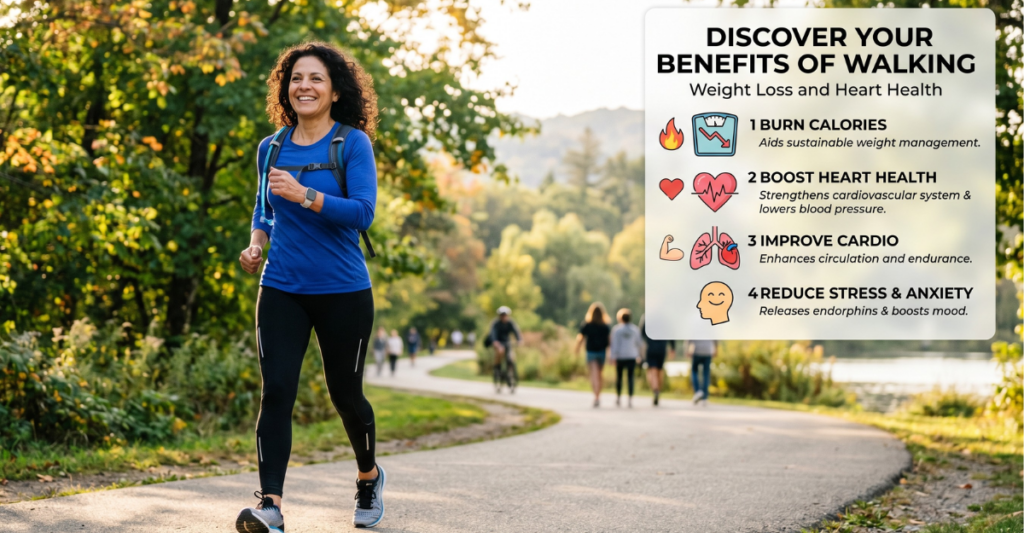
Walking might seem too simple to be effective, but this fundamental human movement holds extraordinary power for transforming your health. Whether you’re a busy mom squeezing in exercise between school pickups or someone who’s been away from fitness for years, walking offers an accessible entry point into better health. The benefits of walking for weight loss and heart health extend far beyond what most people realize, making it one of the most underrated yet scientifically validated forms of exercise available to everyone.
Why Walking Works When Other Exercises Don’t
You’ve probably tried various fitness programs that left you exhausted, injured, or discouraged. Walking stands apart because it works with your body’s natural design rather than against it. Your body evolved to walk efficiently, using a coordinated pattern of muscle activation that burns calories without creating excessive stress on joints and connective tissues. This sustainable approach means you can maintain consistency—the real secret ingredient in any successful health transformation.
The accessibility factor cannot be overstated when discussing the benefits of walking for weight loss and heart health. You don’t need a gym membership, special equipment beyond decent shoes, or particular athletic abilities to start walking today. This democratization of fitness means that regardless of your current fitness level, you can begin exactly where you are and progress at a pace that respects your body’s current capabilities while challenging it enough to create positive adaptations.
The Science Behind Walking and Weight Loss
When you walk, your body initiates a complex metabolic process that extends well beyond the calories burned during the activity itself. Walking activates large muscle groups in your legs, glutes, and core, creating an energy demand that your body must satisfy by mobilizing stored fuel. Initially, your body uses readily available glycogen, but as your walk continues, it increasingly taps into fat stores—exactly what you want for sustainable weight loss.
Research published in multiple peer-reviewed journals demonstrates that regular walking can create significant weight loss when combined with mindful eating habits. One particularly compelling study found that participants who walked briskly for 150 minutes per week lost an average of 6-10 pounds over six months without making dramatic dietary changes. That might not sound revolutionary, but sustainable weight loss typically ranges between one to two pounds per week for healthy, lasting results.
The metabolic benefits extend far beyond the walk itself through a phenomenon called excess post-exercise oxygen consumption, or EPOC. Your body continues burning calories at an elevated rate for hours after you finish walking as it repairs tissues, replenishes energy stores, and returns various systems to baseline. While this effect is more pronounced with higher-intensity exercise, even moderate walking creates this beneficial metabolic afterglow.
Understanding Walking Intensity for Maximum Fat Burning
Not all walking delivers equal results, and understanding intensity zones can help you maximize the benefits of walking for weight loss and heart health. Walking intensity exists on a spectrum from casual strolling to power walking that approaches jogging pace. Your target heart rate during walks should typically fall between 50-70% of your maximum heart rate for optimal fat burning, though varying intensities throughout your week creates superior results.
Moderate intensity walking means you’re moving fast enough that conversation becomes somewhat challenging but still possible. You might need to pause briefly between sentences, and you’ll definitely feel like you’re exercising rather than just moving. This pace typically translates to approximately 3-4 miles per hour for most people, though individual fitness levels affect exact speeds significantly.
Interval walking represents an advanced approach where you alternate between higher and lower intensities. You might walk at a comfortable pace for three minutes, then increase to a challenging pace for one to two minutes, then return to moderate effort. This pattern repeated throughout your walk creates superior cardiovascular adaptations and burns more calories than steady-state walking at the same average pace.
How Walking Transforms Your Cardiovascular System
Your heart is a muscle, and like any muscle, it responds to regular training by becoming stronger and more efficient. Walking regularly causes your heart to pump more blood with each contraction, meaning it doesn’t need to beat as many times per minute to circulate blood throughout your body. This efficiency translates to lower resting heart rates—often considered a hallmark of cardiovascular fitness.
The benefits of walking for weight loss and heart health include measurable improvements in blood pressure that can rival medication in some cases. Regular walking helps relax and dilate blood vessels, reducing the resistance your heart must overcome to push blood through your circulatory system. Many people who commit to consistent walking programs see blood pressure reductions of 5-10 points, which significantly decreases cardiovascular disease risk.
Walking also influences your cholesterol profile in remarkably positive ways. Regular walkers typically see increases in HDL cholesterol—the beneficial kind that helps remove harmful cholesterol from artery walls. Simultaneously, walking helps reduce LDL cholesterol and triglycerides, creating a lipid profile associated with reduced heart attack and stroke risk. These changes don’t require marathon distances; moderate walking several times weekly can create these protective effects.
Creating Your Personalized Walking Program
Starting a walking program requires honest assessment of your current fitness level without judgment or comparison to others. If you’ve been sedentary, beginning with ten-minute walks several times daily might represent an appropriate challenge. There’s absolutely no shame in starting small—every fitness journey begins with a single step, literally in this case.
Progressive overload represents the fundamental principle that drives fitness improvements across all exercise modalities. You need to gradually increase the demands placed on your body to continue seeing benefits. For walking, this might mean adding five minutes to your walk each week, increasing your pace slightly, incorporating hills, or adding another walking session to your weekly routine.
Your weekly walking schedule should balance consistency with recovery. Most health organizations recommend accumulating at least 150 minutes of moderate-intensity walking per week, which you might distribute as:
- Five 30-minute walks spread throughout the week
- Three 50-minute walks on alternate days
- Six 25-minute walks, with one rest day
- A combination of shorter and longer walks that total 150+ minutes
Walking Techniques That Enhance Results
Proper walking form might seem intuitive, but small adjustments can dramatically increase the benefits of walking for weight loss and heart health while reducing injury risk. Your posture should position your ears roughly over your shoulders, shoulders over hips, and hips over ankles when viewed from the side. This alignment allows for efficient movement patterns and proper breathing mechanics.
Your arm swing contributes more to walking efficiency than most people realize. Bend your elbows to approximately 90 degrees and swing your arms naturally forward and back, keeping them relatively close to your body. Avoid crossing your arms across your midline, as this creates rotational forces that waste energy and can strain your lower back. The arm swing should feel natural and rhythmic, coordinating with your leg movement on the opposite side.
Foot strike patterns in walking typically involve landing on your heel and rolling through to push off with your toes. This heel-to-toe progression engages your calf muscles properly and provides natural shock absorption. However, avoid over-striding—reaching too far forward with your leading leg—as this creates braking forces that slow you down and stress your knees unnecessarily. Instead, focus on quicker steps that land underneath your body’s center of mass.
The Mental and Emotional Benefits Nobody Talks About
Walking delivers profound psychological benefits that often surpass the physical changes in terms of life impact. When you walk, especially outdoors in natural settings, your nervous system shifts away from the stressed “fight or flight” state toward the calming “rest and digest” mode. This physiological relaxation response reduces cortisol levels and triggers the release of mood-enhancing endorphins that can last for hours after your walk.
The meditative quality of walking creates space for mental processing that our busy, screen-filled lives rarely provide. Many people find that solutions to problems emerge spontaneously during walks, as the rhythmic movement and reduced distractions allow different brain networks to activate. This phenomenon explains why history’s greatest thinkers—from Aristotle to Einstein—were known for their walking habits.
Depression and anxiety respond remarkably well to regular walking, with multiple studies showing effects comparable to antidepressant medications for mild to moderate cases. The combination of physical activity, outdoor exposure, natural light, and social interaction (if walking with others) creates a powerful intervention for mental health. While walking shouldn’t replace professional mental health treatment when needed, it represents a valuable complementary approach available to nearly everyone.
Optimizing Nutrition to Support Your Walking Program
The relationship between walking and weight loss becomes supercharged when you align your nutrition with your activity. However, this doesn’t mean extreme restriction or complicated meal plans—simple, sustainable adjustments create the best long-term results. The benefits of walking for weight loss and heart health amplify significantly when combined with mindful eating that emphasizes whole foods.
Pre-walk nutrition depends on timing and walk duration. For walks under 45 minutes, most people perform well without eating immediately beforehand, though this varies individually. Longer walks benefit from having some easily digestible carbohydrates 30-60 minutes prior, such as a banana, a slice of toast with honey, or a small serving of oatmeal. These foods provide glucose for energy without sitting heavily in your stomach.
Post-walk nutrition matters more than many casual exercisers realize. Your body enters a heightened state of nutrient receptivity after moderate exercise, making this an ideal time to consume a balanced meal or snack. Including both protein and carbohydrates within an hour or two of walking supports recovery, muscle maintenance, and metabolic adaptation. This might look like:
- Greek yogurt with berries and a handful of granola
- A turkey and avocado sandwich on whole grain bread
- A protein smoothie with banana and spinach
- Eggs with whole wheat toast and fruit
Walking Variations That Prevent Boredom and Plateaus
Your body adapts quickly to repeated stimuli, meaning the same walk route at the same pace eventually provides diminishing returns. Introducing variety prevents both mental boredom and physical plateaus. Hill walking represents one of the most effective variations, increasing calorie burn by 30-50% compared to flat terrain while building leg strength and cardiovascular capacity.
Nordic walking adds specially designed poles that engage your upper body, transforming walking into a full-body workout. This technique can increase calorie burn by up to 46% compared to regular walking at the same pace, while reducing stress on lower body joints by distributing force across four points of contact instead of two. Nordic walking has gained tremendous popularity in Europe and continues growing in North America as people discover its benefits.
Treadmill walking offers advantages that outdoor walking cannot, particularly in extreme weather or for people with safety concerns about walking alone. Modern treadmills allow precise control over speed and incline, enabling structured interval workouts that would be difficult to replicate outdoors. The consistent surface also reduces some variables, which can benefit people recovering from injuries who need predictable conditions.
Tracking Progress Beyond the Scale
Weight fluctuates daily based on hydration status, sodium intake, hormonal changes, and numerous other factors that have nothing to do with actual fat loss. Stepping on the scale weekly rather than daily provides useful data without triggering unnecessary stress. However, the scale tells an incomplete story about the benefits of walking for weight loss and heart health you’re experiencing.
Body measurements often reveal progress that the scale misses. Measuring your waist, hips, thighs, and arms monthly provides concrete evidence of body composition changes. Many people lose inches while maintaining or even gaining weight as they build lean muscle mass and reduce body fat—a physiologically superior change that the scale might classify as “failure.”
Functional improvements represent perhaps the most meaningful metrics of all. Notice and celebrate when you can:
- Walk farther without fatigue than when you started
- Climb stairs without getting winded
- Play actively with your children or grandchildren
- Maintain your target pace more easily
- Sleep better and wake feeling more refreshed
- Notice improved mood and mental clarity
Overcoming Common Walking Obstacles
Time constraints represent the most frequently cited barrier to regular walking. However, walking’s flexibility allows creative solutions that don’t require finding a free hour. Breaking walks into multiple shorter sessions throughout the day provides nearly identical benefits to one continuous walk. Three ten-minute walks spread across morning, lunch, and evening accumulate the same metabolic benefits while potentially being easier to schedule around work and family obligations.
Weather challenges affect outdoor walking but shouldn’t derail your entire program. Investing in appropriate gear transforms previously unsuitable conditions into opportunities. Rain becomes manageable with a good waterproof jacket and cap. Cold weather responds to layering strategies that keep you comfortable without overheating. Extreme heat requires early morning or evening walks when temperatures moderate, along with appropriate sun protection and hydration.
Motivation fluctuations affect everyone, even fitness professionals. Expecting to feel enthusiastic about every walk sets you up for disappointment. Instead, focus on discipline over motivation—showing up even when enthusiasm wanes. Many people find that making their walk non-negotiable, like brushing teeth, removes the mental energy spent debating whether to go. Once walking becomes habitual rather than optional, consistency becomes dramatically easier.
Walking with Your Family for Multigenerational Health
Walking offers unique opportunities to model healthy behaviors for your children while spending quality time together. Children who see parents prioritizing movement develop attitudes toward exercise that influence their entire lives. Family walks create space for conversation without the distractions of screens, strengthening relationships while everyone benefits physically.
Adapting walks to include children of various ages requires creativity but delivers worthwhile rewards. Younger children might need the walk framed as an adventure or treasure hunt, with goals of spotting specific birds, colors, or objects along the route. Older children and teenagers often engage more readily when they can bring a friend along or when the walk includes a destination they find interesting, like a favorite park or ice cream shop.
The benefits of walking for weight loss and heart health extend across generations, making it an ideal family activity. Grandparents can participate at their own pace, parents gain stress relief and exercise, and children burn energy while developing healthy habits. This shared experience creates traditions and memories while addressing the epidemic of sedentary behavior affecting all age groups.
Advanced Strategies for Experienced Walkers
Once you’ve established a consistent walking habit and built a solid fitness foundation, advanced techniques can take your results to the next level. Weighted vests add resistance without the joint stress that hand or ankle weights create. Start conservatively with just 5-10% of your body weight and increase gradually. This additional load forces your cardiovascular system and muscles to work harder, increasing both calorie burn and fitness adaptations.
Structured training plans borrowed from running can be adapted to create sophisticated walking programs. This might include a weekly long walk that gradually increases in distance, several moderate-paced walks, and one interval or tempo session where you maintain a challenging pace for an extended period. This variety in training stimuli creates superior results compared to doing the same walk repeatedly.
Participating in organized walking events provides motivation and community that many people find energizing. Charity walks, virtual challenges, and local walking groups offer social accountability and shared purpose that make showing up easier. Training toward a specific event—whether a 5K walk, a half-marathon distance, or a multi-day hiking adventure—provides concrete goals that structure your training and celebrate progress.
The Relationship Between Walking and Longevity
Large-scale population studies consistently demonstrate that regular walkers live longer than sedentary individuals, with the benefits beginning at surprisingly modest activity levels. You don’t need to walk for hours daily to access longevity benefits—research suggests that even 15 minutes of daily walking can add years to your lifespan. These effects appear to result from walking’s positive influence on nearly every physiological system in your body.
Walking specifically protects against the leading causes of death in developed nations. Heart disease risk drops significantly among regular walkers through mechanisms including blood pressure reduction, improved cholesterol profiles, better blood sugar control, and reduced inflammation. Cancer risks decrease as well, with particularly strong evidence for colon and breast cancer prevention. These protective effects scale with activity levels, meaning more walking generally provides greater protection.
Quality of life during later years matters as much as lifespan itself, and walking helps ensure you remain independent and capable as you age. Regular walkers maintain better balance, bone density, muscle mass, and cognitive function compared to inactive peers. This means you’re more likely to continue doing the activities you love, caring for yourself independently, and enjoying an active lifestyle well into your later decades.
Addressing Special Considerations and Medical Conditions
Most people can safely begin a walking program without medical clearance, but certain conditions warrant consultation with healthcare providers before starting. If you have heart disease, diabetes, or other chronic conditions, your doctor can help you determine appropriate intensity levels and provide guidance on monitoring your response to exercise. Far from being a reason to avoid walking, these conditions represent situations where the benefits of walking for weight loss and heart health become even more crucial.
Arthritis and joint issues cause many people to avoid exercise, yet walking often helps rather than harms arthritic joints. Movement lubricates joints, strengthens supporting muscles, and maintains range of motion—all factors that reduce arthritis symptoms. Starting very gradually and choosing forgiving surfaces like tracks, trails, or grass rather than concrete allows most people with joint issues to walk comfortably. Some people benefit from trekking poles that reduce lower body stress.
Pregnancy and postpartum periods represent times when walking offers particular benefits for those cleared by their healthcare providers. Walking maintains fitness during pregnancy without excessive stress, helps control gestational diabetes risk, and often improves pregnancy-related discomforts. Postpartum, walking facilitates recovery and provides much-needed mental health benefits during a demanding life transition. Many new mothers find that walking with their baby in a stroller provides the break they desperately need while getting the infant outdoors.
Building a Walking-Friendly Lifestyle
The most successful long-term walkers don’t just exercise—they build walking into their daily lives as transportation and recreation. Looking for opportunities to walk instead of drive creates additional activity that doesn’t feel like formal exercise. Parking farther from entrances, taking stairs instead of elevators, and walking to nearby errands all accumulate meaningful activity throughout your day.
Creating environmental cues that support walking makes consistency easier. Laying out your walking shoes and clothes the night before removes morning friction. Scheduling walks in your calendar as non-negotiable appointments increases follow-through. Finding walking partners creates accountability—you’re less likely to skip when someone else is counting on you, and the social connection makes the activity more enjoyable.
Technology can support your walking practice through apps that track distance and pace, provide guided audio walks, or connect you with virtual walking communities. However, don’t become so dependent on technology that a dead battery derails your walk. The fundamental activity requires nothing but your body and a safe place to move. Technology serves best as an enhancement rather than a requirement.
The Economic Benefits of Walking
Walking represents perhaps the most cost-effective health intervention available. While the medical industry spends billions developing new drugs and treatments for obesity and heart disease, walking offers profound benefits for the price of decent shoes. This economic accessibility means that regardless of your financial situation, you can access one of the most powerful health tools available.
The healthcare cost savings from regular walking extend beyond individual benefits to society-wide impacts. Research suggests that if inactive adults began walking regularly, healthcare costs would drop by billions annually through reduced medication needs, fewer doctor visits, and decreased hospitalization rates. For you personally, improving your health through walking may reduce your medication needs, lower insurance premiums, and decrease your risk of expensive medical interventions.
Productivity gains from regular walking often surprise people who worry about the time investment. Regular walkers report better focus, improved problem-solving abilities, enhanced creativity, and increased energy levels—all factors that improve work performance. Many people find they accomplish more in less time despite dedicating 30-60 minutes daily to walking, as the mental clarity and energy gains more than compensate for time spent exercising.
Environmental and Community Impacts of Walking
Choosing to walk instead of driving for short trips reduces carbon emissions and contributes to environmental sustainability. If you’re motivated by environmental concerns, walking aligns your personal health goals with broader ecological values. This convergence of personal and planetary health creates additional meaning and motivation that helps sustain your practice.
Communities with high rates of walking benefit in numerous ways beyond individual health. Walkable neighborhoods tend to have stronger social connections, as people encounter neighbors and build relationships through regular interactions. Local businesses benefit from foot traffic, and the increased “eyes on the street” from walkers enhances neighborhood safety. Your walking practice contributes to these broader community benefits while improving your personal health.
The benefits of walking for weight loss and heart health ripple outward from your individual practice to influence those around you. When coworkers see you taking lunch walks, some will join or start their own practice. When children see parents choosing active transportation, they internalize different values about movement. Your walking practice becomes a small but meaningful act that contributes to cultural change around physical activity and health.
Give us a call today at 1-877-777-6086 or fill out our contact form to become a retail
distributor of our top-of-the-line safety lights