As parents and caregivers, you’ve probably noticed that encouraging physical activity for teens isn’t as simple as it was when they were younger. Remember when your kids would run around the backyard for hours without any prompting? Those days feel like a distant memory now that screens, social pressures, and academic demands compete for their attention. The teenage years bring unique challenges that can make keeping your adolescent moving feel like an uphill battle, but the benefits of regular physical activity during this crucial developmental period cannot be overstated.
The statistics are sobering: according to recent data, only about 20% of adolescents meet the recommended guidelines of 60 minutes of moderate to vigorous physical activity per day. This decline in movement has contributed to rising rates of obesity, mental health challenges, and chronic diseases that now appear earlier in life than ever before. Yet despite these challenges, you have more power than you might think to influence your teen’s relationship with exercise and movement. The key lies in understanding what motivates teenagers, removing barriers to participation, and creating an environment where physical activity feels less like a chore and more like an enjoyable part of daily life.
Understanding the Teenage Brain and Motivation
Encouraging physical activity for teens starts with recognizing that adolescent brains function differently than both children and adults. During these formative years, the prefrontal cortex—responsible for planning, impulse control, and decision-making—is still developing, while the limbic system, which governs emotions and reward-seeking behavior, is in overdrive. This neurological reality means your teen is likely more motivated by immediate rewards and social connections than by abstract concepts like “staying healthy” or “preventing future diseases.”
Understanding this developmental stage helps you frame physical activity in ways that resonate with teenage psychology. Rather than lecturing about long-term health outcomes, you’ll find more success by emphasizing how exercise can help them look better, perform better in activities they care about, boost their mood right now, or connect with friends. The teenage years are marked by an intense desire for autonomy and identity formation, so your approach needs to respect their growing independence while still providing the structure and support they need.
Brain chemistry also plays a significant role in teenage motivation patterns. Dopamine receptors are particularly active during adolescence, making teens more responsive to rewards but also potentially more prone to risk-taking behaviors and seeking novel experiences. You can leverage this by helping them discover activities that provide natural dopamine hits—whether that’s the runner’s high from a great workout, the thrill of learning a new skateboarding trick, or the satisfaction of beating a personal record. When physical activity becomes associated with positive feelings and social connection rather than obligation, you’ve won half the battle.
Removing Common Barriers to Teen Exercise
Your efforts in encouraging physical activity for teens must address the very real obstacles standing between your adolescent and regular movement. Transportation often tops the list of barriers, especially in suburban or rural areas where teens can’t easily get to gyms, parks, or sports facilities on their own. Before your teen can even think about exercising, they need to figure out how to get there, which may require your time, coordination with other parents, or creative problem-solving around public transportation options.
Cost represents another significant barrier that many families face. Sports equipment, gym memberships, team fees, and specialized athletic wear can quickly add up to hundreds or even thousands of dollars per year. You might feel discouraged when you see the price tags associated with keeping teens active, but many budget-friendly alternatives exist. Community recreation centers often offer sliding-scale fees, school sports programs are typically less expensive than club teams, and activities like running, bodyweight exercises, or pickup basketball require minimal financial investment. Sometimes the best approach involves getting creative and prioritizing free or low-cost options that still provide quality physical activity.
Time constraints and scheduling conflicts create additional challenges as teens juggle academics, extracurricular activities, part-time jobs, and social lives. Your teenager might genuinely want to be active but feels overwhelmed by competing demands on their limited time. The solution isn’t necessarily adding more structured activities to an already packed schedule—sometimes it’s about finding opportunities to incorporate movement into existing routines. Walking or biking to school, doing homework while on a stationary bike, or organizing study groups that include activity breaks can help teens accumulate physical activity without requiring additional time blocks.
Addressing Self-Consciousness and Body Image Concerns
Perhaps the most emotionally charged barrier to teenage physical activity is self-consciousness about appearance and athletic ability. Adolescence is peak time for social comparison and body image concerns, and many teens avoid physical activity precisely because they’re worried about how they look while exercising or fear being judged for their skill level. Girls especially report avoiding sports and exercise due to concerns about their appearance, what to wear, or not wanting to get sweaty, but boys experience these pressures too, particularly around expectations of masculine strength and athletic prowess.
You can help by normalizing conversations about these concerns rather than dismissing them. Acknowledge that feeling self-conscious is completely normal, share your own experiences with exercise anxiety if you have them, and help your teen find activities and environments where they feel comfortable. Single-gender exercise options, smaller group settings, or activities focused on personal improvement rather than competition can feel less intimidating for self-conscious teens. Sometimes simply having appropriate, comfortable workout clothing that your teen feels good in can make a meaningful difference in their willingness to participate.
Building competence gradually also reduces self-consciousness over time. When teens develop skills and see themselves improving, their confidence grows and appearance concerns often fade into the background. Start with activities where your teen can experience success relatively quickly, whether that’s achieving a fitness milestone, mastering a new skill, or simply completing a challenging workout. Each small victory builds the foundation for continued participation and helps shift focus from “how do I look?” to “what can I do?”
Making Physical Activity Social and Fun
The most powerful strategy for encouraging physical activity for teens involves tapping into their fundamental need for social connection and enjoyment. Research consistently shows that adolescents are far more likely to maintain physical activity when it’s enjoyable and provides opportunities to connect with peers. This means that the best exercise for your teen isn’t necessarily the one that burns the most calories or builds the most muscle—it’s the one they’ll actually do consistently because they genuinely look forward to it.
Team sports offer obvious social benefits, providing built-in friend groups and shared experiences that many teenagers crave. Whether it’s soccer, basketball, volleyball, or lacrosse, team participation creates natural accountability and social motivation. Your teen is less likely to skip practice when they know their teammates are counting on them, and the post-game celebrations or team bonding activities often become highlights of their week. Even if your teenager doesn’t make a school varsity team, community leagues, recreational teams, and intramural programs can provide similar benefits with less competitive pressure.
For teens who aren’t interested in traditional team sports, countless other social activity options exist. Group fitness classes designed for teens, hiking clubs, dance teams, martial arts studios, rock climbing gyms, and skateboarding communities all offer ways to be active while connecting with like-minded peers. The key is helping your teen explore different options until they find activities and communities that resonate with their interests and personality. Some teens thrive in highly structured environments with clear rules and objectives, while others prefer the creative expression and freedom of activities like parkour or freestyle dance.
Leveraging Technology and Gaming for Movement
While excessive screen time is often positioned as the enemy of physical activity, you can actually harness technology as a tool for encouraging physical activity for teens. Many adolescents are highly motivated by tracking metrics, earning achievements, and engaging with apps and devices, so fitness technology can provide the immediate feedback and reward that teenage brains crave. Fitness trackers, smartphone apps, and online challenges transform abstract concepts like “being active” into concrete, measurable goals with visible progress.
Virtual fitness communities and online workout programs offer another avenue for tech-savvy teens. YouTube fitness channels, Instagram workout challenges, and fitness apps with social components allow your teen to work out from home while still feeling connected to a community. The variety available through these platforms also helps prevent boredom—if they don’t like one workout style, they can try something completely different the next day without any additional cost or commitment.
Active gaming represents perhaps the most seamless integration of screen time and physical activity. Games that require physical movement—from dance games to VR fitness experiences to interactive sports simulations—can get sedentary teens moving without it feeling like traditional exercise. While these activities may not provide the same intensity as sports or structured workouts, they’re infinitely better than sitting still, and they can serve as gateway activities that build confidence and interest in other forms of movement. You might start by having active gaming sessions together as a family, making it a fun bonding activity while modeling that movement can be enjoyable.
The Parent’s Role in Modeling and Supporting Activity
Your own relationship with physical activity profoundly influences your teen’s attitudes and behaviors around exercise. Teenagers are remarkably perceptive, and they notice the disconnect when parents preach about the importance of being active while remaining sedentary themselves. You don’t need to be an elite athlete or fitness fanatic to positively influence your teen, but you do need to demonstrate that physical activity is a valued part of a healthy lifestyle through your own actions.
Consider how you talk about exercise and your body around your teen. If your teenager primarily hears you complaining about workouts, making negative comments about your appearance, or viewing exercise solely as punishment for eating, they’re internalizing these attitudes. Instead, focus on how physical activity makes you feel—more energetic, less stressed, stronger, clearer-headed. Share the aspects of movement that you genuinely enjoy rather than only the obligatory elements. When your teen sees you prioritizing physical activity because it adds value to your life rather than out of guilt or appearance concerns, they’re more likely to develop a similarly positive relationship with exercise.
Participating in physical activities together can strengthen your relationship with your teen while simultaneously supporting their active lifestyle. These shared experiences don’t need to be formal workouts—a weekend hike, an evening walk around the neighborhood, a bike ride to get ice cream, or shooting hoops in the driveway all count. These moments provide opportunities for connection and conversation that might not happen otherwise, as side-by-side activities often make teens more comfortable opening up than direct, face-to-face conversations. You’re also creating positive associations between physical activity and quality time rather than exercise being something they do separately from family life.
Providing Logistical and Emotional Support
Beyond modeling, encouraging physical activity for teens requires concrete support in the form of time, transportation, financial resources, and emotional encouragement. Your involvement might include driving to practices and games, purchasing necessary equipment, rearranging family schedules to accommodate activities, or helping problem-solve obstacles that arise. This practical support communicates that you value your teen’s physical activity enough to invest your own resources in making it happen.
Emotional support is equally critical, particularly when your teen faces setbacks, doesn’t make a team, struggles with a skill, or wants to quit. These moments test your ability to strike the delicate balance between pushing your teen to persist through normal challenges and recognizing when an activity genuinely isn’t a good fit. Your goal is to support effort, improvement, and persistence rather than only celebrating wins and natural talent. When you praise your teen for showing up to early morning practice even when they didn’t feel like it, for trying a new activity even though they were nervous, or for continuing to practice a difficult skill, you reinforce the mindset that commitment and growth matter more than immediate success.
It’s also important to monitor your own emotions and expectations around your teen’s physical activities. The parents who derive too much of their identity or satisfaction from their teen’s athletic performance often inadvertently create pressure that backfires, causing teens to disengage from activities that no longer feel enjoyable. Check in with yourself regularly: Are you more invested in your teen’s activities than they are? Are you living vicariously through their achievements? Does your mood depend on whether they win or perform well? If so, work on maintaining healthy boundaries that allow your teen to pursue physical activity for their own intrinsic reasons rather than to please or impress you.
Emphasizing Variety and Trying New Activities
One of the most effective approaches to encouraging physical activity for teens involves exposing them to diverse movement experiences rather than assuming they’ll find their passion immediately. Many teens disengage from all physical activity simply because they had negative experiences with one or two specific sports or exercise types and concluded that they’re “not athletic” or “don’t like exercise.” By encouraging experimentation and framing it as exploration rather than commitment, you help your teen discover activities they might genuinely enjoy.
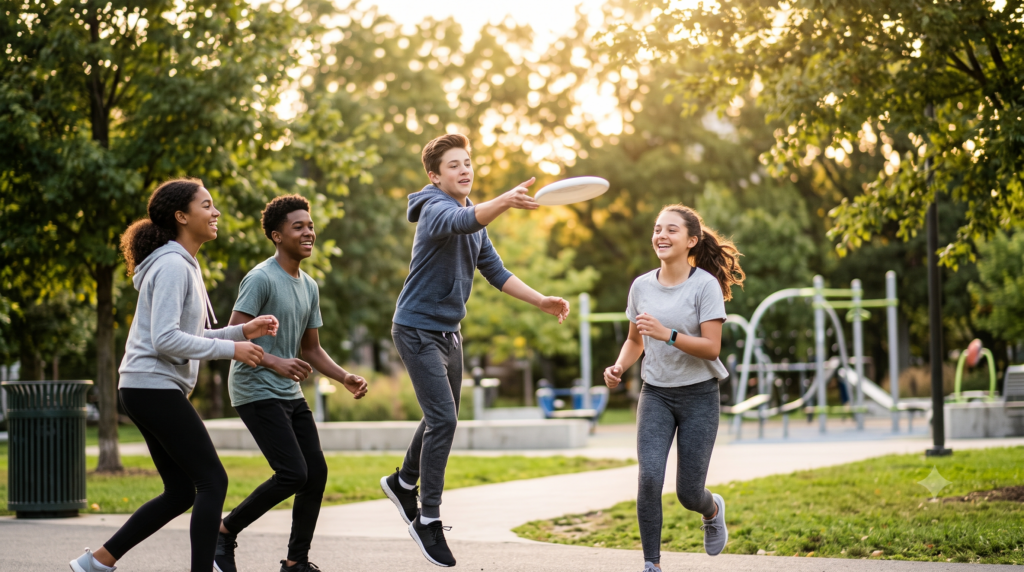
Create opportunities for your teen to sample different activities with low stakes and minimal pressure. Many facilities offer trial classes, drop-in sessions, or beginner workshops designed for people trying an activity for the first time. Summer camps, community education programs, and school PE electives can provide exposure to activities your teen might never encounter otherwise—everything from archery to yoga to ultimate frisbee. The goal during this exploration phase isn’t to find the single perfect activity but to help your teen build a repertoire of movement options they can choose from based on their current mood, schedule, and interests.
Encourage your teen to think beyond traditional sports and exercise categories. Outdoor recreation like kayaking, mountain biking, or trail running; performing arts like dance, circus skills, or marching band; and active hobbies like gardening, dog walking, or car washing all count as physical activity. When teens understand that “being active” doesn’t necessarily mean playing a sport or going to a gym, they’re more likely to find ways of moving that align with their unique interests and personality. The teenager who hates team sports might discover they love the meditative quality of distance running, while the teen who finds traditional exercise boring might thrive in the creative environment of a parkour gym.
Adapting Activities to Individual Preferences and Needs
Recognizing that every teen is different is crucial for successful encouragement of physical activity. Your teenager’s temperament, interests, physical abilities, and social preferences should guide your suggestions and support rather than trying to force them into activities that don’t match who they are. The introverted teen who loves reading might resist team sports but embrace solo activities like swimming, running, or home workouts. The teen with ADHD might struggle with activities requiring sustained focus but excel at fast-paced sports with constant action. The creative, artistic teen might find traditional athletics unfulfilling but love activities that combine movement with self-expression.
For teens with physical disabilities, chronic health conditions, or athletic challenges, encouraging physical activity for teens requires additional creativity and advocacy. Work with your teen’s healthcare providers, school counselors, and adaptive sports programs to identify appropriate activities and necessary accommodations. Many communities now offer adaptive sports leagues, inclusive fitness programs, and specialized instruction that allow teens of all abilities to participate. The benefits of physical activity—improved mood, better sleep, increased confidence, social connection—are just as important for teens facing physical challenges, and finding accessible movement opportunities can be transformative.
Pay attention to whether your teen prefers individual or group settings, indoor or outdoor environments, structured or unstructured activities, competitive or non-competitive contexts. Some teens need the external motivation of scheduled classes and coaches, while others do better with the flexibility of activities they can do on their own schedule. Some thrive on competition and constantly trying to improve their performance, while others find competitive pressure demotivating and prefer activities focused on personal enjoyment or mindfulness. There’s no single right way to be physically active, and honoring your teen’s preferences increases the likelihood they’ll maintain activity into adulthood.
Incorporating Movement Into Daily Life
While structured exercise and sports participation are valuable, encouraging physical activity for teens should also include finding ways to increase everyday movement throughout their regular routines. Research shows that accumulated physical activity throughout the day provides health benefits even when it doesn’t occur in dedicated workout sessions. For busy teens juggling multiple commitments, this approach can feel more manageable than trying to carve out additional time for exercise.
Start by examining your family’s current patterns and identifying opportunities to add movement without major lifestyle overhauls. Could your teen walk or bike to school instead of driving? Can they take the stairs instead of the elevator? Would they be willing to do homework standing at a counter or while on a treadmill desk? Could family errands become walking trips when possible? These small changes accumulate over time, and they help normalize physical activity as something integrated into life rather than a separate, optional activity.
Household responsibilities offer another avenue for incorporating movement into daily routines. Assigning teens active chores like mowing the lawn, washing cars, cleaning floors, raking leaves, or shoveling snow contributes to family functioning while getting them moving. Framing these tasks as contributions to the household rather than punishment helps maintain positive attitudes. You might also involve your teen in active family projects like building something, organizing the garage, or planting a garden—activities that require physical effort while teaching practical skills and providing a sense of accomplishment.
Active Transportation and Reducing Sedentary Time
Active transportation deserves special attention as a highly practical way of encouraging physical activity for teens. When teens can walk, bike, or skateboard to school, friends’ houses, part-time jobs, or other regular destinations, they accumulate significant physical activity without requiring additional time or motivation. A teen who bikes 15 minutes to school and 15 minutes home five days per week accumulates 150 minutes of physical activity without setting foot in a gym or joining a team.
Of course, active transportation isn’t feasible for all families depending on distance, weather, safety concerns, and community infrastructure. If your situation allows for it, you might start small—perhaps your teen could bike one way and get picked up the other way, or walk to destinations within a certain radius. Teaching your teen to navigate public transportation also often involves considerable walking and can build independence alongside physical activity. Even parking farther away from destinations or getting off the bus a stop early can increase daily movement, though these strategies work best when framed as positive choices rather than inconveniences.
Reducing sedentary time is equally important as increasing active time. The average teen spends seven to eight hours per day on screens, not including school-related computer work, and prolonged sitting has its own health risks independent of exercise habits. You can set family guidelines around screen time, create phone-free zones or times, and encourage active breaks during homework or gaming sessions. The rule doesn’t need to be harsh or punitive—even small agreements like “stand and stretch every 30 minutes” or “do 10 jumping jacks between every TV episode” can begin breaking up long sedentary periods.
Understanding the Unique Benefits of Teen Physical Activity
Your efforts toward encouraging physical activity for teens are worthwhile because adolescence represents a critical window for establishing lifelong habits and reaping specific benefits that are particularly important during this developmental stage. Regular physical activity during the teenage years contributes to healthy bone development, with the skeleton accumulating much of its density during adolescence. The physical activity patterns established during these years tend to track into adulthood—active teens are more likely to become active adults, while sedentary teens often remain sedentary throughout life.
The mental health benefits of physical activity are especially significant for teenagers, who experience high rates of depression, anxiety, and stress. Exercise has been shown to reduce symptoms of depression and anxiety, improve mood, enhance self-esteem, and help with stress management. During a time when many teens are struggling emotionally, regular physical activity can serve as a powerful, accessible tool for supporting mental wellness. The sense of accomplishment that comes from athletic improvement, the social connections formed through team activities, and the neurochemical effects of exercise all contribute to better mental health outcomes.
Academic performance also benefits from regular physical activity, despite the time it takes away from studying. Active teens demonstrate better concentration, memory, and classroom behavior compared to their sedentary peers. Physical activity increases blood flow to the brain, supports the growth of new brain cells, and enhances cognitive functioning in ways that directly support learning. When you’re helping your teen balance academics and activities, remember that time spent being physically active isn’t competing with academic success—it’s supporting it.
Physical Activity and Teen Social Development
The social dimensions of teenage physical activity deserve particular attention because peer relationships are central to adolescent development. Through sports and active recreation, teens learn crucial social skills like teamwork, communication, conflict resolution, and leadership. They experience both winning and losing, learn to handle disappointment and celebrate others’ successes, and develop resilience through persisting despite challenges. These character-building experiences have value far beyond the physical benefits of the activity itself.
Athletic participation also expands teens’ social networks beyond their immediate friend groups and academic circles. The teammate who goes to a different school, the adult coach who serves as a mentor, the opponents who become friends, and the diverse individuals they encounter through sports all contribute to broader social exposure and perspective. For teens who struggle socially in traditional school settings, athletic teams or activity-based communities can provide alternative social structures where they feel they belong and are valued for their contributions.
Identity formation represents another key aspect of adolescent development that physical activity influences. Being part of a team, identifying as an athlete or active person, and developing competence in physical skills all contribute to teens’ understanding of who they are. This identity can provide stability and positive direction during the often turbulent teenage years. When teens identify as active people, they’re more likely to make choices consistent with that identity, creating a positive self-reinforcing cycle.
Creating a Supportive Home Environment
The physical environment of your home plays an underestimated role in encouraging physical activity for teens. When equipment, space, and opportunities for movement are readily available, the barrier to being active drops significantly. You don’t need an elaborate home gym, but having some basic equipment accessible can make the difference between your teen exercising and not exercising on any given day. Items like resistance bands, a yoga mat, a jump rope, a basketball hoop, or a pull-up bar are relatively inexpensive and create opportunities for spontaneous movement.