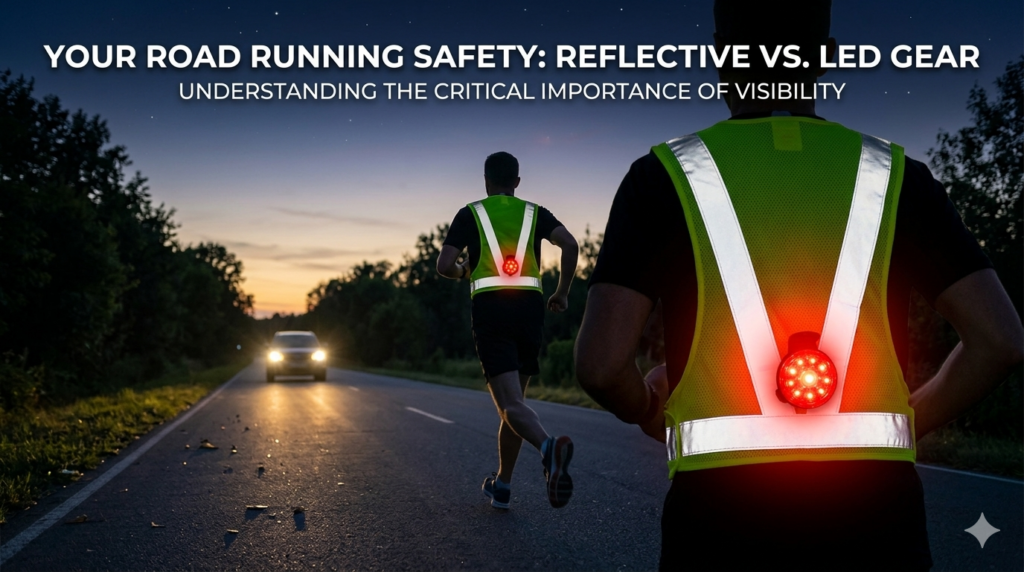
When you lace up your running shoes and head out the door for an early morning or evening run, visibility should be at the forefront of your mind. The statistics paint a sobering picture: according to the National Highway Traffic Safety Administration, pedestrian fatalities occur most frequently during low-light conditions, with the hours between 6 PM and 9 PM accounting for a significant portion of these tragic incidents. As someone committed to maintaining your health through running, you need to understand that road running safety: reflective vs. LED gear isn’t just about personal preference—it’s about ensuring you make it home safely to your family after every single run.
The reality is that drivers simply cannot avoid what they cannot see. Whether you’re squeezing in a quick 5K before the kids wake up or unwinding with an evening jog after a long workday, your visibility can mean the difference between a close call and a devastating accident. Many runners underestimate how difficult they are to spot from a driver’s perspective, especially during those transitional periods of dawn and dusk when light levels are deceptive and shadows play tricks on depth perception.
Your choice between reflective gear and LED lighting systems represents one of the most crucial decisions you’ll make regarding your running safety protocol. Both technologies serve the fundamental purpose of making you visible to motorists, cyclists, and other road users, but they accomplish this goal through distinctly different mechanisms that offer unique advantages and limitations depending on your specific running conditions and routes.
How Reflective Gear Works to Keep You Safe
Reflective materials operate on a fascinatingly simple yet effective principle called retroreflection. When light from a vehicle’s headlights strikes the reflective material on your running gear, it bounces back directly toward the light source—meaning straight into the driver’s field of vision. This happens because reflective materials contain thousands of tiny glass beads or prismatic structures that capture incoming light and redirect it back along the same path it traveled. The result? You appear as a bright, attention-grabbing figure against the dark backdrop of the road environment.
The effectiveness of reflective gear depends heavily on several critical factors that you need to consider when selecting your safety equipment. First and foremost, the quality of reflective materials varies dramatically across different products and price points. High-quality reflective gear uses what’s known as microprismatic technology, which can reflect light from angles up to 90 degrees and remains effective even when wet or dirty. Lower-quality reflective materials, often found on budget-friendly running apparel, may only work within a narrow angle range and can lose significant effectiveness when exposed to moisture or accumulated grime from repeated use.
Placement of reflective elements on your body makes an enormous difference in how visible you become to approaching drivers. Research conducted by transportation safety experts has demonstrated that reflective strips positioned on moving parts of your body—such as your ankles, wrists, and knees—create a distinctive biological motion pattern that the human brain recognizes immediately as a person in motion. This “biomotion” effect triggers faster recognition responses in drivers compared to static reflective patches placed on your torso alone, potentially giving motorists additional precious seconds to react to your presence on or near the roadway.
Modern reflective running gear comes in various forms that you can incorporate into your safety strategy. Reflective vests provide broad coverage across your torso and are often the most visible option for upper body protection. Reflective bands or snap-on strips offer versatility, allowing you to add visibility to any outfit, including those favorite running clothes that didn’t come with built-in safety features. Specialized reflective running jackets combine weather protection with safety elements, making them excellent choices for year-round runners who face varying conditions. Many running shoes now incorporate reflective elements as well, helping establish that crucial biomotion visibility pattern at ground level where drivers’ eyes naturally track.
The Technology Behind LED Running Gear
LED (Light Emitting Diode) running gear represents the active approach to visibility, generating its own light rather than relying on reflection from external sources. Unlike reflective materials that remain invisible until illuminated by another light source, LED gear makes you conspicuous regardless of whether vehicle headlights are shining in your direction. This fundamental difference gives LED technology a significant advantage in certain running scenarios that we’ll explore throughout this discussion of road running safety: reflective vs. LED gear options.
The science of LED visibility centers on the concept of active illumination and the way human vision responds to light-emitting sources. Your eyes—and the eyes of drivers who share the road with you—are naturally drawn to light sources in the environment, especially when those lights appear in unexpected places or exhibit movement. LED running gear exploits this biological response, commanding attention through brightness and often through programming that includes flashing or pulsing patterns designed to maximize noticeability. Studies in visual perception have shown that a flashing light can be detected at distances up to three times greater than a steady light of the same intensity, which explains why many LED running accessories offer multiple lighting modes.
LED running products have evolved dramatically over the past decade, expanding far beyond the simple clip-on blinking lights that early adopters wore on their waistbands. Today’s LED safety gear encompasses an impressive array of options engineered specifically for athletic performance while maintaining visibility standards. LED armbands and ankle bands provide targeted illumination at key motion points on your body, enhancing that biomotion effect we discussed earlier. LED-equipped vests distribute multiple light sources across your torso, creating a highly visible profile from virtually any angle of approach. Some innovative products even integrate LED strips into flexible materials that wrap around your limbs or torso, creating a futuristic appearance that’s nonetheless highly functional.
Battery technology and power management represent crucial considerations when you’re evaluating LED running gear for your safety arsenal. The inconvenient truth is that LED devices require a power source, and dead batteries render your safety equipment completely useless at the worst possible moment. Modern LED running accessories typically use one of three power solutions: replaceable coin cell batteries, rechargeable built-in batteries, or small replaceable AAA/AA batteries. Each system offers distinct advantages—coin cells provide long operational life and are lightweight, rechargeable systems eliminate ongoing battery costs and environmental waste, while standard AAA/AA batteries offer the flexibility of quick replacement if you carry spares. When shopping for LED gear, pay attention to the claimed battery life and consider your typical running schedule to ensure the device won’t leave you literally in the dark.
Comparing Visibility Range and Driver Detection
Understanding the actual distances at which drivers can detect you wearing different types of safety gear provides essential context for making informed decisions about your running safety equipment. Research conducted by transportation departments and safety organizations has established that the average driver requires approximately 1.5 seconds of perception and reaction time after detecting a hazard before taking corrective action. At highway speeds of 55 mph, a vehicle covers more than 120 feet during this perception-reaction window—meaning drivers need to spot you well in advance of that distance to avoid a collision.
High-quality reflective gear, when properly illuminated by vehicle headlights, can be visible from distances ranging from 500 feet to over 1,000 feet under ideal conditions. This impressive range gives drivers ample time to process your presence and adjust their path or speed accordingly. However—and this is a critical caveat—this visibility range assumes that vehicle headlights are aimed in your direction and functioning properly. If you’re running on a curved road section where headlight beams haven’t yet swept across your position, or if a vehicle approaches from a side angle without direct headlight illumination, reflective gear provides minimal to no visibility until that crucial moment when the light finally strikes those reflective surfaces.
LED running gear, by contrast, provides omnidirectional visibility that doesn’t depend on external light sources. Quality LED devices can be seen from distances of 500 to 1,500 feet depending on the brightness level, ambient light conditions, and visual obstacles in the environment. The self-illuminating nature of LED gear means you remain visible from all angles, including side approaches that wouldn’t illuminate reflective materials. This becomes particularly relevant when you’re crossing intersections or running on roads with multiple approach vectors where vehicles might emerge from directions that wouldn’t trigger reflective elements.
Weather conditions dramatically affect the performance characteristics of both reflective and LED gear in ways that should influence your equipment choices. Reflective materials maintain consistent performance across various weather conditions as long as they remain reasonably clean and aren’t obscured by outer layers of clothing. Rain, fog, and mist actually enhance the visibility of reflective gear in some scenarios because water droplets in the air create additional reflective surfaces that diffuse and spread the retroreflected light. However, heavy rain can reduce the overall distance at which drivers can see any object, and dirty road spray can coat reflective materials, significantly reducing their effectiveness until cleaned.
LED devices face their own weather-related challenges that you need to account for in your safety planning. Most quality LED running gear features water-resistant construction, but the varying degrees of protection (usually indicated by IP ratings) mean not all devices hold up equally well in downpours or extended wet conditions. Fog and mist can actually work in LED gear’s favor by creating a glowing halo effect around the light source, making you even more visible to approaching traffic. However, extremely cold temperatures can affect battery performance in LED devices, potentially reducing operational time or causing unexpected shutdowns during winter runs when visibility gear is most critical for your safety.
Cost Considerations and Long-Term Value
The financial investment required for proper visibility gear represents a legitimate concern for many runners, especially when you’re already budgeting for quality shoes, appropriate clothing, and perhaps race registration fees. Reflective running gear typically occupies the lower end of the price spectrum, with basic reflective vests available for $10-$20 and premium reflective running jackets ranging from $50-$150 depending on additional features like weather resistance and ventilation systems. Reflective bands and snap-on strips can be found for as little as $5-$15 per set, making them an accessible entry point for runners on tight budgets who nonetheless recognize the importance of road running safety: reflective vs. LED gear considerations.
LED running gear generally commands higher upfront prices due to the electronic components, battery systems, and engineering required to make devices weatherproof and durable enough for athletic use. Simple LED armbands or clip-on lights start around $15-$25, while comprehensive LED vest systems with multiple light sources and various display modes can cost $40-$80 or more. Premium LED running gear incorporating rechargeable batteries, multiple brightness levels, and innovative designs might reach $100-$150, though these top-tier products often deliver exceptional performance and longevity that justify the investment.
Long-term cost analysis reveals some nuances that aren’t immediately apparent when comparing price tags at the point of purchase. Reflective gear, once acquired, incurs virtually no ongoing costs beyond normal wear and tear over time. Quality reflective materials can last for years of regular use before the retroreflective properties degrade to the point where replacement becomes necessary. However, you’ll need to replace reflective clothing as it wears out from normal running activities, and those specialized reflective jackets or vests eventually require renewal just like any other running apparel.
LED devices introduce ongoing operational costs that factor into the total ownership equation. If you choose LED gear that uses replaceable batteries, you’ll need to factor in the recurring expense of battery purchases throughout the device’s lifespan. A runner who logs five early-morning or evening runs per week might replace batteries monthly or quarterly depending on battery type and usage duration, potentially adding $20-$50 annually to the real cost of LED gear. Rechargeable LED systems eliminate this recurring expense but introduce the consideration that the built-in battery will eventually degrade, potentially requiring device replacement when the battery no longer holds sufficient charge rather than when the LED components fail.
Durability and replacement frequency provide another lens through which to evaluate long-term value. Reflective materials integrated into clothing or gear follow the natural lifecycle of those products—your reflective vest lasts as long as the base material remains serviceable, and your reflective jacket needs replacement when it no longer provides adequate weather protection or fit. LED devices face additional failure points beyond normal wear and tear, including electronic component failure, water intrusion damage, and battery system problems. Quality LED running gear from reputable manufacturers typically includes warranty protection and is engineered to withstand the mechanical stresses of running, but the technological complexity inherently creates more potential failure modes compared to the simplicity of reflective materials.
Practical Applications for Different Running Scenarios
Your specific running routes and typical running times should heavily influence your decision-making process when selecting between reflective and LED safety gear. Urban runners who primarily navigate city streets with consistent streetlight illumination face different visibility challenges than rural runners who cover long stretches of unlit roadway. Similarly, your running schedule—whether you’re exclusively a dawn and dusk runner or you sometimes run in full darkness—affects which visibility technology best serves your safety needs.
Morning runners who hit the pavement during that predawn darkness face perhaps the most challenging visibility conditions. The sky provides no ambient light, streetlights may be sparsely placed or absent entirely depending on your location, and drivers themselves are often less alert as they navigate their commutes in those early hours. For these conditions, combining both reflective and LED gear provides the most comprehensive safety coverage. LED devices ensure you’re visible from all angles and don’t rely on headlights to illuminate you, while reflective elements maximize your visibility in the specific moments when vehicle headlights do sweep across your position, creating a brilliant burst of retroreflected light that demands driver attention.
Evening runners encounter different but equally significant challenges as daylight fades and darkness descends. The transition period of dusk creates particularly dangerous conditions because drivers experience reduced visibility but haven’t yet adjusted their attention levels to compensate for darkness. Traffic volumes often peak during evening hours as well, placing you on roads shared with more vehicles than during other times of day. LED gear shines (quite literally) in these scenarios because you remain continuously visible rather than only when headlights illuminate your reflective materials. The ability to be seen from the side becomes especially valuable during evening runs when you might cross streets at intersections where approaching vehicles don’t directly face you with their headlights.
Rural and suburban runners on roads without sidewalks or adequate shoulders face heightened risks that demand the most robust visibility solutions. These environments often combine high vehicle speeds with limited or nonexistent streetlight infrastructure, creating situations where drivers have minimal time to react once they do spot you. Running on rural roads during low-light conditions absolutely requires both reflective and LED gear working in concert to provide maximum visibility. The extended sight lines common on rural roads mean LED lights can alert drivers to your presence from extreme distances, while reflective gear delivers that brilliant flash of visibility when headlights finally illuminate you directly.
Trail runners who occasionally encounter road crossings or brief road sections during their routes shouldn’t neglect visibility gear despite spending most of their time off-road. The transition from trail to road often occurs at points where visibility is compromised—trailheads near parking areas, creek crossings that emerge onto bridges shared with vehicle traffic, or connecting segments that link separate trail sections. Carrying lightweight LED clip-on lights or wearing reflective elements even during primarily trail-based runs provides crucial safety during those road interfaces where vehicles don’t expect to encounter runners.
Maximizing Visibility Through Strategic Gear Combination
The most effective approach to road running safety doesn’t require you to choose exclusively between reflective or LED gear but instead leverages the complementary strengths of both technologies in a layered safety strategy. Think of visibility gear the same way you approach clothing layers for weather protection—each layer serves a specific purpose, and the combination provides more comprehensive protection than any single element alone. By strategically combining reflective and LED components, you create a visibility profile that addresses multiple detection mechanisms and remains effective across varied conditions and approach angles.
Start building your visibility system with a foundation of reflective elements integrated into your core running outfit. A reflective vest or jacket provides broad coverage across your torso, establishing your basic visible profile to approaching drivers. Add reflective bands to your ankles and wrists to create that biomotion effect that helps drivers immediately recognize you as a person in motion rather than a static object. Many runners find that reflective elements on the limbs prove especially effective because the pumping motion of your arms and the striding action of your legs create a distinctive animated pattern that catches driver attention even in peripheral vision.
Layer LED components onto this reflective foundation to add active illumination that doesn’t depend on vehicle headlights for visibility. A chest-mounted LED light or LED-equipped vest ensures you’re visible from both front and rear approach angles with self-generated illumination. Consider adding LED armbands or ankle lights that enhance the biomotion effect created by your reflective bands—the combination of moving reflective materials and moving light sources creates an unmistakably human profile that drivers recognize and respond to faster than either element alone.
Color selection deserves careful consideration when you’re assembling your visibility gear collection. Fluorescent colors—particularly lime yellow, orange, and pink—enhance daytime and twilight visibility by absorbing ultraviolet light and re-emitting it in the visible spectrum, literally making you appear to glow even in daylight conditions. These bright colors work synergistically with reflective and LED elements during dawn and dusk when some ambient light remains but visibility becomes compromised. For LED gear, choose lights with high-contrast colors, particularly red for rear-facing illumination (which drivers associate with other road users who require caution) and white or bright green for forward and side visibility.
Distribution of visibility elements around your body creates the comprehensive coverage that ensures driver detection regardless of approach angle. Front-facing elements alert drivers approaching from ahead or at intersections where you’re crossing their path. Rear-facing visibility components protect you from vehicles approaching from behind, which represent perhaps the greatest threat since these drivers may not anticipate encountering a runner on the roadway ahead. Side visibility often gets neglected but proves crucial at intersections and on curved road sections where vehicles might approach from angles that don’t trigger front or rear visibility elements. The ideal visibility setup provides 360-degree coverage through strategic placement of both reflective and LED components around your entire body.
Maintenance and Care for Optimal Performance
Your visibility gear can only protect you if it’s functioning at peak performance, which requires regular maintenance and proper care that many runners unfortunately overlook. Reflective materials gradually degrade over time and through repeated use, while LED devices require battery management and protection from environmental factors that can compromise their functionality. Establishing routine maintenance habits for your safety gear should become as integral to your running practice as maintaining your shoes or tracking your mileage.
Reflective gear maintenance centers primarily on keeping the reflective surfaces clean and unobstructed. Road grime, mud, dust, and even laundry detergent residue can accumulate on reflective materials, filling in the microscopic prismatic structures or coating the glass beads that make retroreflection possible. This contamination dramatically reduces reflective performance, potentially compromising your visibility without any obvious indication that your gear isn’t functioning properly. Regularly clean reflective elements according to manufacturer instructions, typically involving gentle hand washing with mild soap and air drying away from direct heat sources that might damage the reflective coating.
Inspect reflective gear periodically for signs of wear, damage, or degradation that indicate replacement is necessary. Reflective materials that appear cracked, peeling, or have visible gaps in the reflective coating have lost effectiveness and should be replaced. Perform simple visibility tests by having a friend shine a flashlight on your reflective gear in darkened conditions while you observe from the driver’s perspective distance—if the reflective elements don’t light up brilliantly and remain visible from significant distances, it’s time for replacement regardless of how much life remains in the base garment.
LED device maintenance requires more active attention to ensure reliable operation when you need illumination. Develop a habit of testing your LED gear before each run rather than discovering dead batteries or malfunctioning lights after you’ve already left for your run. For devices using replaceable batteries, keep spare batteries in your running bag or vehicle so unexpected power failure doesn’t leave you without visibility. Rechargeable LED devices should be placed on charge after each use or according to a regular schedule that ensures sufficient power for your typical run duration plus a safety margin.
Weather resistance ratings provide guidance on how much exposure your LED gear can handle, but proper care extends device lifespan significantly. After running in rain or wet conditions, wipe down LED devices and allow them to air dry completely before storage. Check battery compartments and charging ports for moisture intrusion, which can corrode electrical contacts and cause device failure. Store LED gear in climate-controlled conditions rather than leaving it in vehicles where extreme temperatures—both hot and cold—can damage battery cells and reduce electronic component lifespan.
Understanding Legal Requirements and Liability Considerations
While running for fitness should be an enjoyable stress-relief activity, the legal landscape surrounding pedestrian and runner safety creates considerations you need to understand to protect yourself both physically and legally. Laws governing pedestrian visibility equipment vary significantly by jurisdiction, with some municipalities requiring specific types of reflective or illuminated gear during certain conditions, while others make visibility equipment merely recommended rather than legally mandated. Understanding the regulations in your area ensures you remain compliant while also establishing that you took reasonable precautions for your safety.
Many jurisdictions have enacted pedestrian visibility laws that specifically address nighttime and low-light conditions. These regulations typically require pedestrians—which legally includes runners in most contexts—to wear or carry reflective or light-emitting devices when on or near roadways during darkness or limited visibility conditions. Violations can result in citations and fines, but more importantly, failure to comply with visibility regulations can affect liability determinations if you’re involved in an accident. Demonstrating that you wore appropriate visibility gear establishes that you took reasonable precautions for your safety, potentially affecting legal outcomes and insurance claim decisions.
Even in jurisdictions without specific visibility equipment mandates, liability considerations favor runners who take proactive safety measures. In the unfortunate event of a runner-vehicle collision, investigations and potential legal proceedings will examine whether both parties took appropriate steps to prevent the incident.