Starting your day with the right movements can transform not just your morning, but your entire approach to daily activities. Whether you’re chasing after kids, heading to a construction site, or preparing for an intense training session, incorporating the best morning stretches for energy and mobility into your routine can dramatically improve how you feel and perform throughout the day. Unlike jumping straight into coffee or scrolling through your phone, dedicating just ten to fifteen minutes to purposeful stretching awakens your body at the cellular level, increases blood flow to sleepy muscles, and signals to your nervous system that it’s time to transition from rest to activity.
The beauty of morning stretching lies in its accessibility—you don’t need expensive equipment, a gym membership, or even much space. You can perform most of these movements right beside your bed, in your living room, or even outside if weather permits. What matters most is consistency and intentionality, approaching each stretch with mindfulness about what your body needs after hours of stillness during sleep.
Why Morning Stretches Matter for Your Body
Your body undergoes significant changes during sleep that make morning stretching particularly beneficial. While you rest, your muscles remain relatively static for six to eight hours, causing them to tighten and your fascia—the connective tissue surrounding muscles—to become somewhat dehydrated and less pliable. This natural overnight stiffness explains why you might feel rigid or creaky when you first wake up, especially as you move into your late thirties and beyond.
Morning stretches specifically address this phenomenon by rehydrating tissues, increasing synovial fluid in your joints, and gradually elevating your heart rate in a gentle, sustainable way. Unlike the jarring effect of an alarm clock followed immediately by rushed movement, stretching provides a bridge between sleep and wakefulness that respects your body’s need for gradual transition. This is particularly important for parents who might otherwise go from bed to immediate high-stress demands, or for tradesmen whose work requires physical readiness from the moment they arrive on site.
The best morning stretches for energy and mobility work synergistically with your circadian rhythm and natural cortisol awakening response. When you stretch in the morning, you’re not fighting against your biology but working with it, enhancing the natural energy boost your body provides while adding the physical readiness that stretching uniquely offers. Research consistently shows that people who stretch in the morning report feeling more alert, experience less pain throughout the day, and maintain better posture during both active and sedentary periods.
The Science Behind Stretching and Energy Levels
Understanding why stretching boosts energy requires looking beyond the muscles themselves to the broader physiological systems at play. When you stretch, you’re activating mechanoreceptors in your muscles and tendons that send signals to your brain about body position and movement. This proprioceptive feedback essentially “wakes up” your nervous system, creating heightened body awareness that translates to feeling more alert and present.
Blood flow represents another crucial mechanism through which morning stretches enhance energy. During sleep, your cardiovascular system operates at a reduced rate, and blood pools in certain areas while circulation to extremities decreases. Stretching reverses this pattern by creating muscular contractions and releases that act like a pump, pushing blood through vessels and delivering oxygen-rich blood to tissues that have been relatively deprived overnight. This increased oxygenation of tissues, particularly in the brain, contributes significantly to the mental clarity and physical vitality you experience after stretching.
The lymphatic system also benefits tremendously from morning movement. Unlike your circulatory system, which has the heart to pump blood, your lymphatic system relies entirely on muscular contractions and body movement to circulate lymph fluid that removes waste products from tissues. Morning stretching jumpstarts this system, helping to clear metabolic debris that accumulated overnight and reducing the sluggish feeling that often accompanies waking. For busy moms juggling multiple responsibilities or athletes preparing their bodies for training, this lymphatic activation can make the difference between dragging through the morning and attacking it with purpose.
Essential Morning Stretches for Full-Body Mobility
The best morning stretches for energy and mobility address all major muscle groups and movement patterns your body will use throughout the day. Starting with your spine makes anatomical and functional sense, as your spinal column serves as the central axis for virtually all movement. The cat-cow stretch, performed on hands and knees, perfectly illustrates this principle by taking your spine through flexion and extension in a controlled, rhythmic pattern that mobilizes each vertebral segment.
To perform cat-cow effectively, position yourself on all fours with hands directly under shoulders and knees under hips. As you inhale, drop your belly toward the floor while lifting your chest and tailbone toward the ceiling, creating an arch in your spine. Hold this cow position for a breath, then exhale while rounding your spine upward like a frightened cat, tucking your chin to chest and tailbone under. The key lies in moving slowly and deliberately, synchronizing breath with movement rather than rushing through repetitions. Perform eight to ten complete cycles, and you’ll feel your entire back region awaken with increased blood flow and reduced stiffness.
Hip Flexor and Quad Stretches
Your hip flexors and quadriceps deserve special attention in any morning routine, particularly if you spend significant time sitting or if your sport or work involves repetitive forward motion like running or cycling. These muscle groups tend to tighten overnight and from modern lifestyle patterns, creating limitations that affect everything from your gait to your lower back health.
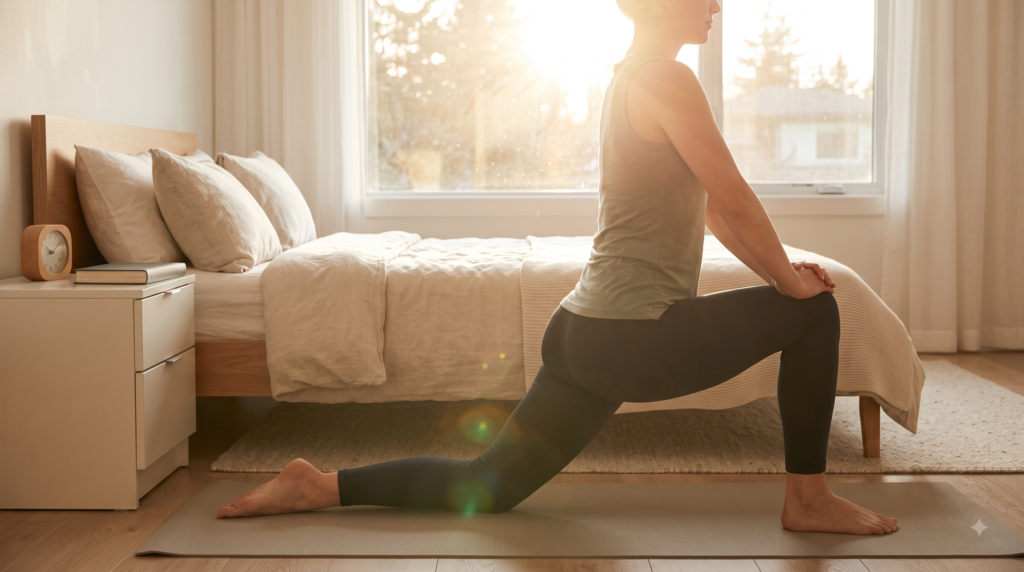
The low lunge stretch targets these areas comprehensively while also challenging your balance and engaging your core. Begin in a kneeling position, then step your right foot forward into a lunge with your knee aligned over your ankle. Keep your left knee on the ground (use a cushion if needed for comfort), and gently press your hips forward until you feel a stretch along the front of your left hip and thigh. For enhanced effectiveness, engage your left glute by squeezing it, which reciprocally relaxes the hip flexor through a neurological principle called reciprocal inhibition.
Hold this position for 30 to 45 seconds while breathing deeply, then add a vertical reach with your arms overhead to intensify the stretch and incorporate your torso. This compound movement exemplifies efficiency—you’re addressing multiple tight areas while also working on balance and body awareness. Switch sides and repeat, ensuring you give equal attention to both legs. Many people discover they have significant asymmetries between sides, which this stretch helpfully reveals.
Hamstring and Lower Back Release
The posterior chain—comprising your hamstrings, glutes, and lower back—often becomes particularly tight overnight, especially for individuals who sleep in the fetal position. A standing forward fold offers an accessible yet highly effective way to address this entire region while also incorporating the calming, introspective quality of inversion as your head drops below your heart.
Stand with feet hip-width apart and knees slightly bent—this is crucial, as locked knees can strain the joint and actually prevent effective hamstring stretching. Hinge forward from your hips rather than rounding from your waist, letting your upper body hang heavy toward the ground. Your hands can rest on your shins, ankles, or the floor, depending on your flexibility level. The goal isn’t to touch the floor but rather to feel a gentle, sustainable stretch along the backs of your legs and through your lower back.
Remain in this position for 45 to 60 seconds, using your breath to deepen the stretch. With each exhale, imagine releasing tension and allowing gravity to do the work of lengthening tight tissues. You can gently sway side to side or bend one knee then the other to explore different angles and sensations. This stretch not only improves hamstring flexibility but also helps decompress the spine after a night of horizontal positioning, making it particularly valuable for anyone who deals with lower back discomfort.
Upper Body Stretches for Posture and Strength
While lower body mobility often receives primary attention, your upper body equally requires morning stretching, especially given how modern life promotes forward-hunched positions. Your shoulders, chest, and upper back work as an integrated unit that influences not just your posture but also your breathing capacity and even your confidence levels. Opening this region through targeted stretches can literally and figuratively help you stand taller as you move through your day.
The doorway chest stretch represents one of the most effective movements for counteracting rounded shoulders and tight pectoral muscles. Stand in a doorway and place your forearms against the door frame with elbows bent at 90 degrees. Step one foot forward through the doorway and gently lean your body weight forward until you feel a stretch across your chest and the front of your shoulders. This position can be adjusted by raising or lowering your arm position on the door frame to target different fibers of the pectoral muscles.
Hold this stretch for 30 to 40 seconds while maintaining steady breathing, being careful not to let your ribs flare forward or your lower back arch excessively. The sensation should feel like a gentle opening across your chest rather than a sharp pulling. For many people who work at computers, drive vehicles, or engage in activities that emphasize forward arm positioning, this stretch often produces an immediate sense of relief and improved breathing capacity. Your thoracic spine can extend more fully when chest muscles aren’t pulling your shoulders forward, which explains why this simple stretch often leads to people feeling like they can take deeper, more satisfying breaths.
Shoulder and Neck Mobility Work
Your neck and shoulders carry tremendous tension for most people, making them prime candidates for morning attention through the best morning stretches for energy and mobility. The neck particularly deserves gentle, mindful stretching since it contains delicate structures and numerous nerve pathways that don’t respond well to aggressive manipulation.
Begin with simple neck rotations, standing or sitting tall with shoulders relaxed. Slowly turn your head to look over your right shoulder, moving only as far as feels comfortable without forcing. Hold for 15 to 20 seconds, then return to center and repeat on the left side. Follow this with lateral flexion by tilting your right ear toward your right shoulder, again avoiding any pushing or pulling with your hands. These simple movements increase blood flow to neck muscles while gently mobilizing the cervical vertebrae.
For shoulders, arm circles provide dynamic mobility work that prepares the glenohumeral joint for the varied movements you’ll perform throughout the day. Stand with feet shoulder-width apart and extend your arms straight out to the sides at shoulder height. Make small circles forward for 10 repetitions, gradually increasing the size of the circles. Reverse direction and perform backward circles. This movement pattern lubricates the shoulder joint with synovial fluid while activating the rotator cuff muscles that stabilize this highly mobile joint.
Dynamic Stretches for Athletic Performance
While static stretching has its place in a morning routine, incorporating dynamic stretches brings your movement preparation to another level, particularly if you’re planning exercise later in the day or have physically demanding work ahead. Dynamic stretching involves moving through ranges of motion rather than holding positions, which more closely mimics functional movement patterns and creates neuromuscular readiness that static stretching alone cannot provide.
Leg swings represent an excellent dynamic stretch for hip mobility and hamstring flexibility. Stand beside a wall or sturdy surface for balance, then swing one leg forward and backward in a controlled manner, gradually increasing the range of motion as your muscles warm up. Perform 10 to 15 swings per leg, then switch to lateral leg swings by standing facing the wall and swinging your leg side to side across your body. These movements dynamically stretch hip flexors, hamstrings, adductors, and abductors while challenging your balance and core stability.
The world’s greatest stretch—aptly named for its comprehensive nature—combines multiple movement patterns into one flowing sequence. Start in a push-up position, then step your right foot outside your right hand into a deep lunge. Rotate your right arm up toward the ceiling while following it with your eyes, opening through your chest and thoracic spine. Return your hand to the ground, then sit your hips back to straighten your front leg and fold forward over it, stretching your hamstring. Return to the lunge position and repeat the sequence three to five times before switching sides. This complex movement addresses hip mobility, thoracic rotation, hamstring flexibility, and ankle mobility all within one efficient pattern.
Core Activation Through Stretching
Your core musculature benefits immensely from morning stretching that simultaneously activates and lengthens these crucial stabilizing muscles. The thread-the-needle stretch combines thoracic mobility with core engagement in a way that prepares your torso for rotational movements and lateral bending that you’ll encounter throughout the day.
Begin on hands and knees in a tabletop position. Reach your right arm underneath your body toward the left side, threading it through the space between your left arm and left knee. Allow your right shoulder and the right side of your head to rest on the ground while your hips remain stacked over your knees. This position creates rotation through your thoracic spine while gently stretching the muscles between your shoulder blades. Hold for 30 seconds, using your breath to relax into the stretch, then return to center and repeat on the opposite side.
The cobra or upward-facing dog stretch addresses core muscles from the anterior perspective, creating extension through your spine and opening your abdominal region. Lie face-down with hands placed beside your ribs, then press through your hands to lift your chest off the ground. Keep your hips and legs grounded while focusing on creating a smooth arch through your entire spine rather than hinging from one segment. This position stretches your abdominals and hip flexors while strengthening the small muscles along your spine that maintain postural integrity. Hold for 20 to 30 seconds, breathing deeply to expand into the stretch.
Breathing Techniques to Enhance Your Stretching Routine
The relationship between breath and stretching effectiveness cannot be overstated when discussing the best morning stretches for energy and mobility. Your breathing pattern directly influences your autonomic nervous system, with slow, deep breathing activating your parasympathetic nervous system that promotes relaxation and allows muscles to release tension more completely.
Incorporate diaphragmatic breathing throughout your stretching routine by placing one hand on your chest and another on your belly. As you inhale through your nose, focus on expanding your belly rather than lifting your chest, allowing your diaphragm to descend fully and create maximum lung expansion. Exhale slowly through your mouth or nose, feeling your belly naturally contract. This breathing pattern increases oxygen delivery to working muscles while simultaneously signaling to your nervous system that you’re safe and can release protective tension patterns.
Box breathing represents another powerful technique to integrate with stretching. This method involves inhaling for a count of four, holding the breath for four counts, exhaling for four counts, and holding empty for four counts before repeating the cycle. Practicing this pattern during holds in static stretches helps maintain focus, ensures adequate oxygenation, and creates a meditative quality that makes your stretching routine feel less like exercise and more like a moving meditation. Many athletes and busy parents find that this breathing integration transforms their morning stretching from a physical obligation into a cherished ritual that centers them for the day ahead.
Creating Your Personalized Morning Stretch Routine
Building an effective morning stretching practice requires honest assessment of your current flexibility levels, time constraints, and specific needs based on your activities and any areas of chronic tension or limitation. Rather than attempting to perform every stretch mentioned, you’ll see better results by selecting six to eight movements that address your primary tight areas and mobility restrictions.
For runners and cyclists, prioritizing hip flexor stretches, hamstring work, and calf mobility makes logical sense since these areas receive the most repetitive stress during your sport. Busy moms who frequently lift children and perform household tasks might benefit more from focusing on lower back stretches, hip openers, and shoulder mobility work. Tradesmen who perform overhead work or repetitive motions should emphasize whatever body regions their occupation demands most, ensuring those areas receive attention before the workday compounds existing tightness.
Start with a foundation routine that takes just 10 minutes and can be performed consistently seven days per week. Consistency trumps duration when establishing any new habit, and you’re far more likely to maintain a brief daily practice than an elaborate routine you only complete occasionally. As this practice becomes ingrained, you can gradually expand it by adding movements or increasing hold times, but the initial goal should be establishing the habit itself rather than achieving flexibility milestones.
Sequencing Your Stretches for Maximum Benefit
The order in which you perform stretches matters more than many people realize, as certain sequences prepare your body more effectively for subsequent movements. Generally, start with movements that address your spine, since spinal mobility influences virtually all other movement patterns. Cat-cow or gentle spinal twists serve as excellent opening movements that awaken your central axis.
Progress from there to larger muscle groups and compound movements before addressing smaller, more specific areas. Performing leg swings or hip circles before holding static hip flexor stretches, for example, warms the tissues and increases blood flow, making static stretches both more comfortable and more effective. Save smaller, more isolated stretches like neck work for later in the sequence after your body temperature has risen and your nervous system has fully transitioned from sleep state to active awareness.
Finish your routine with a brief integration period—perhaps child’s pose or simply standing still with eyes closed for 30 to 60 seconds—allowing your body to register and consolidate the work you’ve just completed. This intentional closure transforms your stretching session from a series of disconnected movements into a cohesive practice that your mind and body recognize as a unified ritual. This ritualistic quality strengthens the habit formation process and increases the likelihood that you’ll maintain your practice long-term.
Common Mistakes to Avoid During Morning Stretching
Even with the best morning stretches for energy and mobility at your disposal, executing them incorrectly can diminish benefits or even create problems. The most common error involves pushing into pain rather than working at the edge of mild discomfort. Stretching should produce a sensation of gentle pulling or tension, never sharp pain or burning. Your nervous system responds to pain by contracting muscles as a protective mechanism, which directly opposes your goal of increasing flexibility and mobility.
Holding your breath represents another frequent mistake that undermines stretching effectiveness. When you hold your breath, you trigger a stress response that increases muscular tension, making it nearly impossible for tissues to lengthen and relax. Conscious, continuous breathing must remain a priority throughout every stretch, with particular emphasis on exhaling as you move deeper into positions. Many people find it helpful to count breaths rather than seconds when holding stretches, ensuring breathing remains central to the practice.
Bouncing or using momentum to push deeper into stretches activates the stretch reflex—a protective mechanism where muscles contract in response to rapid lengthening. This reflexive contraction not only prevents effective stretching but can also cause microscopic tears in muscle fibers. Instead, ease into stretches gradually and hold positions steadily, allowing your nervous system time to register the new position as safe and permit appropriate muscle lengthening. Any deepening of the stretch should occur slowly and mindfully, never with sudden force or momentum.
Addressing Asymmetries and Imbalances
As you develop your morning stretching practice, you’ll likely notice that one side of your body feels significantly tighter or less mobile than the other. This asymmetry is completely normal and actually provides valuable information about movement patterns, dominant-side preferences, and areas requiring extra attention. Rather than rushing through both sides equally, consider spending additional time on your tighter side to gradually reduce these imbalances.
Document your asymmetries in a journal or phone notes, tracking which stretches feel dramatically different side-to-side and monitoring whether these differences diminish over weeks and months of consistent practice. Significant imbalances sometimes indicate underlying issues that might benefit from professional assessment by a physical therapist or sports medicine practitioner, particularly if they’re accompanied by pain or functional limitations during daily activities.
For athletes, addressing asymmetries through targeted stretching can enhance performance and reduce injury risk. A runner with significantly tighter hip flexors on one side, for example, may unconsciously alter their gait to compensate, creating cascading effects up and down the kinetic chain that can eventually lead to injury. Identifying and addressing such imbalances during morning stretching represents proactive injury prevention that pays dividends throughout your training and competition.
Adapting Stretches for Different Life Stages and Situations
Your stretching needs and capabilities change across different life stages, and the best morning stretches for energy and mobility should evolve accordingly. Parents of young children might need to perform stretches in short bursts between childcare demands, perhaps doing three stretches before the kids wake, then adding more while they eat breakfast. This fragmented approach still provides benefits, as long as the total time spent stretching remains consistent.
As you move through your forties, fifties, and sixties, you may notice that achieving the same range of motion requires more time and gentler progression than in earlier decades. This isn’t failure but rather normal age-related changes in connective tissue elasticity and joint mobility. Respond by extending warm-up time, holding stretches slightly longer, and perhaps adding foam rolling or other self-massage techniques to prepare tissues before stretching. The goal shifts from achieving maximum flexibility to maintaining functional range of motion that supports your desired activities.
Pregnancy represents another situation requiring stretch modifications, particularly as you progress through the second and third trimesters. Avoid stretches that involve lying flat on your back for extended periods, and be mindful that the hormone relaxin increases joint laxity throughout pregnancy, making it possible to overstretch if you’re not careful. Focus on gentle hip openers, pelvic tilts, and upper back stretches that counteract the postural changes pregnancy creates, always working within comfortable ranges and consulting with your healthcare provider about appropriate modifications.