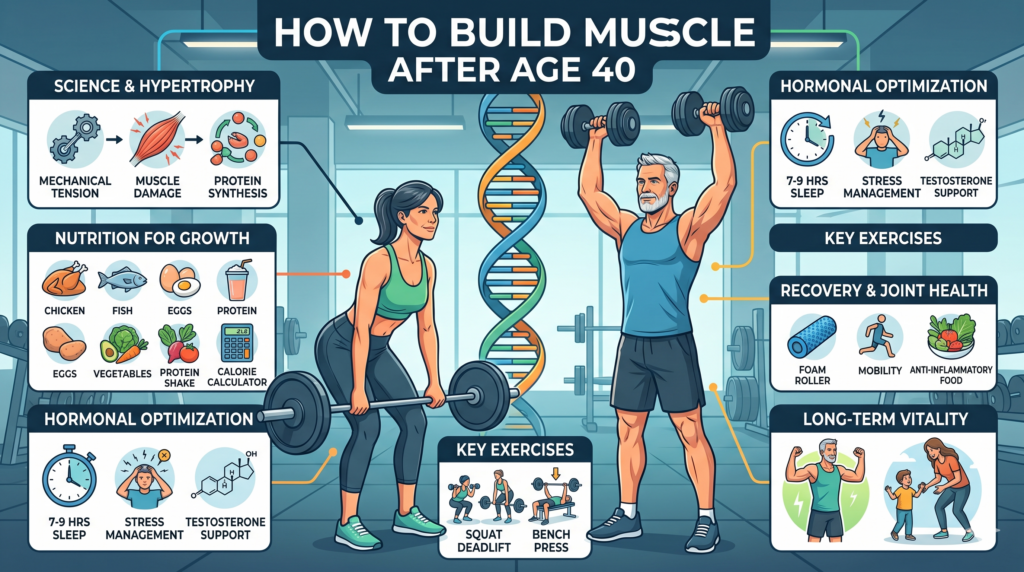
Building muscle after 40 isn’t just possible—it’s essential for maintaining your health, vitality, and quality of life. While your body does experience natural changes as you age, understanding how to work with these changes rather than against them makes all the difference. The journey of learning how to build muscle after age 40 begins with recognizing that your approach needs to be smarter, more strategic, and perhaps even more effective than what worked in your twenties.
Your body’s hormonal profile shifts significantly after crossing the 40-year threshold. Testosterone levels naturally decline by about 1% per year after age 30, growth hormone production slows down, and your metabolic rate begins its gradual descent. But here’s the exciting news: resistance training and proper nutrition can counteract many of these changes. In fact, studies consistently show that people in their 40s, 50s, and beyond can build substantial muscle mass when following appropriate training protocols.
The reality is that muscle building after 40 requires patience, consistency, and a willingness to prioritize recovery just as much as your workouts. You’re not competing with your younger self—you’re optimizing your current self. This mindset shift alone can transform your entire approach to fitness and help you achieve remarkable results that enhance every aspect of your daily life, from playing with your kids to maintaining independence well into your later years.
The Science Behind Muscle Growth at Midlife
When you understand the biological mechanisms of muscle growth, you can make informed decisions about your training program. Muscle hypertrophy—the scientific term for muscle growth—occurs when your muscles experience mechanical tension, metabolic stress, and muscle damage through resistance training. These three factors trigger a cascade of cellular responses that ultimately lead to increased muscle protein synthesis, which is how your body builds new muscle tissue.
After 40, your body becomes slightly less efficient at muscle protein synthesis, meaning you need to be more deliberate about creating the right conditions for growth. Research indicates that older adults require higher protein intake per meal to maximally stimulate muscle protein synthesis compared to younger individuals—a concept known as “anabolic resistance.” This doesn’t mean muscle building is harder; it simply means your nutritional timing and protein quality become increasingly important factors in your success.
Your nervous system also plays a crucial role in how to build muscle after age 40, as strength gains in the initial weeks of training often come from improved neuromuscular efficiency rather than actual muscle growth. This is particularly advantageous for those returning to training after a hiatus, as your body remembers previous adaptations through a phenomenon called “muscle memory.” This cellular memory can help you regain lost muscle faster than you initially built it, giving you a significant advantage if you’ve been active earlier in life.
Hormonal Considerations for Muscle Building
Your endocrine system orchestrates muscle growth through various hormones, with testosterone, growth hormone, and insulin-like growth factor (IGF-1) playing starring roles. While levels of these anabolic hormones naturally decline with age, resistance training itself acts as a powerful stimulus to optimize whatever hormonal environment you currently have. Heavy compound movements like squats and deadlifts can trigger acute increases in these hormones, creating an internal environment conducive to muscle growth.
Sleep quality becomes increasingly important for hormonal optimization after 40, as growth hormone is primarily secreted during deep sleep stages. If you’re chronically sleep-deprived, you’re essentially sabotaging your muscle-building efforts before you even step into the gym. Prioritizing 7-9 hours of quality sleep isn’t optional—it’s a fundamental requirement for anyone serious about building muscle at any age.
Cortisol, your primary stress hormone, deserves special attention when learning how to build muscle after age 40. Chronic elevation of cortisol can directly interfere with muscle protein synthesis and promote muscle breakdown. Managing life stress through meditation, adequate recovery between workouts, and proper nutrition helps keep cortisol in check, allowing your anabolic hormones to work their magic without constant interference.
Creating Your Optimal Training Program
Your training program after 40 should emphasize progressive overload while respecting your body’s increased need for recovery. Progressive overload means gradually increasing the demands on your muscles over time through added weight, more repetitions, additional sets, or decreased rest periods. This principle remains the cornerstone of muscle building regardless of age, but how you implement it requires thoughtful planning and attention to how your body responds.
Compound movements should form the foundation of your program because they recruit multiple muscle groups simultaneously, maximize hormonal response, and provide the most practical strength gains. Exercises like squats, deadlifts, bench presses, rows, and overhead presses deliver exceptional results for the time invested. However, you’ll want to prioritize perfect form and controlled movement over ego-driven weight selection—injuries derail progress far more than using slightly lighter weights ever could.
Training frequency needs careful calibration as you age because recovery capacity typically decreases while recovery time increases. Most people over 40 thrive on training each muscle group 2-3 times per week with at least 48 hours between sessions targeting the same muscles. This might look like a full-body routine three times weekly, an upper/lower split four times per week, or a push/pull/legs arrangement that cycles through every five or six days depending on your schedule and recovery capacity.
Repetition Ranges and Volume
The repetition range you choose significantly impacts your results when figuring out how to build muscle after age 40. While traditional bodybuilding wisdom often emphasized the 8-12 rep range for hypertrophy, research now shows that muscle growth can occur across a broad spectrum from 5-30 reps per set, provided you’re training close to muscular failure. This flexibility allows you to vary your approach based on how your joints feel on any given day.
Lower rep ranges (5-8 reps) with heavier weights build both strength and size but place more stress on your nervous system and joints. Moderate rep ranges (8-15 reps) offer an excellent balance of mechanical tension and metabolic stress with manageable joint strain. Higher rep ranges (15-30 reps) emphasize metabolic stress and pump, often feeling better on aging joints while still triggering muscle growth. Incorporating all three ranges throughout your training week provides comprehensive stimulus while managing fatigue.
Total weekly volume—the number of hard sets per muscle group—matters tremendously for results. Research suggests that most people build muscle optimally with 10-20 hard sets per muscle group per week, with “hard” meaning within 2-3 reps of failure. Starting at the lower end of this range and gradually increasing volume over several months allows your body to adapt without overwhelming your recovery capacity. Remember that more isn’t always better; it’s only better if you can recover from it.
Essential Exercises for Maximum Results
Building your training program around these proven exercises ensures you’re targeting all major muscle groups effectively:
- Squats or leg press: Essential for quadriceps, glutes, and overall lower body development
- Romanian deadlifts or conventional deadlifts: Targets hamstrings, glutes, and entire posterior chain
- Bench press or push-ups: Develops chest, shoulders, and triceps
- Rows (barbell, dumbbell, or cable): Builds back thickness and biceps
- Overhead press: Develops shoulders and upper chest
- Pull-ups or lat pulldowns: Creates back width and arm development
- Lunges or step-ups: Adds unilateral leg strength and stability
- Planks and carries: Builds core strength essential for all other movements
You don’t need to perform all these exercises every session or even every week. Instead, select 4-6 compound movements per workout, ensuring you’re hitting all major movement patterns throughout your training week. This approach provides sufficient stimulus without creating excessive fatigue or turning your workouts into exhausting marathons that you’ll struggle to recover from.
Nutrition Strategies for Muscle Growth
Understanding how to build muscle after age 40 requires recognizing that nutrition might actually be more important than your training program. You can have the perfect workout routine, but without adequate protein, calories, and micronutrients, your body simply won’t have the raw materials needed to build new muscle tissue. Your nutrition strategy should be sustainable, flexible enough to accommodate real life, and structured enough to ensure you’re hitting your targets consistently.
Protein intake becomes increasingly critical as you age due to anabolic resistance—your body’s decreased sensitivity to the muscle-building effects of protein. While younger individuals might build muscle optimally on 0.7-0.8 grams of protein per pound of body weight, those over 40 typically need closer to 1 gram per pound of body weight or even slightly higher. This increased requirement ensures you’re providing enough amino acids to overcome the age-related resistance and maximize muscle protein synthesis.
The timing and distribution of protein throughout the day matters significantly for optimizing muscle growth after 40. Rather than consuming most of your protein in one or two large meals, spreading it across 4-5 meals with 30-40 grams per meal creates multiple opportunities to stimulate muscle protein synthesis. Each protein feeding creates an anabolic window that lasts several hours, and strategically spacing these feedings maintains a nearly constant muscle-building environment throughout your day.
Caloric Requirements and Energy Balance
Building muscle requires a positive energy balance, meaning you need to consume slightly more calories than you burn. The challenge after 40 is that your metabolic rate has likely decreased, making it easier to accidentally overeat and gain excessive fat while trying to build muscle. A modest caloric surplus of 200-300 calories above your maintenance level typically provides sufficient energy for muscle growth without unnecessary fat gain that would later require aggressive cutting phases.
Calculating your maintenance calories involves considering your basal metabolic rate, activity level, and individual metabolic factors. Online calculators provide reasonable starting estimates, but you’ll need to track your weight and strength progress over several weeks to determine your actual needs. If your weight increases too quickly (more than 0.5-1% of body weight weekly), you’re likely in too large a surplus and gaining excessive fat. If you’re not gaining weight at all despite consistent training, you need to increase calories gradually.
Carbohydrates often get unfairly demonized in popular diet culture, but they’re actually your friend when learning how to build muscle after age 40. Carbs fuel intense training sessions, help replenish muscle glycogen, and have a protein-sparing effect that allows dietary protein to be used for muscle building rather than energy production. Most active individuals over 40 should consume 1.5-3 grams of carbohydrates per pound of body weight depending on training volume and intensity.
Micronutrients and Supplements
While protein, carbs, and fats rightfully receive most of the attention, micronutrients play crucial supporting roles in muscle building and recovery. Vitamin D supports testosterone production and muscle function, yet deficiency is widespread, particularly in those living at northern latitudes. Magnesium is involved in over 300 enzymatic reactions including muscle contraction and energy production. Zinc supports immune function and hormone production. A high-quality multivitamin can provide insurance against deficiencies, though whole foods should always be your primary micronutrient source.
Creatine monohydrate stands as one of the most researched and effective supplements for building muscle after 40. It increases your muscles’ phosphocreatine stores, allowing for improved performance during high-intensity exercise and enhanced muscle growth over time. A daily dose of 5 grams taken consistently provides full benefits without requiring loading phases or cycling. Creatine is particularly valuable for aging athletes as it may also offer cognitive and neuroprotective benefits.
Protein supplements like whey protein powder aren’t necessary if you can meet your protein requirements through whole foods, but they offer convenience that shouldn’t be underestimated. When you’re busy juggling work, family, and fitness, having a quick protein shake option ensures you hit your targets even on hectic days. Whey protein is rapidly digested and rich in leucine, the amino acid that most powerfully triggers muscle protein synthesis, making it ideal for post-workout nutrition.
Recovery and Regeneration Priorities
Recovery isn’t what happens between workouts—it’s when the actual muscle building occurs. The weights you lift create the stimulus for growth, but the adaptation happens during rest when your body repairs damaged muscle fibers and builds them back stronger and larger. After 40, your recovery capacity decreases while your recovery needs increase, creating a situation where strategic rest becomes just as important as strategic training.
Sleep quality and quantity directly determine your muscle-building success because growth hormone secretion, protein synthesis, and tissue repair all peak during deep sleep stages. Adults over 40 often experience changes in sleep architecture that reduce deep sleep time, making it even more critical to prioritize sleep hygiene. This means maintaining consistent sleep and wake times, creating a dark and cool sleeping environment, limiting screen time before bed, and potentially addressing sleep disorders like sleep apnea that become more common with age.
Active recovery strategies can enhance your ability to train consistently without accumulation of excessive fatigue. Light cardio like walking or cycling, gentle yoga or stretching sessions, and recreational activities all promote blood flow to recovering muscles while keeping you mobile and active. These sessions shouldn’t be intense enough to require their own recovery—think of them as movement therapy that supports your hard training rather than competing with it.
Managing Inflammation and Joint Health
Chronic inflammation increases with age and can interfere with recovery and muscle building while accelerating joint deterioration. Your nutrition choices significantly impact inflammatory status—diets rich in omega-3 fatty acids, colorful vegetables, fruits, and anti-inflammatory spices like turmeric help control inflammation. Conversely, excessive consumption of processed foods, refined sugars, and omega-6-heavy vegetable oils tends to promote inflammatory states that work against your muscle-building goals.
Joint health becomes increasingly important when learning how to build muscle after age 40 because joint pain or injuries can derail your training consistency. Incorporating exercises that strengthen the stabilizing muscles around major joints, maintaining healthy body composition to reduce load on weight-bearing joints, and ensuring adequate collagen and vitamin C intake all support joint health. Don’t ignore minor aches and pains—address them early through mobility work, exercise modifications, or professional guidance before they become major problems.
Foam rolling and self-myofascial release can improve tissue quality and reduce muscle soreness when incorporated regularly into your routine. Spending 10-15 minutes several times weekly working on tight or tender areas helps maintain mobility and can improve your movement quality during training. While foam rolling won’t directly build muscle, it supports the consistency needed to accumulate enough training volume over months and years to achieve significant results.
Cardiovascular Training Considerations
Cardiovascular exercise plays an important but carefully balanced role in your muscle-building program after 40. While cardio supports heart health, endurance, and overall fitness, excessive amounts can interfere with recovery and potentially limit muscle growth. The key is finding the minimum effective dose that maintains your cardiovascular health without compromising your primary goal of building muscle.
Low-intensity steady-state cardio like walking, easy cycling, or swimming offers the best balance for most people focused on muscle building. These activities promote recovery by increasing blood flow, burn some additional calories without excessive appetite stimulation, and support cardiovascular health without the recovery demands of high-intensity training. Most individuals do well with 2-4 sessions of 20-40 minutes weekly at an easy conversational pace that complements rather than competes with their resistance training.
High-intensity interval training (HIIT) can be incorporated strategically but requires careful management because it’s demanding on your recovery capacity. If you enjoy HIIT or play sports that require interval-based fitness, limit these sessions to 1-2 times weekly on days when you’re not training legs or performing other highly fatiguing resistance work. The cumulative fatigue from combining heavy squats and intense HIIT in the same training block can quickly exceed your recovery capacity and stall muscle-building progress.
Addressing Common Challenges and Obstacles
Time constraints represent one of the biggest barriers to consistent training for busy adults trying to learn how to build muscle after age 40. Between career demands, family responsibilities, and the countless other obligations of midlife, finding time for hour-long gym sessions can feel impossible. The solution lies in efficiency rather than duration—focused 30-45 minute sessions performed 3-4 times weekly can produce excellent results when you eliminate wasted time and prioritize compound movements.
Home training offers a practical solution when getting to the gym regularly isn’t feasible. A basic setup of adjustable dumbbells, a pull-up bar, and a bench provides enough equipment to build substantial muscle. Bodyweight exercises become increasingly effective when you learn to manipulate leverage, tempo, and range of motion to create appropriate challenge levels. The best training program is the one you’ll actually follow consistently, so don’t let lack of gym access become an excuse for inaction.
Previous injuries or movement limitations require creative problem-solving rather than serving as reasons to avoid training altogether. Almost every exercise has multiple variations that train similar movement patterns with different joint angles and loading patterns. If barbell squats bother your knees, try goblet squats, split squats, or leg presses. If overhead pressing causes shoulder discomfort, emphasize horizontal pressing and work on shoulder mobility. A skilled trainer or physical therapist can help you identify appropriate modifications that allow productive training around limitations.
Motivation and Consistency
Maintaining motivation over the months and years required to build significant muscle after 40 demands connecting your training to deeper values beyond aesthetics. While looking better is a perfectly valid goal, linking your muscle-building efforts to being able to play actively with your children or grandchildren, maintaining independence as you age, or simply feeling strong and capable in daily life creates more sustainable motivation than appearance goals alone.
Tracking your progress through multiple metrics helps maintain motivation when the scale isn’t moving as quickly as you’d like. Take regular progress photos, track your strength gains on key exercises, measure body part circumferences, or simply notice how your clothes fit differently. Muscle building after 40 often occurs more slowly than rapid weight loss programs promise, but the changes accumulate impressively over six months to a year when you remain consistent.
Training partners or accountability systems significantly improve adherence to your program. Whether it’s a friend who trains with you, an online community of like-minded individuals, or simply a coach who expects you to check in regularly, external accountability helps you show up even when motivation wanes. Building muscle after 40 isn’t about perfection—it’s about accumulating enough consistent training sessions over time that the results become inevitable.
Adapting Your Approach Over Time
Your muscle-building program shouldn’t remain static indefinitely because both your body and your goals evolve over time. Periodization—systematically varying your training variables—prevents adaptation plateaus, manages fatigue accumulation, and keeps training interesting. This might involve cycling between phases that emphasize different rep ranges, alternating between periods of higher and lower training volume, or rotating exercise selections every few months to provide novel stimulus.
Deload weeks are scheduled periods of reduced training volume or intensity that allow accumulated fatigue to dissipate while maintaining your adaptations. Most people over 40 benefit from taking a deload week every 4-6 weeks where they reduce volume by 40-50% or simply take several days completely off from structured training. These breaks might feel counterproductive, but they’re actually when your body supercompensates and often when you’ll notice new muscle development becoming visible.
Listening to your body becomes increasingly important with age, as pushing through legitimate pain or excessive fatigue leads to injuries that can set you back months. There’s an important distinction between the discomfort of challenging training and the pain that signals actual tissue damage. Learning to recognize this difference allows you to train intensely when appropriate while backing off when necessary, ultimately keeping you training consistently for years rather than cycling through periods of hardcore training followed by forced time off due to injuries.
Long-Term Sustainability
Building muscle after 40 should be viewed as a lifestyle commitment rather than a short-term project with a defined endpoint. The muscle you build through consistent training over years provides protective benefits against age-related muscle loss (sarcopenia), maintains your metabolic rate, supports bone density, and enhances your quality of life in countless ways. The goal isn’t to look like a bodybuilder unless that specifically appeals to you—it’s to carry enough lean muscle mass to stay strong, functional, and independent throughout your entire lifespan.
Your approach to learning how to build muscle after age 40 should allow for life’s inevitable disruptions. Vacations, busy work periods, minor illnesses, and family obligations will occasionally interfere with perfect training consistency. Rather than viewing these as failures, have a plan for minimum effective training during disrupted periods and quickly return to your normal routine when circumstances allow. Progress isn’t linear, but the overall trajectory matters far more than any single week or month.
Creating habits and systems that support your muscle-building goals transforms willpower-dependent actions into automatic behaviors. When training occurs at consistent times, meal preparation follows predictable patterns, and recovery practices become non-negotiable parts of your routine, you’ve transcended motivation and created a sustainable lifestyle. This systematic approach makes building and maintaining muscle after 40 feel less like constant effort and more like simply who you are and what you do.