As you move past 35, your body begins sending different signals than it did in your twenties. You might notice that recovery takes longer after an intense workout, or that old injuries from your high school football days decide to make a surprise comeback. These changes aren’t signs that you should hang up your running shoes or abandon your fitness goals—they’re simply your body’s way of asking you to train smarter, not necessarily harder. The good news is that with the right approach, you can maintain peak performance well into your later years while actually reducing your injury risk.
Your connective tissues, including tendons and ligaments, naturally lose some elasticity as the years pass. This biological reality means that jumping straight into high-intensity activities without proper preparation increases your vulnerability to strains and tears. Additionally, your bone density begins to decrease, particularly for women entering perimenopause and menopause, making stress fractures a more significant concern. Understanding these physiological shifts is the foundation of smart fitness safety tips for older athletes who want to stay active without sidelining themselves with preventable injuries.
Your metabolism also shifts gears as you age, affecting everything from how quickly you process nutrients to how efficiently your body repairs muscle tissue. This doesn’t mean you can’t build strength or improve endurance—countless athletes in their 40s, 50s, and 60s prove otherwise every day. What it does mean is that you need to pay closer attention to recovery protocols, nutritional timing, and the overall stress you’re placing on your system. Think of it as upgrading from a general maintenance plan to a premium service package for a high-performance vehicle that you intend to keep running smoothly for decades.
The Essential Warm-Up: Your Non-Negotiable Foundation
Remember when you could roll out of bed and immediately crush a five-mile run? Those days might be behind you, but that’s actually a blessing in disguise because it forces you to adopt practices that will serve you far better in the long run. A comprehensive warm-up becomes absolutely essential as you age, and this isn’t just about preventing immediate injury—it’s about priming your cardiovascular system, lubricating your joints, and activating your neuromuscular pathways for optimal performance.
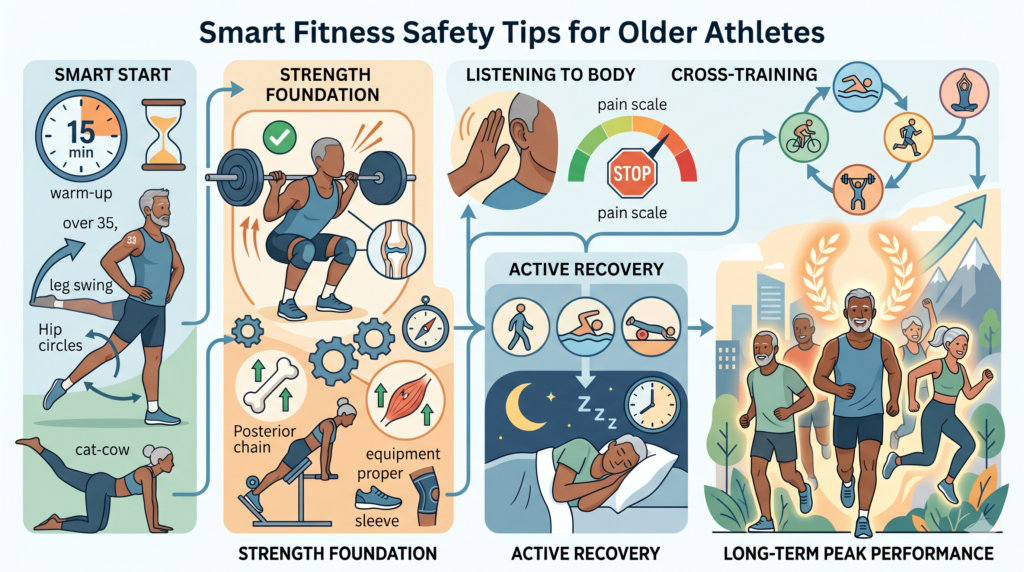
Your warm-up should last at least 10-15 minutes, and longer if you’re tackling a particularly challenging workout. Start with gentle movement that gradually increases your heart rate: walking before jogging, light cycling, or dynamic stretching that takes your joints through their full range of motion. Static stretching—where you hold a position for 30 seconds or more—should be saved for after your workout when your muscles are warm and pliable. During your warm-up, focus on movements that mirror what you’ll be doing during your main workout, but at a much lower intensity.
Pay particular attention to areas that commonly tighten with age: your hips, shoulders, and thoracic spine. Cat-cow stretches, hip circles, arm swings, and gentle torso rotations should all feature in your pre-workout routine. Consider adding activation exercises for your glutes and core, as these stabilizing muscles often become dormant from too much sitting, leaving you vulnerable to compensatory movement patterns that lead to injury. These smart fitness safety tips for older athletes might add time to your workout, but they’ll subtract countless hours you’d otherwise spend in physical therapy.
Strength Training: The Foundation of Injury Prevention
If you’re still operating under the outdated belief that cardio is king and strength training is optional, it’s time for a major mindset shift. Resistance training becomes increasingly critical as you age because it’s the most effective way to combat muscle loss, maintain bone density, and protect your joints from the wear and tear of athletic activities. You don’t need to become a powerlifter, but you absolutely need to incorporate regular strength work into your weekly routine.
Aim for at least two to three strength training sessions per week, focusing on compound movements that engage multiple muscle groups simultaneously. Squats, deadlifts, rows, presses, and lunges should form the backbone of your program, as these functional movements translate directly to improved athletic performance and everyday activities. Start with lighter weights than you think you need, focusing obsessively on perfect form before gradually increasing the load. Your ego might want you to lift what you lifted a decade ago, but your joints will thank you for checking that impulse at the door.
Don’t neglect your posterior chain—the muscles along the back of your body from your calves to your upper back. These muscles are often undertrained in modern athletes who spend too much time in forward-flexion positions, whether sitting at a desk or hunched over a bike. Romanian deadlifts, glute bridges, face pulls, and back extensions will help balance out anterior dominance and reduce your risk of common overuse injuries. Remember that strength training isn’t just about building muscle; it’s about creating a resilient, balanced body that can handle whatever athletic challenges you throw at it.
Recovery: The Secret Weapon You’re Probably Ignoring
Here’s a truth that many older athletes learn the hard way: recovery is where the magic happens. You don’t get stronger during your workout—you get stronger during the rest period that follows when your body repairs and adapts to the stress you’ve placed on it. As you age, this recovery process takes longer, and ignoring this reality is one of the fastest paths to burnout, overtraining, and injury.
Sleep is your most powerful recovery tool, yet it’s often the first thing to get sacrificed in a busy schedule. Prioritize getting 7-9 hours of quality sleep each night, and understand that this isn’t laziness—it’s essential athletic training. During deep sleep, your body releases growth hormone, repairs tissue damage, consolidates motor learning, and regulates the hormones that control appetite and metabolism. If you’re consistently sleeping less than seven hours, you’re essentially trying to build a house while someone keeps removing the bricks.
Active recovery days are just as important as rest days. This might include gentle yoga, swimming, walking, or easy cycling at a pace where you could comfortably hold a conversation. These activities increase blood flow to sore muscles without adding significant stress, helping to clear metabolic waste products and deliver nutrients needed for repair. Foam rolling, massage, and stretching also support recovery, though they shouldn’t replace proper rest. One of the most valuable smart fitness safety tips for older athletes is learning to distinguish between being lazy and being strategic about recovery—they’re completely different things.
Listen to Your Body: Understanding Pain Signals
There’s a pervasive myth in athletic culture that pain is just weakness leaving the body, but this dangerous oversimplification has sidelined countless athletes who ignored important warning signals. As an older athlete, developing sophisticated body awareness is crucial for long-term success. You need to understand the difference between productive discomfort—like muscle fatigue during a challenging workout—and pain that signals potential injury.
Sharp, stabbing, or sudden pain should always stop you in your tracks. This type of pain indicates that something is wrong, not that you need to tough it out. Similarly, pain that persists after you stop exercising, that wakes you up at night, or that gets progressively worse over several workouts deserves immediate attention. Many overuse injuries start with whispers before they become screams, and catching problems early can mean the difference between taking a few days off and facing months of rehabilitation.
Muscle soreness that appears 24-48 hours after a workout—known as delayed onset muscle soreness or DOMS—is normal and not a cause for concern. This sensation should be symmetrical (affecting both legs or both arms equally) and should gradually improve over a few days. However, if you experience pain that’s localized to one side, that’s accompanied by swelling or significant loss of range of motion, or that doesn’t improve with rest, you need to investigate further. Learning these distinctions is one of the most important smart fitness safety tips for older athletes because it empowers you to make informed decisions about when to push through and when to back off.
Cross-Training: Your Insurance Policy Against Injury
Single-sport specialization might work for elite athletes in their twenties, but for older athletes, it’s a recipe for overuse injuries and burnout. Cross-training—incorporating multiple types of athletic activities into your routine—distributes stress across different muscle groups, movement patterns, and energy systems. This approach not only reduces injury risk but also tends to keep training more mentally engaging and fun.
If you’re primarily a runner, add swimming or cycling to give your joints a break from impact forces while maintaining cardiovascular fitness. If you’re a cyclist, incorporate running or hiking to load your bones differently and engage stabilizing muscles that don’t get much attention in the saddle. Strength training, as mentioned earlier, should be a non-negotiable component regardless of your primary sport. Yoga or Pilates can complement any athletic pursuit by improving flexibility, balance, and body awareness.
The beauty of cross-training is that it allows you to maintain fitness even when one type of activity needs to be temporarily reduced. If you’re dealing with a minor knee issue that makes running uncomfortable, you can emphasize swimming and upper-body strength work while the knee heals. This approach prevents the all-or-nothing mentality that leads many athletes to either push through pain or completely stop training. Versatility is a cornerstone of smart fitness safety tips for older athletes who want to stay active year-round without accumulating the repetitive stress that comes from doing the same movements day after day.
Proper Equipment and Environment Considerations
Your 35-year-old feet, knees, and hips will not forgive you for running 500 miles in worn-out shoes the way your 25-year-old body might have. Equipment maintenance and replacement becomes more critical as you age because your body has less resilience to compensate for poor support or inadequate cushioning. Track the mileage on your running shoes and replace them every 300-500 miles, or sooner if you notice the midsole feels compressed or the tread is significantly worn.
Beyond footwear, consider whether your other equipment is serving you well. That bike you’ve been riding for 15 years might no longer be the right fit for your current body mechanics. A professional bike fitting can prevent numbness, back pain, and repetitive stress injuries. If you’re swimming, having goggles that actually seal properly and don’t leak can make the difference between enjoying your workout and dealing with irritated eyes that cut your session short. Quality equipment isn’t about status—it’s about setting yourself up for sustainable, comfortable training.
Environmental factors also play a bigger role as you age. Your thermoregulation system becomes less efficient, making you more vulnerable to both heat illness and hypothermia. When training in hot weather, schedule workouts for early morning or evening, wear light-colored and moisture-wicking clothing, and hydrate proactively rather than waiting until you feel thirsty. In cold weather, dress in layers that you can remove as you warm up, and pay special attention to protecting your extremities. If air quality is poor due to wildfire smoke or high pollution, consider moving your workout indoors rather than stressing your respiratory system unnecessarily.
Nutrition Timing and Hydration Strategies
What you eat and when you eat it has always mattered for athletic performance, but as you age, these factors become even more influential. Your body’s ability to synthesize protein decreases somewhat with age, meaning you need to be more strategic about protein intake to maintain and build muscle mass. Aim for 20-40 grams of high-quality protein within an hour or two after strength training sessions, when your muscles are primed to utilize amino acids for repair and growth.
Don’t fall into the trap of under-fueling your workouts in an attempt to lose weight. Older athletes who consistently train in a significant caloric deficit put themselves at risk for numerous problems: compromised immune function, hormonal imbalances, poor recovery, and increased injury susceptibility. You need adequate fuel to support both your training and your recovery. Focus on whole foods that provide a balance of complex carbohydrates, lean proteins, and healthy fats, along with plenty of colorful vegetables that deliver the micronutrients your body needs for countless physiological processes.
Hydration deserves special attention because your thirst mechanism becomes less reliable with age, meaning you might be dehydrated before you feel thirsty. Monitor your urine color—it should be pale yellow, not dark amber or colorless. Weigh yourself before and after long or intense workouts to gauge fluid loss, and aim to replace approximately 150% of what you lost (since you’ll continue losing fluid through respiration and sweating even after you stop exercising). Don’t forget that hydration isn’t just about water; you also need to replace electrolytes, particularly sodium, after prolonged exercise.
The Role of Flexibility and Mobility Work
Flexibility and mobility are related but distinct qualities, and both decline with age unless you actively work to maintain them. Flexibility refers to the length of your muscles and the range of motion at a joint, while mobility encompasses flexibility plus the strength and control to move through that range. Simply being able to passively stretch into a position isn’t enough—you need the muscular control to access that position during dynamic movement.
Dedicate at least 10-15 minutes after each workout to static stretching, holding each position for 30-60 seconds. Focus on areas that tend to tighten: hip flexors, hamstrings, calves, chest, and shoulders. Don’t bounce or force the stretch; instead, breathe deeply and allow your muscles to gradually release. This post-workout stretching session is also an excellent time for meditation or mental decompression, serving double duty for both physical and mental recovery.
Mobility work should be incorporated daily, not just on workout days. Simple routines like the “World’s Greatest Stretch,” hip 90/90 transitions, thoracic spine rotations, and ankle circles can be done while watching TV or during work breaks. These movements keep your joints healthy and your movement patterns functional, reducing the likelihood that you’ll move poorly during athletic activities and set yourself up for injury. Including comprehensive flexibility and mobility work in your routine represents some of the most accessible and effective smart fitness safety tips for older athletes who want to maintain athletic function as they age.
Progressive Overload: The Safe Path to Improvement
You want to get stronger, faster, or more capable, but attempting to make dramatic leaps in performance is how older athletes land themselves on the injured list. Progressive overload—the principle of gradually increasing the stress placed on your body—is your roadmap to improvement without injury. This might mean adding just 5-10% to your weekly mileage, increasing weight by only five pounds, or adding one additional rep per set before moving up in resistance.
The “10% rule” is a useful guideline for endurance training: don’t increase your weekly volume by more than 10% from one week to the next. Some weeks you might not increase at all, instead holding steady to allow your body to consolidate adaptations. Every fourth or fifth week, consider a “deload” week where you reduce volume by 30-50% to give your system a chance to fully recover and supercompensate. This wave-like approach to training—periods of stress followed by periods of recovery—is far more effective than constantly pushing forward without respite.
Track your training in a log or app so you can see patterns over time. This documentation helps you identify what’s working, recognize when you might be overreaching, and provides valuable information if you do get injured. Include not just what you did (distance, weight, reps) but also how you felt, any unusual aches, your sleep quality, and your stress levels. Over time, you’ll notice patterns that help you fine-tune your training for optimal results. Patience and consistency beat aggressive programming every time, especially for older athletes who need to balance athletic ambitions with long-term joint and tissue health.
Working with Healthcare and Fitness Professionals
There’s enormous value in developing relationships with professionals who can help you navigate the challenges of training as an older athlete. A good sports medicine physician, physical therapist, or athletic trainer can identify potential problems before they become significant injuries and provide guidance on managing minor issues before they force you to stop training completely. Don’t wait until you’re seriously hurt to establish these relationships—the best time to find these professionals is when you don’t desperately need them.
Consider working with a qualified coach or trainer who has experience with your age demographic and your specific sport or fitness goals. A good coach will program progressive, periodized training that pushes you appropriately while building in adequate recovery. They’ll also provide an external perspective that can be invaluable when your own judgment might be clouded by enthusiasm, frustration, or competitive drive. Yes, coaching involves an investment of money, but it’s modest compared to the cost of repeated injuries or months of lost training time.
Massage therapists, chiropractors, and other bodywork professionals can also be valuable members of your support team. Regular massage can identify areas of excessive tension before they lead to injury and can accelerate recovery by improving circulation and breaking up adhesions. Think of professional support not as a luxury but as essential maintenance for an athlete who’s serious about long-term performance. These relationships are integral to smart fitness safety tips for older athletes because they provide expert guidance tailored to your specific body and goals rather than relying on generic advice from internet searches.
Mental Approach and Managing Expectations
Perhaps the most challenging adjustment for older athletes is mental rather than physical. You need to compete against your current self rather than your 25-year-old self, and this recalibration can be difficult for people who derive significant identity and self-worth from athletic performance. Setting process goals (consistency, technique improvement, injury-free training) rather than solely outcome goals (specific times or distances) tends to be more sustainable and psychologically healthy.
Understand that progress won’t be linear, and that’s okay. Some weeks will feel strong; others will feel like you’re moving through mud. Hormonal fluctuations, work stress, sleep quality, and dozens of other factors influence how you feel on any given day. Learning to adjust your training based on how you feel rather than rigidly following a predetermined plan is a sophisticated skill that serves older athletes well. Sometimes the smartest thing you can do is cut a workout short or substitute an easy session for a hard one when your body is sending clear signals that it needs more recovery.
Celebrate what your body can still do rather than mourning what it can’t do anymore. The fact that you’re still out there training, competing, and improving in your 40s, 50s, or beyond puts you in an impressive minority. Reframe challenges as opportunities to become a smarter, more strategic athlete rather than viewing them as limitations. The mental resilience you develop by learning to train intelligently through various life stages will serve you well beyond athletics, influencing how you approach challenges in other areas of your life. This mindset adjustment is perhaps the most important of all smart fitness safety tips for older athletes because it determines whether you’ll still be active and enjoying movement in another decade or will have burned out from constantly fighting against biological realities.