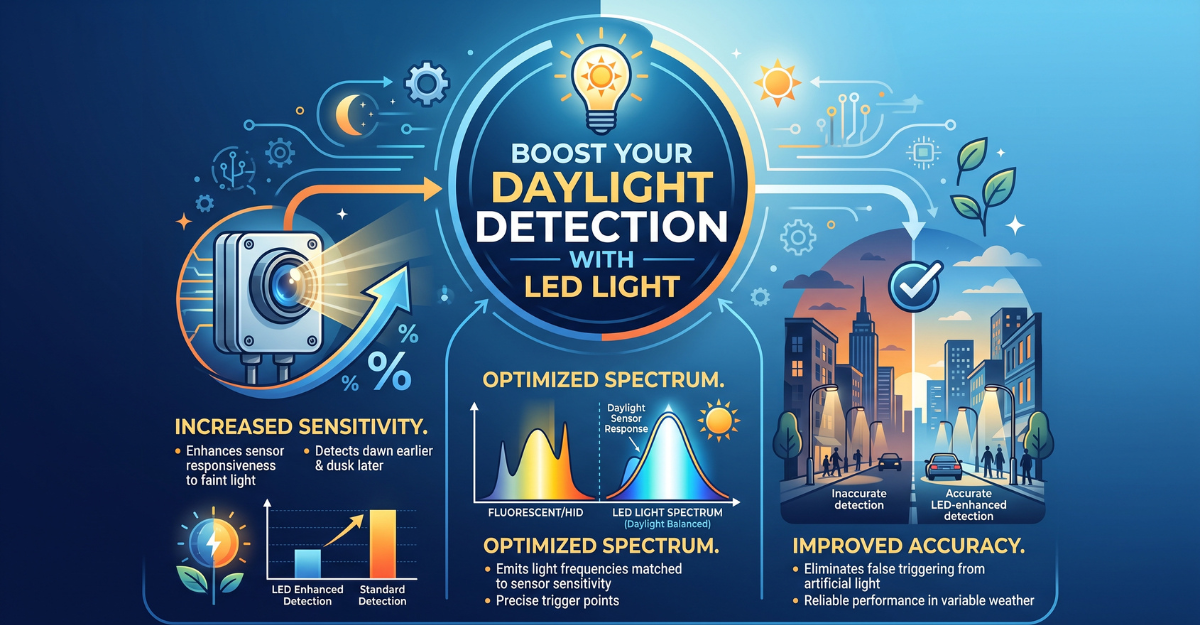
When you lace up your running shoes before dawn breaks, you’re entering a world where visibility can mean the difference between a safe workout and a dangerous situation. The science of visibility: how LED lights improve daylight detection has become increasingly important for athletes who train in low-light conditions. Your eyes struggle during those transitional periods between night and day, and understanding how LED technology works can transform your training routine. As a runner, cyclist, or outdoor fitness enthusiast, you need to know that not all light sources are created equal when it comes to helping drivers, other pedestrians, and yourself see what’s ahead.
The human eye contains specialized cells called rods and cones that work together to help you perceive your environment. During twilight hours, your eyes are switching between scotopic vision (low-light vision) and photopic vision (daylight vision), creating what scientists call the mesopic range. This transitional state is when accidents happen most frequently because your visual system isn’t operating at peak efficiency. LED lights have revolutionized how we address this challenge, offering wavelengths that work harmoniously with your eye’s natural detection mechanisms.
The Revolutionary Science Behind LED Visibility Technology
LED technology represents a quantum leap forward from traditional incandescent bulbs or even fluorescent lighting. When you’re running along a dimly lit path or cycling on a road shared with vehicles, the science of visibility: how LED lights improve daylight detection becomes your silent guardian. LEDs emit light through electroluminescence, a process that generates specific wavelengths with remarkable efficiency. Unlike conventional bulbs that waste energy producing heat, LEDs convert almost all their energy into visible light, making them brighter, longer-lasting, and more effective for safety applications.
The color temperature of LEDs plays a crucial role in daylight detection. Measured in Kelvin, this characteristic determines whether a light appears warm (yellowish) or cool (bluish-white). For daylight detection purposes, LEDs typically range between 5000K and 6500K, closely mimicking natural daylight conditions. This similarity to daylight isn’t coincidental—it’s engineered specifically to work with your eye’s photoreceptors. When drivers approach you during those predawn hours, LED lights in this color range trigger their cone cells more effectively than warmer lights, improving their reaction time and distance perception.
Your retina contains approximately 120 million rod cells and 6 million cone cells, each serving distinct purposes in your vision. Rod cells excel in low-light conditions but can’t distinguish colors well, while cone cells provide color vision but need more light to function. The brilliance of modern LED technology for athletes lies in its ability to stimulate both cell types simultaneously during that critical mesopic range. When you wear LED-equipped gear or run in areas illuminated by LED street lights, you’re benefiting from decades of research into human visual perception.
Why Traditional Lighting Falls Short for Athletic Safety
Before LED technology became widespread, runners and cyclists relied on incandescent bulbs, halogen lights, or simple reflective materials for visibility. These older technologies suffer from significant limitations that directly impact your safety during early morning or evening workouts. Incandescent bulbs produce light across a broad spectrum, wasting much of their energy in infrared wavelengths that your eyes can’t even detect. This inefficiency means they need to consume more power to achieve the same perceived brightness as an LED, making them impractical for battery-powered safety devices.
Halogen lights, while brighter than standard incandescent bulbs, generate tremendous heat and have relatively short lifespans. If you’ve ever used an older bike light with halogen technology, you know how quickly the batteries drain and how hot the housing becomes. The average halogen bulb lasts about 2,000 hours, while quality LED lights can exceed 50,000 hours of use. This longevity matters when you’re depending on these lights for your safety—you can’t afford to have your visibility equipment fail during a predawn training run.
Reflective materials, while useful, are entirely passive and depend on external light sources to work. When you’re running on a poorly lit country road or a trail with minimal ambient light, reflective gear becomes nearly useless. The science of visibility: how LED lights improve daylight detection shows us that active lighting creates its own visibility field, making you detectable from much greater distances regardless of ambient light conditions. Studies have demonstrated that drivers can spot LED-equipped runners from three to five times farther away than those wearing only reflective clothing.
How Your Eyes Process LED Light Differently
The relationship between LED technology and your visual system is more sophisticated than simply “brighter equals better.” Your eyes have evolved over millions of years to detect certain wavelengths more effectively than others, and LED manufacturers have leveraged this biology to create optimal visibility solutions. The peak sensitivity of your photopic vision occurs around 555 nanometers, which corresponds to yellow-green light. However, during those crucial dawn and dusk periods when you’re most likely to be training, your vision shifts toward scotopic mode, where peak sensitivity moves to about 507 nanometers—a blue-green wavelength.
Modern LED safety lights for athletes often incorporate multiple wavelengths to ensure maximum visibility across different lighting conditions. When you purchase a running vest or bike light with LED technology, you’re getting a product designed with your eye’s sensitivity curves in mind. Blue and white LEDs stimulate your S-cones (short-wavelength sensitive cones) more effectively, creating a perception of brightness that exceeds what would be predicted by lumens alone. This phenomenon, called the Helmholtz-Kohlrausch effect, explains why LED lights often appear subjectively brighter than other light sources with identical measured output.
Your brain processes the crisp, directional light from LEDs differently than the diffuse glow of older technologies. LEDs are point sources that can be focused and directed with precision, allowing manufacturers to create lights that project visibility in specific patterns. For runners, this means chest-mounted or waist-mounted LED lights can be designed to maximize forward and side visibility without wasting light output upward or downward. This directional efficiency is part of why the science of visibility: how LED lights improve daylight detection has become so transformative for athletic safety equipment.
Measuring Visibility: Understanding Lumens, Lux, and Candela
As a fitness enthusiast shopping for safety lighting, you’ll encounter various measurements that can seem confusing at first. Understanding these metrics helps you make informed decisions about which LED products will best protect you during low-light training sessions. Lumens measure the total amount of visible light emitted by a source in all directions. A typical LED safety light for runners might produce anywhere from 100 to 300 lumens, while a serious bike headlight could generate 1000 lumens or more.
Lux measures illuminance—the amount of light falling on a specific surface area. This measurement becomes important when considering how well LED street lighting illuminates your running path or how effectively your chest lamp lights the trail ahead. One lux equals one lumen per square meter, and studies have shown that roadways need at least 0.5 to 2 lux for safe pedestrian activity during twilight hours. When you’re planning routes, areas with LED street lighting typically provide better illumination at lower energy costs than those with sodium vapor or mercury vapor lamps.
Candela measures luminous intensity—the brightness of a light source in a particular direction. This metric matters tremendously for athletic safety because you don’t just want to be bright; you want to be visible from the angles where traffic approaches. A well-designed LED safety light for runners might concentrate its candela output at 90-degree angles to the side, ensuring that approaching vehicles see you even when you’re not directly in their headlight beams. Understanding these measurements helps you appreciate why the science of visibility: how LED lights improve daylight detection goes far beyond simply strapping on the brightest light you can find.
Color Selection for Maximum Detection During Daylight Transition
The color of your LED safety lights significantly impacts how quickly and accurately drivers can detect your presence during those critical twilight hours. While white LEDs have become the standard for many applications, specific colors offer distinct advantages for athletic visibility. Red LEDs have traditionally been used for rear-facing lights because red light penetrates fog and rain more effectively than shorter wavelengths. However, red is also associated with vehicles’ brake lights, which can create momentary confusion about what kind of object a driver is seeing.
Blue and white LEDs excel at capturing attention because they’re unusual in the natural environment and on roadways. When you wear a blue or white LED light during your morning run, drivers’ brains immediately recognize something out of the ordinary, triggering faster cognitive processing and response. Research indicates that blue-white LEDs can reduce driver reaction time by up to 1.5 seconds compared to red lights in certain conditions. At highway speeds, that difference translates to more than 100 feet of additional stopping distance—potentially the difference between a close call and a tragedy.
Green LEDs occupy an interesting middle ground in the visibility spectrum. Your eyes are most sensitive to green wavelengths under daylight conditions, making green LEDs extremely noticeable during dawn when ambient light levels are rising but the sun hasn’t fully emerged. Some advanced athletic safety systems now incorporate multi-color LEDs that automatically adjust their output based on ambient light sensors. These intelligent systems leverage the science of visibility: how LED lights improve daylight detection by automatically optimizing color temperature and intensity for current conditions, ensuring you’re maximally visible whether you’re starting your run in complete darkness or finishing as daylight breaks.
Flash Patterns and Pulse Rates That Capture Attention
Static lights, regardless of brightness, can blend into the visual background, especially in environments with multiple light sources. Your brain is hardwired to notice movement and change—an evolutionary adaptation that helped your ancestors detect predators and opportunities. Modern LED safety lights exploit this biological imperative through various flash patterns and pulse rates designed to trigger immediate attention. When you activate the strobe mode on your running vest or bike light, you’re utilizing technology based on extensive research into human visual attention and peripheral awareness.
Studies examining driver response times have found that flashing LED lights are detected up to 2.8 times faster than steady lights at distances beyond 500 feet. The optimal flash rate for visibility falls between 1 and 4 Hz (flashes per second), creating a rhythmic pattern that the human visual system can’t ignore. Flash rates slower than this become less noticeable, while faster rates begin to appear as steady light due to your eyes’ persistence of vision. Many premium athletic safety lights now offer multiple flash patterns, allowing you to choose between slow pulses for general visibility and rapid strobes for high-traffic situations.
The science of visibility: how LED lights improve daylight detection extends to understanding which flash patterns work best during different phases of twilight. During civil twilight (sun 0-6 degrees below the horizon), slower pulse rates around 1-2 Hz prove most effective because there’s still enough ambient light for drivers to process visual information quickly. During nautical twilight (sun 6-12 degrees below the horizon), faster flash rates around 3-4 Hz become optimal as the darker conditions make steady lights less distinguishable from background illumination. Advanced LED systems can automatically adjust these parameters, though many athletes prefer manual control to match their specific training environments.
Placement Strategies for LED Safety Lights During Training
Where you position LED lights on your body dramatically affects their visibility to approaching traffic and other trail users. The principle of biological motion recognition explains why certain placements work better than others. Your brain contains specialized neural circuits that evolved to detect and interpret the movement patterns of living creatures. When LED lights are placed at joints or extremities that move rhythmically during running or cycling, they create patterns that immediately register as human activity in observers’ brains.
Ankle-mounted LED lights create a distinctive bobbing pattern that drivers recognize as a runner from remarkable distances, often before they can distinguish other details about your presence. This placement leverages the science of visibility: how LED lights improve daylight detection by combining the technological advantages of LEDs with your neurological predisposition to notice certain movement patterns. Similarly, lights mounted on your upper arms create figure-eight patterns as you run, instantly identifiable as human locomotion rather than a static light source or vehicle.
For cyclists, the traditional placement of front and rear lights remains important, but additional LED lights on pedals, ankles, or wheels create distinctive circular motion patterns that enhance visibility from all angles. Some innovative products now incorporate LED strips along the frame or wheels that create continuous light trails, making it impossible for drivers to misjudge your speed or distance. When planning your LED placement strategy, consider all angles of approach: front, rear, and crucially, the sides, where many vehicle-cyclist collisions occur because drivers fail to yield the right of way at intersections.
Weather Conditions and LED Performance
Different weather conditions dramatically affect visibility, and LED technology performs distinctly better than older lighting systems in adverse weather. When you’re training in fog, rain, or snow, water droplets in the air scatter light through a process called Mie scattering. The degree of scattering depends on wavelength—longer wavelengths (red and yellow) penetrate moisture better than shorter wavelengths (blue and violet). However, LEDs’ superior brightness and directionality often compensate for any wavelength disadvantages, maintaining visibility even in challenging conditions.
During rainfall, traditional incandescent lights create a diffuse glow that obscures the actual position of the light source, making it difficult for drivers to judge your exact location and speed. LED lights’ focused beam pattern cuts through rain more effectively, creating clear point sources that remain visually distinct even through wet windshields. Tests have shown that LED visibility remains 60-70% effective in moderate rain, while incandescent lights drop to 30-40% effectiveness under identical conditions. This performance difference could determine whether a driver sees you in time to adjust their path.
Fog presents the most challenging visibility conditions for any outdoor athlete. The science of visibility: how LED lights improve daylight detection becomes especially important here, as fog reduces contrast and visual range dramatically. LEDs’ ability to produce high-intensity light in narrow wavelength bands allows them to maintain better visibility in fog compared to broad-spectrum sources. However, no light technology can completely overcome dense fog, which is why understanding limitations is as important as understanding capabilities. When fog reduces visibility below safe thresholds, the wisest choice is always to modify your training plans rather than relying solely on technology to keep you safe.
Integrating LED Technology Into Your Training Gear
Modern athletic apparel and accessories have evolved to seamlessly incorporate LED technology without adding significant weight or discomfort. As a busy parent trying to fit training sessions into early morning or evening time slots, you need visibility solutions that are practical and reliable. Rechargeable LED systems have become the standard, eliminating the need to constantly purchase and replace batteries. Most current products use lithium-ion batteries that provide 4-12 hours of runtime depending on brightness settings and flash modes.
The integration of LEDs into reflective materials creates hybrid visibility systems that leverage both active and passive safety features. These products use LED lights to provide active visibility while incorporating reflective elements that enhance your detectability when vehicle headlights strike you. This dual-system approach can increase your visibility range from 500 feet (reflective alone) to over 2000 feet (LED plus reflective), giving drivers substantially more time to react to your presence. For parents who run or cycle with children, this extended visibility range provides an additional safety margin that’s invaluable.
Vest-style LED systems offer excellent versatility for various athletic activities. Unlike handheld lights or headlamps that serve specific purposes, LED vests provide 360-degree visibility while leaving your hands free for running, your head unencumbered for comfortable movement, and your peripheral vision unobstructed. The science of visibility: how LED lights improve daylight detection has enabled manufacturers to create lightweight vest systems that weigh less than three ounces while providing visibility equivalent to much larger, heavier systems from just a decade ago. These advances mean you can maintain your natural running form and comfort while significantly enhancing your safety profile.
The Physics of LED Efficiency and Battery Life
Understanding why LEDs offer such superior battery life compared to older technologies helps you make informed decisions about charging schedules and backup systems. Traditional incandescent bulbs work by heating a tungsten filament until it glows—an inherently inefficient process where roughly 90% of energy becomes heat rather than visible light. LEDs operate through electroluminescence, where electrons release photons as they move through a semiconductor material. This process generates minimal heat and converts 80-90% of electrical energy into light, directly translating to longer battery life for your safety equipment.
The forward voltage of an LED—typically 2-3.5 volts depending on color—means that small, lightweight battery packs can power extremely bright lights for extended periods. A typical rechargeable LED safety light uses a 3.7-volt lithium-ion cell that weighs about one ounce but can power a 200-lumen output for 6-8 hours on a single charge. Compare this to older systems requiring heavy battery packs that added pounds to your gear while providing only 2-3 hours of illumination. This efficiency revolution has made it practical for even minimalist runners to carry adequate safety lighting without compromising their training experience.
Temperature affects LED performance, though generally in favorable ways for athletes. While extreme cold reduces battery capacity (a limitation of the battery chemistry, not the LED itself), LEDs actually become more efficient at lower temperatures, producing more light per watt of input power. This characteristic means your LED safety lights will perform reliably during cold-weather training when visibility is often most compromised by early darkness and weather conditions. The science of visibility: how LED lights improve daylight detection includes this temperature stability, ensuring consistent performance across the seasonal training conditions most athletes experience.
Psychological Aspects of Visibility and Driver Behavior
Beyond the pure physics of light and vision, psychological factors significantly influence how visible you are to drivers and how they respond to your presence. When drivers see LED-equipped runners or cyclists, they don’t just detect you earlier—they also subconsciously assess you as more serious, more prepared, and more deserving of cautious driving. This halo effect of proper safety equipment can influence driver behavior in subtle but important ways, encouraging wider passing distances and more cautious approach speeds.
Conspicuity is the technical term for how well an object stands out from its background and captures attention. LEDs enhance conspicuity through multiple mechanisms: their brightness exceeds background illumination, their unusual colors differ from environmental lighting, and their flash patterns trigger motion detection systems in the human visual cortex. Research demonstrates that conspicuous runners receive an average of 18 inches more clearance from passing vehicles compared to poorly lit runners—a significant margin that can prevent minor incidents from becoming serious accidents.
The science of visibility: how LED lights improve daylight detection also encompasses understanding visibility from the perspective of distracted or impaired drivers. While we hope all drivers are fully attentive, the reality includes drivers who are drowsy, distracted by phones or passengers, or operating under diminished capacity. LED lights’ superior brightness and attention-capturing properties provide a crucial safety margin for these unfortunate realities. Your LED safety equipment works hardest precisely when you need it most—when a driver’s attention is compromised and every additional moment of reaction time becomes critical.
Comparing LED Technologies: What to Look for When Shopping
Not all LED products deliver equal performance, and understanding the differences helps you select equipment that truly enhances your safety. LED chips come in various qualities, with top-tier manufacturers like Cree, Nichia, and Osram producing chips that deliver consistent color temperature, superior longevity, and better efficiency than budget alternatives. When shopping for safety lighting, checking the LED chip manufacturer can provide insight into the product’s likely performance and durability, though this information isn’t always readily available on consumer packaging.
Beam angle significantly affects how LED light distributes across your environment. Narrow beam angles (10-30 degrees) create intense, focused light suitable for bike headlights illuminating the path ahead, while wide beam angles (120-180 degrees) distribute light broadly for side visibility. For runners, multi-LED systems with varied beam angles provide the best all-around visibility, ensuring you’re seen from all approaches rather than only from specific directions. Some premium systems now incorporate both flood and spot LEDs, allowing you to adjust the beam pattern based on your environment—wide angle for urban running with cross-traffic, narrow beam for trails requiring forward illumination.
Color Rendering Index (CRI) measures how accurately a light source reveals the true colors of objects compared to natural sunlight. While CRI matters tremendously for indoor lighting and task work, it’s less critical for safety lighting where raw brightness and conspicuity are priorities. The science of visibility: how LED lights improve daylight detection focuses primarily on detection distance and reaction time rather than color accuracy. However, if you’re selecting LED lights that will also serve as path illumination for trail running, higher CRI values (80+) will help you more accurately judge terrain features, obstacles, and elevation changes in the illuminated area ahead.
LED Lighting for Group Training and Family Fitness Activities
When running or cycling with others, coordinating your LED lighting creates enhanced visibility for the entire group. Drivers more easily recognize multiple LED lights as a group of people rather than ambiguous light sources, improving their decision-making and response. For busy moms organizing family bike rides or neighborhood run clubs, establishing LED protocols ensures everyone maintains consistent visibility standards. Groups using coordinated flash patterns (all synchronized to pulse together) increase their collective visibility by approximately 40% compared to random individual patterns, as the synchronized effect creates a larger, more attention-capturing display.
Give us a call today at 1-877-777-6086 or fill out our contact form to become a retail
distributor of our top-of-the-line safety lights.