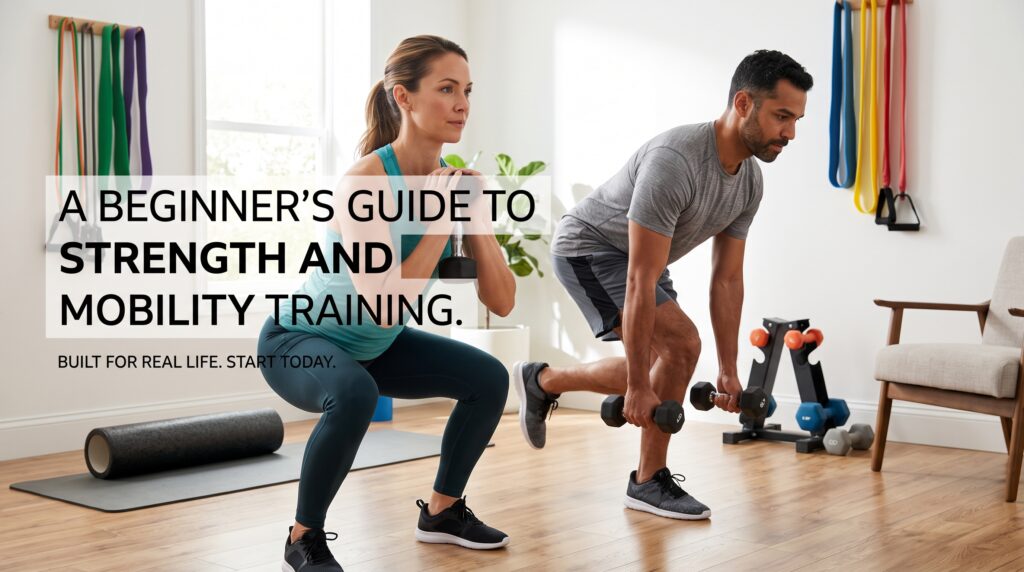
You’ve probably heard countless times that exercise is important, but when you’re juggling work deadlines, family responsibilities, and trying to squeeze in time for yourself, the thought of adding another complex workout routine can feel overwhelming. Here’s the truth: a beginner’s guide to strength and mobility training doesn’t have to be complicated, and the benefits you’ll experience are worth every minute you invest. Whether you’re a parent chasing after energetic kids, an athlete looking to enhance performance, or someone who’s been sitting at a desk for too long, understanding how strength and mobility work together is the foundation for a healthier, more functional body.
Strength training isn’t just about bulking up or looking good in a swimsuit—it’s about building the muscular foundation that supports every movement you make throughout your day. When you lift groceries, carry your toddler, move furniture, or simply get up from a chair, you’re relying on strength. Mobility, on the other hand, is your body’s ability to move through a full range of motion with control and without pain. Together, these two components create a powerhouse combination that can transform how you feel and move every single day.
The beauty of this beginner’s guide to strength and mobility training is that you don’t need expensive equipment or hours of free time to get started. You just need commitment, consistency, and a willingness to learn proper techniques that will serve your body for decades to come. What you’re about to discover will change not only how you exercise but how you approach your overall wellness journey.
The Science Behind Building Stronger, More Mobile Bodies
Your muscles, tendons, ligaments, and joints form an interconnected system that thrives on movement and appropriate stress. When you engage in strength training, you’re creating microscopic tears in muscle fibers that, when properly recovered, grow back stronger and more resilient. This process, called muscle protein synthesis, is your body’s natural adaptation mechanism. The fascinating part is that this doesn’t just make you stronger—it also improves bone density, metabolic rate, and overall hormonal health.
Mobility training works on a different but complementary level. Your joints are surrounded by capsules, supported by ligaments, and moved by muscles that can become tight, restricted, or dysfunctional from lack of use or repetitive patterns. By actively working on mobility, you’re teaching your nervous system to control movement through fuller ranges of motion while simultaneously addressing tissue quality and joint health. This is particularly crucial for those of you over 35, when natural declines in flexibility and joint health begin accelerating.
Research consistently shows that combining strength and mobility training creates synergistic effects that exceed what either discipline offers alone. Stronger muscles can better stabilize joints through larger ranges of motion, while improved mobility allows you to perform strength exercises with better form and therefore better results. For busy parents and working professionals, this efficiency matters—you’re getting more benefit from less time invested. Your body doesn’t compartmentalize these qualities; it uses them simultaneously in every functional movement pattern you perform throughout your day.
Essential Equipment for Your Beginner’s Strength and Mobility Journey
Starting your beginner’s guide to strength and mobility training doesn’t require a garage full of equipment or a gym membership, though both can be helpful. Let’s talk about what actually matters when you’re just beginning. The most important piece of equipment is your own body weight—it provides more than enough resistance for foundational strength development and requires zero financial investment. Bodyweight exercises like push-ups, squats, lunges, and planks have built strong, capable bodies for centuries.
That said, a few strategic additions can significantly expand your training options without breaking the bank:
- Resistance bands in various tensions provide scalable resistance for dozens of exercises
- A foam roller helps with tissue quality and recovery between sessions
- A set of dumbbells or adjustable weights allows for progressive overload as you get stronger
- A yoga mat creates a dedicated space and cushioning for floor-based movements
- A pull-up bar opens up upper body pulling patterns that are otherwise difficult to train at home
As you progress beyond the beginner stage, you might consider adding kettlebells, a stability ball, or suspension training equipment, but these aren’t necessary for building an excellent foundation. What matters far more than equipment is consistency and progressive challenge. You can accomplish remarkable transformations with minimal gear if you’re strategic about exercise selection and intensity management. Remember that fancy equipment doesn’t compensate for poor programming or inconsistent effort—the fundamentals always win.
Building Your Foundation with Fundamental Movement Patterns
Every complex human movement can be broken down into fundamental patterns that your body is designed to perform. This beginner’s guide to strength and mobility training centers on mastering these patterns before adding complexity or heavy loads. The primary patterns include squatting, hinging, pushing, pulling, carrying, and rotating—each serving essential functions in both exercise and daily life. When you understand and can perform these patterns well, you’ve established a framework that will support your fitness journey for life.
The squat pattern is perhaps the most functional movement you can master. Every time you sit down and stand up, you’re squatting. In training, this pattern targets your quadriceps, glutes, hamstrings, and core while also requiring ankle, knee, and hip mobility. Start with bodyweight squats, focusing on keeping your chest up, knees tracking over your toes, and descending as low as your mobility allows without your lower back rounding. As this becomes comfortable, you can add resistance through goblet squats holding a dumbbell or kettlebell at your chest.
The hinge pattern teaches you to move at the hips while maintaining a neutral spine—essential for lifting anything from the ground safely. Deadlifts, Romanian deadlifts, and kettlebell swings all utilize this pattern. For beginners, practicing the hip hinge without weight helps develop the neuromuscular pattern. Stand with your feet hip-width apart, place your hands on your hips, and push your hips backward while keeping your spine neutral and knees slightly bent. You should feel tension in your hamstrings and glutes. This single pattern, when mastered, can prevent countless back injuries and dramatically improve athletic performance.
Pushing movements involve pressing weight away from your body, either horizontally like in push-ups and bench presses, or vertically like in overhead presses. These exercises build your chest, shoulders, and triceps while also requiring core stability. Pulling movements bring weight toward your body through exercises like rows, pull-ups, and face pulls, developing your back, biceps, and rear shoulder muscles. Most people need more pulling than pushing to counteract the forward-slumped posture common in our screen-dominated lives. A good rule of thumb is performing two pulling exercises for every pushing exercise, especially when you’re beginning your journey.
Creating Your First Strength Training Program
Now that you understand the fundamental patterns, let’s put together an actionable program that fits into your busy life. This beginner’s guide to strength and mobility training recommends starting with three full-body sessions per week, allowing at least one rest day between workouts. This frequency provides enough stimulus to drive adaptation while allowing adequate recovery—something that becomes increasingly important as we age. Each session should take approximately 30-45 minutes, making it realistic even for the busiest schedule.
Your workout structure should follow this template:
- Warm-up (5-10 minutes): Dynamic movements that elevate heart rate and prepare joints for work
- Strength work (20-30 minutes): Fundamental movement patterns with progressive challenge
- Mobility work (5-10 minutes): Targeted stretches and mobility drills addressing your specific limitations
Here’s a sample beginner program you can start today. Workout A might include: goblet squats (3 sets of 8-10 reps), push-ups from knees or an elevated surface (3 sets of 8-12 reps), dumbbell rows (3 sets of 10 reps per arm), planks (3 sets holding 20-30 seconds), and glute bridges (3 sets of 12-15 reps). Workout B could feature: Romanian deadlifts with light dumbbells (3 sets of 10 reps), overhead press (3 sets of 8-10 reps), inverted rows or resistance band rows (3 sets of 10-12 reps), side planks (3 sets of 20 seconds per side), and step-ups (3 sets of 10 per leg).
Alternate between these workouts throughout your week, gradually increasing the difficulty by adding repetitions, sets, or weight as exercises become easier. The key principle here is progressive overload—consistently challenging your body slightly beyond its current capacity. This doesn’t mean destroying yourself every session or working to failure; it means methodically adding small increments of difficulty over time. If you performed 8 push-ups last week, aim for 9 this week. If you used 15-pound dumbbells for rows, try 17.5 or 20 pounds next time. These small progressions compound into remarkable transformations over months and years.
Mobility Training Essentials for Beginners
While strength training often gets the spotlight, mobility work is the unsung hero that keeps you moving well and prevents injury. This component of your beginner’s guide to strength and mobility training focuses on improving range of motion, tissue quality, and movement control. Unlike static stretching where you hold positions passively, mobility training involves active movement through ranges of motion, teaching your nervous system to control these positions. This distinction is crucial because your brain only “allows” movements it perceives as safe and controlled.
Your body has predictable areas that tend to become immobile, often related to modern lifestyle patterns. Hip mobility suffers from excessive sitting, leading to tight hip flexors and restricted hip internal rotation. Thoracic spine mobility decreases as we slouch over computers and phones, creating a stiff mid-back that forces compensation from the lower back and neck. Ankle mobility, particularly dorsiflexion (bringing toes toward shin), becomes limited from wearing supportive shoes and walking on flat surfaces, impacting squat depth and knee health. Shoulder mobility declines from the same forward posture, limiting overhead movements and increasing injury risk.
Addressing these areas doesn’t require hours of work—just consistent, targeted effort. Start each strength session with these mobility drills:
- 90/90 hip stretches: Sit with one leg bent 90 degrees in front and one behind, then lean forward over the front leg (2 minutes per side)
- Thoracic rotations: On hands and knees, place one hand behind your head and rotate your upper body, following your elbow with your eyes (10 reps per side)
- Ankle mobility rocks: In a lunge position, rock your front knee forward over your toes while keeping your heel down (15 reps per side)
- Wall slides: Standing against a wall, slide your arms overhead while keeping your back, head, and arms in contact with the wall (10-12 slow reps)
- Cat-cow stretches: On hands and knees, alternate between arching and rounding your spine (15-20 reps)
These five drills address the most common mobility limitations and take less than ten minutes to complete. Perform them before your strength work as part of your warm-up, and you’ll notice immediate improvements in exercise quality. Over time, you’ll achieve ranges of motion you may not have experienced in years. The beautiful thing about mobility training is that it feels good immediately—you’re working with your body rather than fighting against it, releasing tension and improving movement quality in real-time.
Understanding Progressive Overload for Long-Term Results
The concept of progressive overload is absolutely central to this beginner’s guide to strength and mobility training because it explains how your body adapts to training stress over time. Your body is remarkably efficient at maintaining homeostasis—it doesn’t want to change unless it absolutely must. When you apply stress through exercise that exceeds your current capacity, your body responds during recovery by adapting to handle that stress more easily next time. This is how you get stronger, build muscle, and improve performance. Without progressive overload, you’re simply maintaining your current fitness level rather than improving it.
For beginners, progressive overload can take several forms beyond just adding weight to the bar. You can increase the number of repetitions you perform at a given weight. You can add additional sets to your exercises. You can decrease rest periods between sets, making the workout more metabolically challenging. You can increase the range of motion—for example, elevating your feet during push-ups or descending deeper into squats as mobility improves. You can slow down the tempo of exercises, spending more time under tension. Each of these methods provides a progressive challenge that drives adaptation.
The mistake many beginners make is progressing too quickly, adding weight or difficulty faster than their bodies can adapt. This often leads to injury, burnout, or form breakdown that reinforces poor movement patterns. A sustainable approach follows the “two for two” rule: if you can complete two additional reps beyond your target for two consecutive workouts, increase the difficulty. For example, if your goal is 10 reps of goblet squats and you complete 12 reps for two straight sessions, add weight next time. This patient, methodical progression builds strength that lasts while minimizing injury risk—a crucial consideration for those of you with families and jobs that depend on your physical health.
Recovery Strategies That Maximize Your Training Results
Here’s a truth that surprises many beginners: your body doesn’t get stronger during workouts—it gets stronger during recovery between workouts. This concept is fundamental to any effective beginner’s guide to strength and mobility training because inadequate recovery will limit your progress more than almost any other factor. When you strength train, you’re creating stress and damage to muscle tissue. Your body then repairs this damage during rest periods, making the tissue stronger and more resilient than before. Without proper recovery, you’re constantly breaking down tissue without giving it time to rebuild, leading to stagnation or decline.
Sleep is your most powerful recovery tool—it’s when growth hormone levels peak and most tissue repair occurs. Aim for 7-9 hours of quality sleep per night, maintaining consistent sleep and wake times even on weekends. If you’re a parent struggling with sleep consistency, prioritize it wherever possible because it impacts everything from strength gains to fat loss to mood regulation. Create a dark, cool sleeping environment and limit screen time in the hour before bed to improve sleep quality.
Nutrition provides the building blocks your body needs for adaptation. Ensure you’re consuming adequate protein—roughly 0.7-1 gram per pound of body weight daily for optimal muscle protein synthesis. Whole food sources like chicken, fish, eggs, Greek yogurt, and legumes should form the foundation of your protein intake. Don’t neglect carbohydrates, which fuel your workouts and replenish muscle glycogen, or healthy fats, which support hormone production and reduce inflammation. For busy parents and professionals, meal preparation becomes crucial—spending a few hours on Sunday preparing proteins and vegetables for the week removes decision fatigue and ensures you’re properly fueled.
Active recovery practices accelerate the recovery process between sessions. Light movement on rest days—walking, easy cycling, swimming, or yoga—increases blood flow to muscles without creating additional stress. Foam rolling and self-massage improve tissue quality and can reduce muscle soreness. Proper hydration supports every cellular process in your body, including recovery and adaptation. Even stress management through meditation, deep breathing, or simply spending time in nature impacts recovery because chronic stress elevates cortisol, which interferes with muscle building and recovery. Your training, nutrition, sleep, and stress management all work together as a system—you can’t optimize results by focusing on just one component.
Common Beginner Mistakes and How to Avoid Them
As you begin implementing this beginner’s guide to strength and mobility training, being aware of common pitfalls can save you months of frustration and potential injury. The first major mistake is prioritizing weight over form. Your ego might push you to lift heavier than you’re ready for, but improper form not only increases injury risk—it also reinforces dysfunctional movement patterns that become harder to correct over time. Always master the movement pattern with bodyweight or light resistance before progressing to heavier loads. If your form breaks down, reduce the weight immediately. Quality movement always trumps quantity or intensity.
Another frequent error is neglecting the warm-up. Many beginners jump directly into heavy sets without preparing their bodies for the work ahead. This increases injury risk and decreases performance—your first working set won’t be as effective if your muscles are cold and your nervous system isn’t primed. Spend 5-10 minutes performing dynamic movements that mimic the exercises you’re about to do but at lower intensities. If you’re squatting, do bodyweight squats, leg swings, and ankle mobility work first. If you’re pressing, perform arm circles, band pull-aparts, and light push-ups.
Doing too much, too soon is perhaps the most common mistake among enthusiastic beginners. You’re motivated, you want results quickly, so you train six days per week with maximum intensity. Within a few weeks, you’re exhausted, sore constantly, not seeing results, and possibly injured. Your body needs time to adapt to training stress—this is especially true for those of you over 35 whose recovery capacity isn’t what it was at 20. Start with three days per week. Build consistency over months before considering additional training frequency. Trust the process rather than trying to speed it up.
Finally, many beginners ignore pain signals, confusing discomfort with pain. Muscle fatigue and the burn of exertion are normal and expected—sharp pain, joint pain, or pain that persists after workouts are warning signals you shouldn’t ignore. The “no pain, no gain” mentality is outdated and dangerous. If something hurts beyond normal muscle fatigue, stop and assess. Modify the exercise, reduce the load, or skip it entirely and consult a professional if the pain persists. Your long-term health matters far more than any single workout.
Adapting Your Training for Real Life Schedules
The reality of implementing this beginner’s guide to strength and mobility training is that life doesn’t always cooperate with perfect workout schedules. You have work deadlines, kids’ activities, unexpected obligations, and days when you’re simply exhausted. The key to long-term success isn’t maintaining perfection—it’s developing flexibility and resilience in your approach. Having strategies for adapting your training to real-world circumstances prevents all-or-nothing thinking that derails consistency.
When you’re genuinely pressed for time, a 20-minute condensed workout is infinitely better than nothing. Choose two exercises that work opposing patterns—like squats and rows, or push-ups and Romanian deadlifts. Perform them as a circuit with minimal rest: complete one set of the first exercise, immediately follow with one set of the second, rest for 60 seconds, then repeat. You can accomplish meaningful training volume in a brief window. This approach maintains the habit and provides stimulus, even if it’s not your ideal full workout.
Consider training in shorter, more frequent sessions if long blocks of time are hard to find. Perhaps you do your lower body work in the morning before your family wakes up and your upper body work during lunch or after the kids go to bed. Maybe you spread mobility work throughout the day—five minutes after waking, five minutes at lunch, five minutes before bed. This approach, while unconventional, can work remarkably well for busy schedules and actually keeps your metabolism elevated throughout the day.
Build home workout options for days when getting to a gym isn’t feasible. A resistance band and your bodyweight provide enough resistance for excellent workouts. Master variations like single-leg squats, one-arm push-ups, and band-resisted exercises that create significant challenge without equipment. Having these alternatives prevents the excuse of “I couldn’t make it to the gym” from derailing your consistency. Your body doesn’t distinguish between gym-based and home-based training—it only responds to appropriate stimulus applied consistently over time.
Measuring Progress Beyond the Scale
As you implement this beginner’s guide to strength and mobility training, you need meaningful ways to assess your progress that reflect the true changes happening in your body. The scale tells an incomplete story—it can’t distinguish between fat loss and muscle gain, doesn’t account for water retention fluctuations, and often discourages people making excellent progress. Muscle is denser than fat, meaning you can become leaner, stronger, and more athletic while maintaining similar body weight. Relying solely on scale weight creates frustration and misses the bigger picture.
Give us a call today at 1-877-777-6086 or fill out our contact form to become a retail distributor of our top-of-the-line safety lights.