When you lace up your running shoes before dawn or head out for an evening bike ride after work, the last thing on your mind should be whether drivers can see you. Yet visibility remains one of the most critical safety concerns for outdoor fitness enthusiasts who exercise during low-light conditions. Whether you’re a dedicated marathon trainer squeezing in miles before the kids wake up or a busy parent trying to fit in a quick jog after tucking little ones into bed, having the right visibility accessories for outdoor exercise can literally be the difference between a safe workout and a dangerous situation.
The statistics paint a sobering picture: According to traffic safety data, pedestrian and cyclist fatalities peak during dawn and dusk hours when natural light is at its poorest. Many of these accidents could be prevented with proper visibility measures. But beyond just safety, the right visibility gear can give you the confidence to maintain your fitness routine year-round, regardless of shortened daylight hours or unpredictable weather conditions. This comprehensive guide will walk you through everything you need to know about selecting, using, and maximizing visibility accessories that will keep you safe while pursuing your outdoor fitness goals.
Understanding the Science Behind Visibility
Before diving into specific products, it’s helpful to understand how visibility actually works from a driver’s perspective. When you’re exercising outdoors in low light, you’re relying on two primary types of visibility: active illumination and passive reflection. Active illumination comes from light sources you carry or wear, such as headlamps or LED armbands, which produce their own light to make you visible. Passive reflection, on the other hand, uses reflective materials that bounce back light from external sources like car headlights, making you visible to drivers even from considerable distances.
The human eye struggles significantly in low-light conditions, and drivers face additional challenges from dashboard lights, street illumination, and the general complexity of monitoring their surroundings. Research shows that drivers can spot reflective materials from up to 500 feet away, compared to just 150 feet or less for non-reflective dark clothing. This difference in detection distance translates to precious seconds of reaction time that can prevent accidents. When you understand these principles, you can make smarter choices about which visibility accessories for outdoor exercise will provide the most protection for your specific activities and routes.
Color psychology and perception also play crucial roles in visibility. While many people assume that bright colors like neon yellow or orange are always most visible, the reality is more nuanced. During dawn and dusk, these colors can actually blend into the environment more than you’d expect. That’s why combining bright colors with reflective elements creates the most effective visibility strategy, giving you multiple layers of protection regardless of ambient light conditions.
Reflective vests represent perhaps the most straightforward and effective category of visibility accessories for outdoor exercise. Modern reflective vests have come a long way from the bulky, uncomfortable construction site vests of decades past. Today’s options are specifically designed for athletic movement, featuring lightweight, breathable materials that won’t impede your workout or cause overheating. Many incorporate moisture-wicking fabrics and strategic ventilation panels that make them comfortable enough to wear throughout your entire exercise session.
When selecting a reflective vest, you’ll want to consider the pattern and placement of reflective materials. 360-degree visibility is essential, meaning the vest should have reflective strips or panels on the front, back, and sides. Some higher-end models feature biomotion designs, which place reflective strips at key joint areas like shoulders, elbows, and waist. These designs are particularly effective because the moving reflective elements help drivers recognize you as a human rather than a static object, triggering faster recognition and response. The vest should fit snugly enough to stay in place during vigorous movement but not so tight that it restricts your breathing or range of motion.
For those who find traditional vests too warm or constraining, reflective sashes and harnesses offer an excellent alternative. These minimalist designs typically cross over your chest and back in an X-pattern, providing excellent visibility while using less material overall. They’re particularly popular among runners who prefer to wear their regular athletic clothes but still want the safety benefits of reflective gear. Many of these harnesses are adjustable and can be worn over any clothing, from light summer tanks to bulky winter jackets, making them versatile additions to your fitness gear collection.
LED Armbands, Belts, and Clip-On Lights
Active illumination through LED-based accessories adds another critical layer to your visibility strategy. Unlike passive reflective materials that require external light sources, LED accessories make you visible regardless of whether headlights are shining in your direction. This is particularly valuable when exercising on trails, in neighborhoods with limited street lighting, or during heavy fog or rain when visibility conditions are especially challenging. LED visibility accessories for outdoor exercise have become increasingly sophisticated, offering multiple flash patterns, brightness levels, and extended battery life that makes them practical for regular use.
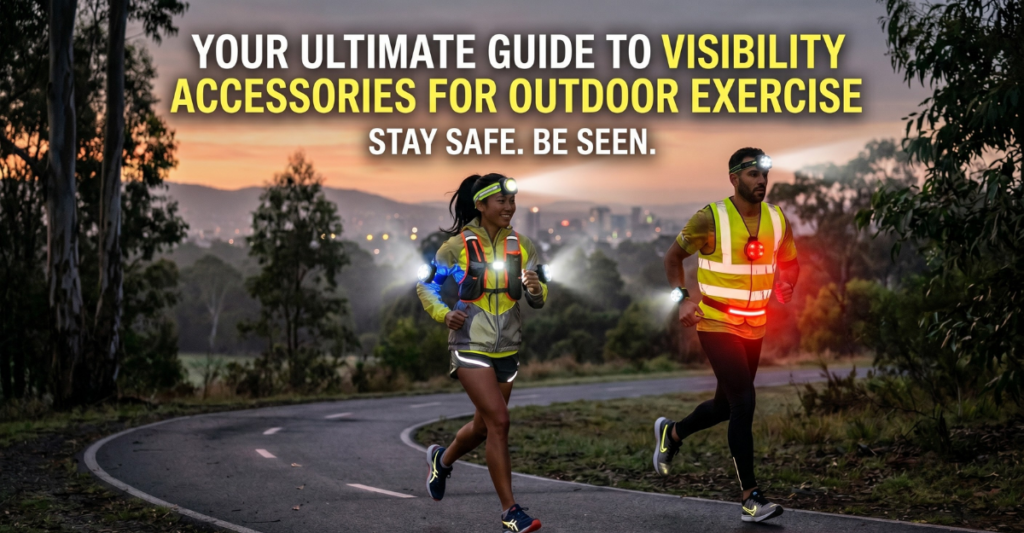
LED armbands are among the most popular active illumination options for runners and walkers. These lightweight bands typically wrap around your upper arm, wrist, or ankle, securing with elastic or Velcro closures. Quality models offer multiple lighting modes, including steady glow, slow flash, and rapid strobe patterns. The strobe settings are generally most effective for visibility since the blinking motion naturally draws the human eye’s attention. Many athletes prefer to wear multiple LED bands simultaneously—perhaps one on each arm and each ankle—creating a lighting pattern that makes them unmistakable to approaching vehicles. The best bands feature water-resistant construction and replaceable or rechargeable batteries, ensuring they’ll last through countless workouts in various weather conditions.
LED waist belts and chest lights provide illumination from your body’s core, which tends to be more visible to drivers than extremity-mounted lights. These accessories typically feature a wider band of LED lights or multiple individual lights arranged in a strip. Some advanced models include rear-facing red LEDs combined with front-facing white LEDs, mimicking the lighting pattern of vehicles themselves and making you immediately recognizable as a road user. Clip-on lights offer the ultimate in versatility, attaching to pockets, waistbands, shoelaces, or virtually any other part of your clothing or gear. While individually they might provide less visibility than larger accessories, when used strategically in multiples, they can create an effective visibility profile. Many outdoor fitness enthusiasts clip these lights to their hydration packs, jacket zippers, and shoe backs for comprehensive coverage.
Headlamps and Chest-Mounted Lights
When your outdoor exercise takes you beyond well-lit streets and into trails, parks, or rural roads, having a forward-facing light source becomes essential not just for others to see you, but for you to see where you’re going. Headlamps have long been the go-to solution for early-morning and evening exercisers, and contemporary models offer impressive capabilities in compact, lightweight packages. A quality headlamp serves the dual purpose of illuminating your path to prevent trips and falls while simultaneously making you visible to oncoming traffic and other trail users.
Modern running-specific headlamps balance several competing priorities: sufficient brightness to light your path, lightweight design that won’t bounce or cause neck strain, long battery life for extended workouts, and weather resistance for year-round reliability. Lumens—the measure of light output—typically range from 100 to 400 for fitness-focused headlamps, with higher outputs available for trail running in particularly remote or dark areas. Many models feature multiple brightness settings, allowing you to conserve battery life on well-lit portions of your route while having extra illumination available when needed. The beam pattern matters too; a wider flood beam helps with general path awareness and peripheral vision, while a focused spot beam extends visibility farther ahead for faster running speeds.
Chest-mounted running lights have gained popularity as an alternative or complement to headlamps. These lights attach to your sternum area, either clipping directly to clothing or mounting on specialized chest straps. The chest position offers several advantages: the light moves less than a head-mounted option, reducing bouncing and creating a steadier beam; it provides better illumination of obstacles at your feet; and it avoids the shadows that headlamps can cast when you turn your head. Some serious trail runners and ultramarathon participants use both headlamps and chest lights simultaneously, creating comprehensive illumination that reveals every detail of the terrain ahead. For those who wear glasses or prefer not to have anything on their head, chest lights represent an excellent primary lighting solution that still counts among essential visibility accessories for outdoor exercise.
Reflective Gear Beyond Traditional Accessories
While vests and lights might be the most obvious visibility solutions, a whole universe of reflective accessories can enhance your safety profile during outdoor exercise. Reflective tape and stickers offer an incredibly versatile and affordable way to add visibility to virtually any surface. You can apply reflective tape to your existing exercise gear—jackets, pants, hats, gloves, strollers, bicycles, and more—customizing your visibility profile without investing in entirely new equipment. High-quality reflective tape uses the same glass bead or microprismatic technology found in road signs, providing exceptional retroreflectivity that makes you visible from remarkable distances.
Reflective gloves and shoe accessories deserve special mention because of their unique visibility advantage. When you’re running or walking, your hands and feet are in constant motion, creating movement that catches drivers’ attention more effectively than static reflective elements. Reflective gloves come in various weights suitable for different weather conditions, from lightweight summer options to insulated winter versions. Similarly, reflective shoe accessories range from clips that attach to laces to reflective covers that slip over the entire heel and back of your shoe. Some runners apply reflective tape directly to their shoes in strategic patterns, creating custom visibility that moves with every stride.
For parents who exercise while pushing strollers, reflective stroller accessories are non-negotiable safety equipment. In addition to any built-in reflectors your stroller might have, you can add reflective flags that extend upward from the stroller frame, increasing your profile size and making you more visible to drivers, especially at intersections. Reflective wheel wraps transform your stroller wheels into spinning beacons that catch light with every rotation. Some innovative parents also attach LED string lights to their strollers or use clip-on LED lights at multiple points around the frame. Remember that when you’re pushing a stroller, your visibility profile extends forward, so ensuring the stroller itself is highly visible protects both you and your precious cargo.
Specialized Visibility Accessories for Cycling
Cyclists face unique visibility challenges that require specialized accessories beyond what runners and walkers typically need. The higher speeds involved in cycling mean that drivers need even more advance warning of your presence, and the mechanics of riding a bicycle create opportunities for visibility solutions that wouldn’t work for other activities. Bike-specific lights are perhaps the most critical safety investment any cyclist can make, with both front white lights and rear red lights required by law in most jurisdictions for riding after dark or before dawn.
Front bike lights have evolved dramatically, with modern LED technology providing remarkable brightness from compact, lightweight units. For commuting on lit streets, lights in the 200-500 lumen range typically suffice, but serious road cyclists and mountain bikers often choose lights exceeding 1000 lumens for rural roads and trail riding. Many high-end bike lights feature multiple modes, including steady burn for maximum visibility, various flash patterns that conserve battery while attracting attention, and daytime running modes specifically designed to make you visible even in full sunlight. The mounting system matters almost as much as the light itself; quality lights use secure mounting brackets that prevent bouncing or slipping while still allowing easy removal to prevent theft.
Rear bike lights have become increasingly sophisticated, with many models now featuring laser lane markers that project visible lines on the road beside you, giving drivers a clear indication of how much space to provide when passing. Some advanced tail lights include built-in sensors that automatically increase brightness when they detect ambient light decreasing or when you apply your brakes. Wheel lights add another dimension to bicycle visibility, with LED systems that attach to spokes, creating brilliant circles of light as your wheels turn. These are especially effective for side visibility at intersections, where many bicycle accidents occur. Reflective rim tape provides a lower-tech alternative that still significantly enhances wheel visibility, catching light from vehicle headlights and making your bicycle’s size and position immediately apparent.
Seasonal Considerations for Visibility Accessories
Your visibility needs change significantly across seasons, requiring different approaches to visibility accessories for outdoor exercise throughout the year. Winter presents particular challenges, with shortened daylight hours meaning that even moderate morning or evening workouts occur in darkness or near-darkness. The contrast between snow and dark clothing can work in your favor, making dark-clothed exercisers more visible than they might be against summer pavement—but this only applies in snowy conditions. Black ice, reduced visibility from precipitation, and the general challenges drivers face in winter conditions all argue for maximum visibility measures during cold-weather months.
Winter also demands layered clothing, which creates opportunities to incorporate multiple visibility elements. Your base layer might feature reflective details, your mid-layer could include a reflective vest, and your outer jacket might have built-in reflective strips or panels. This layering strategy ensures that visibility remains constant even as you add or remove clothing to regulate temperature during your workout. Winter accessories like hats, gloves, and neck gaiters are available in reflective or high-visibility versions, allowing you to stay warm while remaining visible. LED lights become especially important in winter since they actively generate light rather than depending on reflection, making them effective even in heavy snowfall or fog that might diminish the effectiveness of reflective materials.
Summer visibility challenges differ but remain significant. While longer daylight hours reduce the amount of time you might exercise in darkness, early-morning and late-evening workouts can still occur in low-light conditions, particularly at the beginning and end of summer. Additionally, summer’s vibrant green landscape can cause bright clothing colors to blend in more than during other seasons. Lightweight, breathable reflective accessories become essential since heavy vests or multiple layers aren’t practical in hot weather. Reflective mesh vests, LED armbands, and minimal clip-on lights provide visibility without adding excessive heat or weight. Many summer exercisers rely more heavily on active LED illumination than reflective materials since they’re wearing less clothing overall and want to minimize added layers.
Visibility Accessories for Different Exercise Activities
Different outdoor activities demand tailored approaches to visibility. Road running typically requires the most comprehensive visibility setup since you’re directly sharing space with vehicles and have limited physical protection. The combination of a reflective vest, LED armbands or clip-on lights, and reflective shoe accessories creates a visibility profile that makes you noticeable from multiple angles and distances. Many serious road runners adopt a “more is more” philosophy, recognizing that there’s essentially no such thing as being too visible when running on streets with vehicle traffic.
Trail running presents different visibility priorities. While you’re less likely to encounter vehicle traffic on dedicated trails, you still need to be visible to mountain bikers, other trail users, and potentially vehicles at trailhead parking areas or road crossings. More importantly, you need forward illumination to navigate roots, rocks, and other trail obstacles safely. A quality headlamp or chest light becomes the primary safety tool, with reflective elements on clothing serving as secondary features. Trail runners should choose visibility accessories for outdoor exercise that won’t catch on branches or other trail obstacles—streamlined designs without loose straps or dangling elements work best. Many trail runners also appreciate lights with red modes, which preserve night vision better than white light while still providing visibility to others.
Walking and power walking generally occur at lower speeds than running, but this doesn’t reduce visibility needs—it simply changes them. Since you’re moving more slowly, you need to be visible for longer periods as vehicles approach. Bright, steady-light LED options often work better than rapid strobes, which some find appropriate for faster-moving runners but potentially confusing at walking speeds. For walking groups, coordinating visibility accessories so all members are similarly equipped creates a cohesive, recognizable profile that drivers can more easily identify and respond to appropriately. Parents walking with strollers should prioritize making the stroller highly visible while also wearing their own visibility accessories, essentially creating a larger visible profile that accurately represents the space they’re occupying.
Maintaining and Maximizing Your Visibility Accessories
Even the highest-quality visibility accessories lose effectiveness without proper maintenance and care. Reflective materials can degrade over time, accumulating dirt, oils, and grime that significantly reduce their reflective properties. Regular cleaning is essential—most reflective gear can be gently hand-washed with mild soap and water, then air-dried away from direct heat sources. Avoid fabric softeners and bleach, which can damage reflective coatings. When washing reflective clothing in a machine, turn garments inside out and use gentle cycles to minimize wear on reflective elements. Some reflective tapes and materials are specifically designed for washing machine durability, while others are better suited for spot cleaning only.
LED accessories require battery management to ensure they’re functional when you need them. Rechargeable LED lights should be charged after each use or on a regular schedule to prevent you from heading out with dead batteries. Keep spare batteries on hand for accessories that use replaceable cells, and check battery levels before every workout, especially during seasons when you’re exercising in darkness regularly. Many LED accessories feature battery indicators that warn you when power is running low, but proactive checking prevents unpleasant surprises mid-workout. If you’re not planning to use LED accessories for an extended period, remove batteries to prevent corrosion damage from battery leakage.
Storage also affects longevity. Reflective gear should be stored in cool, dry locations away from direct sunlight, which can degrade reflective coatings over time. Avoid crushing or folding reflective materials sharply in the same places repeatedly, which can create permanent creases that reduce effectiveness. LED accessories benefit from similar storage conditions, with the additional consideration of keeping them in easily accessible locations so you’ll actually use them. Many outdoor fitness enthusiasts designate a specific gear area where visibility accessories are always stored together, making it easy to grab what’s needed regardless of the season or time of day. This organizational strategy increases the likelihood that you’ll consistently use appropriate visibility gear rather than skipping it when you’re in a hurry.
Building a Comprehensive Visibility Strategy
The most effective approach to outdoor exercise visibility involves layering multiple accessories and strategies rather than relying on any single solution. This redundant approach ensures that if one visibility element fails, gets covered by clothing, or isn’t oriented toward approaching traffic, other elements maintain your visibility profile. Start with a base layer of reflective clothing or a vest that provides 360-degree passive reflectivity. Add active LED illumination through armbands, clip-on lights, or belt-mounted accessories that create points of light visible from multiple angles. Finally, ensure your extremities—particularly feet and hands, which are in constant motion—include reflective or illuminated elements.
Your specific visibility strategy should respond to your regular exercise routes and conditions. If you primarily exercise on well-lit urban streets with sidewalks, your needs differ from someone running on rural roads with no street lighting and narrow shoulders. Assess your typical routes for their most dangerous sections—perhaps intersections with limited sight lines, curves where drivers might not expect pedestrians, or areas without sidewalks where you’re sharing the road directly with vehicles. Add extra visibility measures for these high-risk sections, such as carrying a bright flashlight you can point toward approaching traffic or wearing a particularly bright LED light that you activate when reaching these areas.
Weather conditions should also influence your visibility approach. Fog, rain, and snow dramatically reduce visibility for both you and drivers, requiring enhanced visibility measures. Some outdoor exercisers keep weather-specific visibility accessories—perhaps an extra-bright headlamp for foggy conditions or additional reflective gear for rainy weather when reflective materials might be partially obscured by water. Consider the specific challenges your local weather creates: if you exercise in an area prone to heavy morning fog, investment in high-quality LED lights that cut through mist becomes particularly important. Creating a mental checklist or actual pre-exercise routine that includes assessing visibility conditions and adjusting your accessories accordingly ensures you’re appropriately equipped for that day’s specific challenges.
Teaching Kids About Visibility and Safety
For parents, modeling proper visibility practices teaches children essential safety habits that will serve them throughout their lives. When kids see you consistently wearing reflective gear and LED lights for outdoor exercise, they internalize the message that visibility is a non-negotiable safety requirement, not an optional add-on. This foundation proves invaluable as children gain independence, begin walking or biking to friends’ houses, and eventually start their own fitness routines. Making visibility gear fun and age-appropriate increases children’s willingness to wear it—many kids enjoy LED accessories with multiple color options or reflective stickers they can customize.
Family outdoor activities provide excellent opportunities to practice visibility as a group. When walking, biking, or jogging together during low-light conditions, ensure every family member has appropriate visibility accessories for outdoor exercise matched to their size and the activity. This might mean reflective vests sized for children, kid-friendly LED bracelets that adjust to small wrists, and stroller accessories for the youngest family members. Many families make a game of visibility checks before heading out, with each person verifying that others are properly equipped. This routine normalizes safety equipment in the same way seatbelts and helmets have become automatic safety measures.
Beyond equipment, teach children the behavioral aspects of outdoor visibility safety. Help them understand that wearing reflective gear doesn’t make them invincible—they still need to follow traffic rules, make eye contact with drivers when possible, and never assume a vehicle has seen them. Explain how reflective materials work and why motion draws attention, perhaps by demonstrating with a flashlight in a dark room.
Give us a call today at 1-877-777-6086 or fill out our contact form to become a retail
distributor of our top-of-the-line safety lights.