Your body is an incredible machine that deserves attention and care, especially as you navigate the demands of daily life. Whether you’re chasing after kids, working long hours on your feet, or trying to maintain your athletic performance, flexibility and balance are foundational elements that often get overlooked. These two components work together like dance partners, supporting every movement you make throughout your day.
The truth is that most of us take our mobility for granted until we notice stiffness when getting out of bed or feel unsteady when reaching for something on a high shelf. But here’s the good news: you don’t need expensive equipment or hours of free time to make meaningful improvements. Simple exercises to improve flexibility and balance can be seamlessly integrated into your existing routine, transforming how you move and feel in just a few weeks.
Think about the last time you bent down to tie your shoes or picked up a dropped item. Did you feel tension? Did you need to brace yourself against something? These everyday movements reveal a lot about your current flexibility and balance levels. The reality is that our modern lifestyle—sitting at desks, driving cars, staring at screens—has created an epidemic of tight muscles and compromised stability that affects people across all age groups and activity levels.
Why Flexibility and Balance Matter More Than You Think
Flexibility and balance aren’t just buzzwords thrown around in yoga studios and physical therapy clinics. These physical attributes directly impact your quality of life, injury prevention, and long-term health outcomes. When you possess good flexibility, your muscles can move through their full range of motion without restriction or discomfort. This means less strain on your joints, better posture, and reduced likelihood of muscle tears or strains during physical activity.
Balance, on the other hand, is your body’s ability to maintain control during movement and stillness. It involves a complex coordination between your visual system, inner ear, muscles, and brain. Strong balance skills reduce your risk of falls, which is particularly important as we age but equally relevant when you’re running after a toddler or navigating a slippery work site.
The connection between these two elements is profound. Improved flexibility allows your body to make the subtle adjustments needed for balance, while better balance enables you to move more confidently through stretches and exercises that enhance flexibility. They feed into each other, creating a positive cycle of improved movement quality. For parents managing busy households, better balance means confidently carrying groceries while opening doors. For athletes, it translates to better performance and fewer training interruptions due to injury.
Understanding What Limits Your Current Range of Motion
Before diving into specific exercises, it’s valuable to understand what might be holding you back. Your muscles are surrounded by connective tissue called fascia, which can become tight and restricted from lack of movement, dehydration, or repetitive stress patterns. When you sit for extended periods, certain muscle groups—particularly your hip flexors, hamstrings, and chest muscles—adapt by shortening, which limits your flexibility.
Your nervous system also plays a significant role in flexibility. Muscles contain specialized receptors that detect stretch and can trigger a protective tightening response if they perceive danger. This is why rushing into deep stretches can be counterproductive; your body fights against movements it interprets as threatening. Gradual, consistent practice teaches your nervous system that these positions are safe, allowing for greater range of motion over time.
Balance limitations often stem from weak stabilizer muscles, particularly in your ankles, hips, and core. These smaller muscle groups work constantly to keep you upright and steady, but they can become underutilized if you primarily perform exercises on stable surfaces or don’t challenge your coordination regularly. Additionally, proprioception—your body’s awareness of where it is in space—can decline without regular practice, making you feel less steady on your feet.
Simple Exercises to Improve Flexibility and Balance for Busy Schedules
Let’s get practical with movements you can start implementing today. These exercises require minimal space and no equipment, making them perfect for anyone juggling multiple responsibilities. The key is consistency rather than duration—even ten minutes daily will yield better results than an occasional hour-long session.
Cat-Cow Stretch is an excellent starting point that mobilizes your entire spine while building awareness of movement quality. Get on your hands and knees with your wrists directly under your shoulders and knees under your hips. As you inhale, drop your belly toward the floor, lift your chest and tailbone upward, and let your shoulder blades slide down your back. This is the cow position. As you exhale, round your spine toward the ceiling, tuck your tailbone, and draw your chin toward your chest—that’s cat. Flow between these positions for eight to ten breaths, moving at whatever pace feels natural to your body.
This movement pattern warms up your spine, shoulders, and hips while establishing the mind-body connection that’s essential for both flexibility and balance work. You’re teaching your body to move fluidly through different positions rather than holding static tension. Parents can easily do this first thing in the morning or even with kids climbing on their backs, turning it into playtime while you exercise.
Standing hip circles address one of the tightest areas for most people while simultaneously challenging your balance. Stand on your right leg with your left foot lifted a few inches off the ground. Place your hands on your hips or extend them out to the sides for balance. Begin making slow circles with your left knee, moving from small to larger circles as your hip warms up. Complete eight circles in one direction, then reverse. Switch legs and repeat. This simple exercise opens up your hip capsule, strengthens your standing leg, and improves your single-leg stability—all crucial elements for running, lifting, and navigating uneven terrain.
Progressive Balance Challenges for Real-World Stability
Building balance is about progressively challenging your stability systems in safe, controlled ways. The single-leg stance is foundational but surprisingly effective. Stand near a wall or sturdy chair for safety, then lift one foot off the ground. Start by holding for twenty to thirty seconds, focusing on a fixed point at eye level to help maintain steadiness. As this becomes easier, try closing your eyes for brief periods, which removes visual input and forces your other balance systems to work harder.
You can make this exercise infinitely more challenging by adding movement. While balancing on one leg, slowly reach down toward your standing foot with your opposite hand, then reach up overhead. Perform gentle knee bends. Turn your head from side to side. Each variation disrupts your equilibrium in different ways, forcing your body to adapt and strengthen its stabilization responses. These adaptations translate directly to real-life situations like catching yourself from stumbling or maintaining control during athletic movements.
Heel-to-toe walking might seem simple, but it’s remarkably effective at developing dynamic balance—the kind you use when actually moving rather than standing still. Place the heel of one foot directly in front of the toes of your other foot, walking in a straight line as if on a tightrope. Keep your eyes focused ahead rather than looking down at your feet. Walk forward for twenty steps, then try walking backward, which is significantly more challenging. This exercise strengthens your ankles, improves your proprioception, and builds confidence in your body’s ability to control movement.
For an added challenge that busy moms might appreciate, try carrying a laundry basket or grocery bags while performing this exercise. This added task forces your brain to divide attention between multiple demands, which better simulates real-world conditions. Your balance system becomes more robust when it learns to function under various circumstances rather than just ideal conditions.
Flexibility Sequences That Target Common Problem Areas
Most people carry tension in predictable patterns based on their daily activities and stress levels. A targeted approach to flexibility work yields faster results than random stretching. Let’s focus on the areas that typically need the most attention for active individuals and parents.
The hip flexor stretch is non-negotiable if you spend any time sitting. These muscles, which run from your lower spine and pelvis to your thigh bone, become chronically shortened in sedentary positions and can contribute to lower back pain and reduced athletic performance. Kneel on your right knee with your left foot planted in front of you, forming a 90-degree angle at your left knee. Keep your torso upright and gently shift your hips forward until you feel a stretch in the front of your right hip. For a deeper stretch, raise your right arm overhead and lean slightly to your left side. Hold for forty-five to sixty seconds, breathing deeply, then switch sides.
What makes this stretch even more effective is adding a posterior pelvic tilt—essentially tucking your tailbone under—which increases the stretch on the hip flexors while protecting your lower back. Think about bringing your pubic bone toward your belly button. This subtle adjustment transforms a good stretch into an excellent one. Perform this stretch daily if possible, especially after long periods of sitting or before running or athletic activities.
Your hamstrings and lower back complex needs regular attention too. Sit on the floor with both legs extended in front of you. Flex your feet so your toes point toward the ceiling. Sit up tall, creating length in your spine, then hinge forward from your hips—not by rounding your back—reaching your hands toward your feet. You might not reach far at first, and that’s perfectly fine. The goal isn’t to touch your toes but to feel a gentle stretch along the back of your legs and lower back. Hold this position for sixty seconds, taking deep breaths and relaxing a bit deeper with each exhalation.
A key principle here is distinguishing between productive discomfort and pain. You should feel a pulling sensation that’s intense but not sharp or burning. Your breath should remain steady and calm. If you’re holding your breath or grimacing, you’ve gone too far. Back off slightly and let your body gradually adapt. Over weeks and months, you’ll notice your range of motion expanding without force or strain.
Dynamic Movements That Build Both Qualities Simultaneously
Some of the most efficient exercises address flexibility and balance together, making them perfect for time-crunched individuals. Simple exercises to improve flexibility and balance often involve controlled movements through ranges of motion that challenge your stability while lengthening tissues.
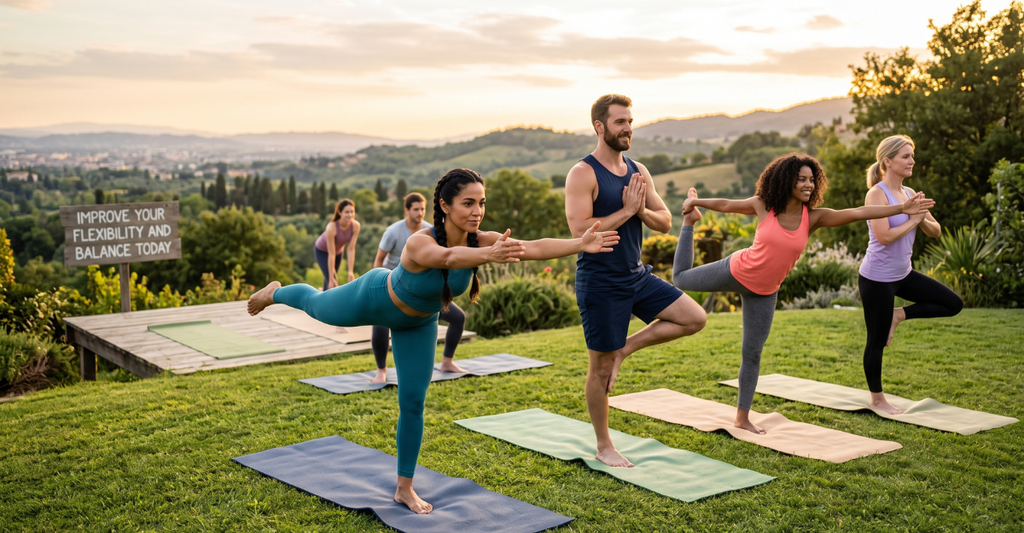
Warrior III pose from yoga is an exceptional full-body exercise. Stand on your right leg and hinge forward at your hips, extending your left leg straight behind you while reaching your arms forward. Your goal is to create a straight line from fingertips to extended heel, parallel to the floor. This position requires significant balance, strengthens your standing leg and glutes, and stretches your hip flexors and shoulders simultaneously. Hold for twenty to thirty seconds, then switch sides. Don’t worry about perfect form initially—even a modified version with hands on hips or just slightly lifted leg provides benefits.
The balance challenge here is obvious, but the flexibility component is equally important. Achieving the proper alignment requires hip flexibility to extend your back leg fully and shoulder flexibility to reach your arms forward while maintaining a neutral spine. As your flexibility improves, the pose becomes easier to hold and control. This creates a feedback loop where each quality supports development of the other.
Walking lunges with rotation combine lower body flexibility and strength with core mobility and balance demands. Step forward with your right foot into a lunge position, lowering your back knee toward the ground. As you settle into the lunge, rotate your torso toward your right leg, bringing your hands toward your right foot. This rotation adds a stretch through your hip flexors, groin, and spine. Push through your right foot to step forward into the next lunge on the opposite side. Continue alternating for ten to twelve lunges per leg. This movement pattern mimics functional activities like climbing stairs or picking things up while moving, making the flexibility and balance gains immediately applicable to daily life.
The Role of Breathing in Flexibility and Balance Work
Your breath is perhaps the most overlooked tool for improving both flexibility and balance. When you hold your breath during stretches or challenging balance positions, you create unnecessary tension throughout your body and trigger your stress response. Conscious breathing activates your parasympathetic nervous system, which promotes relaxation and allows muscles to release more fully.
During stretching, focus on deep belly breathing where your abdomen expands on the inhale and contracts on the exhale. This diaphragmatic breathing pattern signals safety to your nervous system and can help you access greater range of motion. Try spending the first few breaths in any stretch position just establishing rhythm and calm, then with each exhale, gently explore moving slightly deeper into the stretch. This gradual approach respects your body’s protective mechanisms while still creating change.
For balance exercises, breathing serves a different but equally important function. Holding your breath creates rigidity, making micro-adjustments more difficult. Instead, maintain steady, rhythmic breathing even during challenging positions. If you notice yourself holding your breath, it’s a sign you’ve exceeded your current capacity and should modify the exercise. Your breath is a biofeedback tool that tells you whether you’re working at an appropriate intensity or pushing into counterproductive territory.
Creating a Weekly Practice That Fits Your Life
Consistency matters more than perfection when developing flexibility and balance. Rather than aiming for lengthy sessions you’ll struggle to maintain, design a realistic practice that integrates smoothly into your existing schedule. Five to ten minutes daily beats an hour-long session once weekly when it comes to these particular qualities.
Consider bookending your day with brief practices. Spend five minutes in the morning doing dynamic stretches and balance work to prepare your body for the day ahead. This might include cat-cow stretches, hip circles, and single-leg stands while you’re waiting for coffee to brew. In the evening, perform static stretches targeting areas that felt tight during the day, holding each stretch for sixty seconds while watching television or after putting kids to bed.
For those with more structured workout routines, integrate flexibility and balance work into your warm-up and cool-down rather than treating them as separate sessions. Before running or strength training, perform dynamic stretches and balance drills to activate your nervous system and prepare your muscles. After your workout, when tissues are warm and pliable, invest ten minutes in static stretching to improve flexibility and facilitate recovery. This approach ensures you’re addressing these qualities consistently without adding extra time demands to your schedule.
Age-Appropriate Modifications and Family-Friendly Approaches
If you’re a parent trying to model healthy habits, involving your children in flexibility and balance exercises creates valuable family time while instilling positive attitudes toward movement. Kids naturally have better flexibility than most adults, so they often excel at these activities, which can be motivating for them and humbling for you.
Transform balance exercises into games. Create an obstacle course where family members walk heel-to-toe along a line of tape on the floor, stand on one foot for progressively longer times, or play “statue” where everyone holds a balance pose until someone wobbles. Children love the challenge and competition, while everyone benefits from the practice. Making exercise playful removes the burden of “one more thing to do” and instead creates connection and fun.
For older adults or those with limited mobility, modifications ensure these exercises remain accessible and safe. Perform balance exercises near a wall or counter that can provide support if needed. Use a chair for seated flexibility work if getting up and down from the floor is challenging. The principles remain the same regardless of modifications—gradual progression, consistent practice, and respect for your body’s current capabilities.
Tracking Progress and Staying Motivated
Improvements in flexibility and balance can feel subtle day-to-day, making it helpful to track progress more systematically. Take photos or videos of yourself performing specific stretches or balance poses at the beginning of your practice, then revisit them monthly. The visual evidence of increased range of motion or improved stability provides powerful motivation to continue.
Set specific, measurable goals that extend beyond just “be more flexible.” Maybe you want to touch your toes without bending your knees, hold a single-leg stance for sixty seconds with eyes closed, or perform ten consecutive walking lunges with good form. Concrete targets give your practice direction and make achievements more tangible. When you reach one goal, celebrate it genuinely, then set another slightly more challenging objective.
Remember that progress isn’t always linear. You’ll have days when you feel tighter or less stable due to stress, insufficient sleep, or previous day’s activities. This is completely normal and doesn’t represent regression. The long-term trend matters more than daily fluctuations. If you miss a few days of practice, simply resume where you left off without guilt or harsh self-judgment. Flexibility and balance are lifelong practices, not destinations you reach and then abandon.
Common Mistakes That Limit Your Progress
Even with the best intentions, certain approaches can slow your progress or even increase injury risk. Bouncing during static stretches is one of the most common errors. This ballistic stretching triggers the stretch reflex—your muscles’ protective response—causing them to contract rather than lengthen. Instead, move into stretches slowly and hold steady positions, allowing tissues to gradually adapt.
Another mistake is practicing balance exercises only on stable, predictable surfaces. While you should start there, true balance development requires exposure to varied conditions. Once you’ve mastered balance on firm, flat ground, progress to slightly unstable surfaces like grass, gravel, or sand. You can even practice standing on one leg while on a pillow or folded towel to create instability that challenges your system more effectively.
Neglecting one side of your body in favor of the other is a common pitfall, especially among athletes and people with physically demanding jobs. You might naturally favor your dominant side, but this creates imbalances that can lead to injury and compensatory movement patterns. Always work both sides equally in your practice, even if one side is significantly tighter or less stable. Over time, this balanced approach reduces asymmetries and improves overall function.
Perhaps the biggest mistake is comparing yourself to others or to an idealized image of what flexibility and balance “should” look like. Your body is unique, with its own history, structure, and capabilities. Someone with naturally loose ligaments might achieve impressive-looking flexibility with minimal effort, while someone with tighter connective tissue needs more consistent work for smaller visible gains—yet both can have functional, healthy movement. Focus on your own progress and how you feel rather than external comparisons.
Nutrition and Hydration for Optimal Tissue Health
Your flexibility and balance don’t exist in isolation from the rest of your health. What you eat and drink directly impacts tissue quality, recovery capacity, and nervous system function. Proper hydration is essential for maintaining tissue pliability, as fascia and muscles require adequate water to move smoothly. Dehydration makes tissues more prone to injury and reduces your achievable range of motion.
Aim for at least eight glasses of water daily, more if you’re active or live in hot climates. You can assess your hydration status by checking urine color—pale yellow indicates good hydration, while dark yellow or amber suggests you need more fluids. Additionally, foods with high water content like cucumbers, watermelon, and oranges contribute to your overall hydration status while providing valuable nutrients.
Protein intake matters for maintaining and repairing muscle tissue. While flexibility work isn’t as demanding as heavy strength training, your muscles still undergo adaptation and need amino acids for recovery. Include quality protein sources—lean meats, fish, eggs, legumes, or dairy—at most meals. For a 150-pound person, roughly 75-100 grams of protein daily supports optimal tissue maintenance and adaptation.
Anti-inflammatory foods support recovery and reduce excessive muscle tension. Omega-3 fatty acids found in fatty fish, walnuts, and flaxseeds help manage inflammation. Colorful fruits and vegetables provide antioxidants that combat oxidative stress from exercise and daily living. Chronic inflammation contributes to tissue stiffness and restricted movement, so managing it through diet enhances your flexibility work.
The Connection Between Sleep and Movement Quality
Quality sleep might seem unrelated to flexibility and balance, but it’s actually fundamental to progress in both areas. During deep sleep, your body repairs tissues, consolidates motor learning, and regulates the hormones that affect muscle tone and nervous system function. Insufficient sleep increases muscle tension and impairs coordination, making both flexibility and balance work less effective and potentially more risky.
Aim for seven to nine hours of quality sleep nightly. Establish consistent sleep and wake times, even on weekends, to regulate your circadian rhythm. Create a bedtime routine that signals to your body it’s time to wind down—perhaps including some gentle stretching. The relaxation promoted by easy stretches before bed can actually improve sleep quality, creating a positive cycle where better sleep enhances movement quality, and movement practice improves sleep.
If you’re a parent dealing with interrupted sleep from young children, be patient with yourself. Your progress might be slower than ideal, and that’s okay. Focus on what you can control—the consistency of your practice, your breathing technique, and your nutrition—while recognizing that sleep will improve as your children grow. In the meantime, short practice sessions matched to your energy level are better than skipping practice entirely or pushing too hard and risking injury.
Adapting Your Practice Through Different Life Phases
Your flexibility and balance needs will shift throughout your life, and your practice should adapt accordingly. In your thirties and forties, you might focus on maintaining mobility while building strength for active parenting and career demands. Simple exercises to improve flexibility and balance during this phase emphasize functional movements that directly support your lifestyle—lunges for chasing kids, hip stretches for sitting at desks, and balance work for general injury prevention.
As you move into your fifties and beyond, balance becomes increasingly important for fall prevention, while flexibility work can help maintain independence and quality of life. You might need longer warm-ups before stretching and should be even more cautious about respecting your body’s limits.
Give us a call today at 1-877-777-6086 or fill out our contact form to become a retail
distributor of our top-of-the-line safety lights.