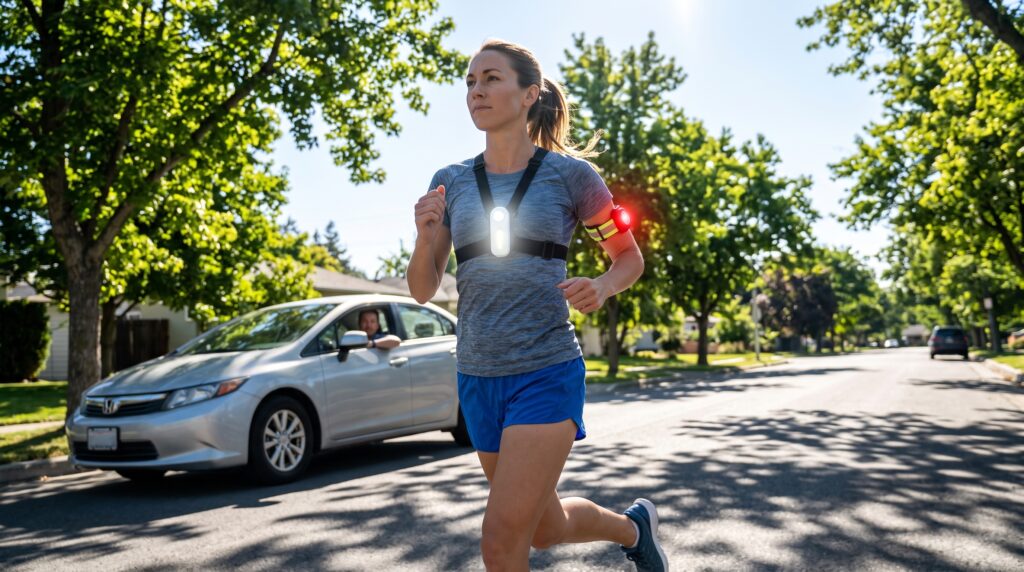
You lace up your running shoes, glance outside at the brilliant sunshine streaming through your window, and think to yourself that visibility won’t be an issue today. After all, it’s broad daylight, the sky is clear, and you can see for miles. But here’s something that might surprise you: why runners need visibility lights even on sunny days isn’t just about whether you can see—it’s about whether drivers can see you in time to react. The statistics are sobering, and the reality is that many runners overlook this critical safety measure when the weather looks perfect.
As a runner who juggles family responsibilities, work commitments, and fitness goals, you already know that finding time to run can be challenging enough without adding safety concerns to the mix. Yet every year, thousands of runners are involved in accidents during daylight hours, many of which could have been prevented with proper visibility equipment. The assumption that sunny weather equals safe running conditions has led too many athletes to leave their visibility lights at home, potentially putting themselves at serious risk.
The Science Behind Daytime Visibility Challenges
Understanding why runners need visibility lights even on sunny days begins with comprehending how human vision and attention work in various lighting conditions. When drivers navigate roads on sunny days, they face numerous visibility challenges that have nothing to do with darkness. Glare from the sun, shadows cast by buildings and trees, and the sheer brightness of reflected light off windshields and chrome can all create dangerous blind spots where a runner dressed in regular athletic wear simply disappears from view.
The human eye struggles to distinguish objects that don’t provide sufficient contrast against their background. On a sunny day, you might be wearing brightly colored running gear, but if that color blends with the surrounding environment—whether it’s green foliage, gray pavement, or the mottled shadows of a tree-lined street—you become effectively invisible to motorists. Research from traffic safety organizations has demonstrated that the human brain processes movement and contrast together, and without sufficient contrast, even moving objects can fail to register in a driver’s conscious awareness.
Drivers also experience what researchers call “inattentional blindness,” a phenomenon where the brain filters out objects that aren’t providing enough visual stimulus to trigger alert mechanisms. A flashing light, however, creates a rhythmic visual disruption that breaks through this filtering system. Even in bright sunlight, LED visibility lights produce a distinct pattern that the human brain recognizes as requiring attention, essentially saying “look at me” in a language your visual cortex can’t ignore.
Common Sunny-Day Scenarios That Put Runners at Risk
You’re running along a residential street at 10 AM on a beautiful Saturday morning. The sun is shining, birds are chirping, and you feel completely visible. But consider this scenario from a driver’s perspective: they’re heading east, sun visor down because the morning sun is streaming directly into their vehicle. As they approach an intersection where you’re about to cross, their windshield is catching glare from multiple angles—the sun itself, reflected light from the car ahead, and the bright concrete of the street surface. In this common situation, understanding why runners need visibility lights even on sunny days becomes crystal clear—you’ve essentially become invisible in a sea of brightness.
Tree-lined running routes present another deceptive hazard during sunny conditions. The dappled shadows created by leaves and branches produce a constantly changing pattern of light and dark across the road surface. When you run through these areas, your silhouette breaks up against this background, making it incredibly difficult for drivers to track your movement accurately. The alternating patches of brilliant sunshine and deep shade challenge the eye’s ability to adjust quickly enough to maintain clear vision of everything in the environment.
Sunny days also bring increased traffic and distracted drivers. Nice weather means more people are out running errands, taking scenic drives, or heading to outdoor activities with kids in tow. These drivers may be more relaxed, perhaps enjoying music or conversation, and their attention isn’t as focused as it might be during poor weather conditions when they’re already on high alert. Additionally, the comfortable conditions mean they’re less likely to be driving with the heightened caution they’d employ in rain, fog, or darkness. You need every advantage you can get to break through their divided attention, and visibility lights provide exactly that advantage.
How Sunlight Affects Driver Perception and Reaction Time
The sun’s position throughout the day creates what traffic safety experts call “critical glare periods”—times when the angle of sunlight directly impairs driver vision. For morning runners, this typically occurs between 7 AM and 9 AM when the sun is low on the eastern horizon. Evening runners face similar challenges between 5 PM and 7 PM when the sun sets in the west. During these periods, drivers may be literally blinded by the sun, unable to see much of anything directly in front of them despite the fact that it’s technically broad daylight. This reality reinforces why runners need visibility lights even on sunny days—you need to be visible even when natural visibility is severely compromised.
When sunlight streams directly into a vehicle, drivers often compensate by using sun visors, which block the upper portion of the windshield. While this helps with the direct glare, it also creates a significant blind spot where a runner on the shoulder of the road or waiting to cross at an intersection might be standing. If you’re not providing an additional visual cue that breaks through the remaining visible area, you’re gambling with your safety. A flashing LED light positioned at chest or waist level projects into the driver’s field of view below the sun visor, providing crucial information about your presence.
Pupil dilation and constriction also play a crucial role in driver visibility on sunny days. When your eyes adjust to bright sunlight, your pupils become very small to protect the retina from excessive light exposure. While this is great for comfort and eye health, it reduces the eye’s ability to detect objects in shadows or darker areas. If you’re running in shade while drivers are in full sun, or vice versa, there’s a mismatch in visual adaptation that can delay recognition of your presence by several critical seconds. LED visibility lights maintain their effectiveness regardless of lighting conditions because they produce light rather than reflecting it, ensuring you’re visible whether you’re in sun or shade.
The Technology Behind Modern Visibility Lights
Today’s running visibility lights have evolved far beyond the simple blinking LEDs of years past. Modern visibility technology incorporates features specifically designed to maximize daytime visibility, addressing the unique challenges of competing with natural sunlight. High-lumen output LEDs can produce brightness levels that remain clearly visible even in direct sunlight, unlike older models that were designed primarily for low-light conditions. When you understand the technological advancement in these devices, you’ll better appreciate why runners need visibility lights even on sunny days—they’re specifically engineered for this purpose.
Many current visibility lights offer multiple flash patterns, and research has shown that certain patterns are more effective at capturing driver attention during daylight hours. Random or irregular flash patterns, for instance, trigger stronger responses from the brain’s attention systems than regular, predictable patterns. Some advanced models also incorporate accelerometers that adjust flash patterns based on your movement, creating even more visual distinction that helps you stand out against the busy visual backdrop of a sunny day.
Color temperature and wavelength matter significantly for daytime visibility. While amber and red lights work well in low-light conditions, many experts recommend white or blue-white LEDs for daytime use because these wavelengths provide better contrast against most outdoor backgrounds. Some visibility lights now include dual-color options, allowing you to switch between settings optimized for different lighting conditions. The intensity of modern LEDs can reach levels that create a noticeable glow even in direct sunlight, essentially creating a “force field” of visibility around you that’s hard for drivers to miss.
Strategic Placement of Visibility Lights for Maximum Effect
Knowing where to position your visibility lights can be just as important as wearing them in the first place. The goal is to create a visual signature that helps drivers quickly identify you as a runner and accurately judge your distance and speed. Front-facing lights should be positioned at chest height or slightly higher, as this places them in the direct sight line of approaching drivers. Side visibility is equally crucial, particularly at intersections, so consider lights that project 180 or 360 degrees of visibility rather than just forward-facing illumination.
Rear visibility lights deserve special attention because approaching drivers from behind often have the least time to react and adjust their path. A rear-facing light positioned at waist or lower back height provides drivers with early warning of your presence, giving them additional seconds to slow down or move over. Some runners prefer to attach rear lights to arm bands or shoulder straps, which adds a vertical component to your visibility profile and helps drivers more accurately gauge your height and body position. The multiple light sources create depth perception cues that a single light can’t provide, reinforcing why runners need visibility lights even on sunny days—they provide dimensional awareness that color alone cannot achieve.
Don’t overlook ankle-mounted lights for enhanced visibility. Lights attached to your lower legs create a unique visual signature because they move with your running stride, producing a distinctive bobbing motion that the human brain immediately recognizes as a pedestrian in motion. This movement pattern stands out dramatically against stationary backgrounds and provides drivers with instant, subconscious recognition that they’re approaching a person, not a bicycle or stationary object. Ankle lights work particularly well in combination with upper body lights, creating multiple reference points that help drivers more accurately assess your location and trajectory.
Real-World Accident Data and Statistics
The data supporting the importance of daytime visibility is both extensive and sobering. According to the National Highway Traffic Safety Administration, nearly half of all pedestrian accidents occur during daylight hours, and runners represent a significant portion of these statistics. Many of these accidents happen not because drivers weren’t paying attention, but because they simply didn’t see the runner in time to react. When investigators analyze these incidents, insufficient contrast between the runner and their environment is frequently cited as a contributing factor—a problem that visibility lights directly address.
Studies conducted by traffic safety researchers have measured the difference in detection distance when runners wear visibility lights versus relying solely on reflective or brightly colored clothing. The results consistently show that drivers identify runners wearing active lights from distances 3 to 4 times greater than those wearing only passive visibility measures. On a road where drivers are traveling at 35 miles per hour, this difference translates to several additional seconds of reaction time—seconds that can mean the difference between a close call and a tragedy. These findings crystallize why runners need visibility lights even on sunny days: mathematics and physics don’t stop working just because the sun is shining.
Insurance data tells a complementary story about accident prevention. Runners who consistently use visibility lights report significantly fewer close calls and near-misses with vehicles. While not every close call results in an accident or insurance claim, these incidents serve as warning signs that conditions were ripe for collision. The reduction in these events when visibility lights are employed suggests that drivers are detecting and responding to runners much more reliably, creating safer conditions for everyone sharing the road.
Psychological Factors: Why Sunny Days Create False Security
There’s a powerful psychological phenomenon at work when you step outside into beautiful sunny weather—your brain interprets the pleasant conditions as “safe” and may unconsciously lower your guard. This optimism bias affects both runners and drivers, creating a dangerous combination where runners feel less need for safety equipment and drivers operate with slightly reduced vigilance. Understanding this mental trap helps explain why runners need visibility lights even on sunny days: you need to compensate for the false sense of security that sunny weather creates in everyone’s minds.
The “it won’t happen to me” mentality becomes particularly strong during pleasant weather. When conditions are perfect and visibility seems unlimited, it’s easy to convince yourself that extra safety measures are unnecessary. You might think that visibility lights are overkill, that you’re being overly cautious, or that you’ll look silly wearing them in broad daylight. But experienced runners who’ve had close calls—or worse—will tell you that these thoughts evaporated the moment they realized how close they came to serious injury in conditions they’d considered completely safe.
Drivers also experience reduced risk perception on sunny days. When the weather is nice, driving feels easy and comfortable, which can lead to slightly slower reaction times and reduced scanning of the environment. Drivers might be more likely to glance at their phone, adjust the radio, or engage in conversation with passengers because the driving task doesn’t feel demanding. Your visibility lights serve as a pattern interrupt that breaks through this comfortable complacency, triggering the attention and focus needed to navigate safely around you.
Choosing the Right Visibility Lights for Daytime Running
Not all visibility lights are created equal, and choosing the right equipment for daytime running requires understanding several key specifications. Lumen output is perhaps the most critical factor for sunny-day visibility—you want lights producing at least 50 lumens, with some experts recommending 100 lumens or more for maximum daytime effectiveness. Battery life becomes less of a concern for daytime use since you won’t need to run the lights for hours on end, but you still want reliable operation throughout your typical run duration.
Durability and weather resistance matter significantly for running lights because they’ll be exposed to sweat, rain, and the physical bouncing and jostling of your running stride. Look for lights with IPX4 rating or higher, which ensures they can handle sweat and light rain without failing. The mounting system should be secure enough that the light doesn’t shift or bounce but comfortable enough that you forget you’re wearing it. Clip-on designs offer versatility, while band-mounted options provide security—choose based on your typical running gear and personal preferences.
Consider visibility lights with smart features that enhance safety. Some modern options include automatic light sensors that increase intensity when they detect bright ambient conditions, ensuring maximum visibility without requiring manual adjustment. Others connect to smartphone apps that allow you to customize flash patterns and check battery status. While these features aren’t essential, they can enhance the overall effectiveness of your visibility strategy. Price shouldn’t be the primary deciding factor when selecting visibility lights—spending a bit more for reliable, high-quality equipment is a worthwhile investment in your safety and peace of mind.
Integrating Visibility Lights Into Your Running Routine
Making visibility lights a consistent part of your running habit requires the same approach you’d use for any other safety equipment. Keep your lights in a dedicated location with your running gear so they’re always at hand when you’re preparing for a run. Charge or replace batteries on a regular schedule—many runners do this weekly regardless of use to ensure the lights are always ready. This systematic approach removes the decision-making process from each individual run; you simply put on your lights the same way you put on your running shoes.
For busy parents juggling multiple responsibilities, creating systems that support safety habits is crucial. If you’re coordinating family schedules, packing lunches, and trying to squeeze in a quick run before school drop-off, it’s easy to skip steps that don’t seem immediately necessary. But when visibility lights become as automatic as grabbing your house keys, they stop being an extra burden and simply become part of the routine. This systematization is particularly important for reinforcing why runners need visibility lights even on sunny days—when it’s automatic, you never have to make the judgment call about whether conditions warrant their use.
Lead by example if you have children who are active. When your kids see you consistently using visibility lights, they learn that safety equipment isn’t just for “dangerous” conditions—it’s for all conditions. This modeling teaches them to think proactively about safety rather than reactively, a lesson that will serve them well throughout their lives. Young athletes who develop the habit of using visibility lights early are more likely to maintain this practice into adulthood, creating lifelong safety patterns. If you’re running with your children, ensure everyone in the family has appropriate visibility lights and make it a non-negotiable part of your family running culture.
Additional Visibility Strategies to Complement Your Lights
While visibility lights are crucial, they work best as part of a comprehensive visibility strategy. Reflective elements on your clothing and shoes provide passive visibility that complements the active visibility of LED lights. The combination creates multiple visual cues that help drivers build a complete picture of your presence, size, and movement. Reflective materials are particularly effective when they’re positioned to move with your body—reflective strips on lower legs and arms create a distinctive motion signature that enhances recognition.
Color choice for your running clothing still matters, even when you’re wearing visibility lights. While you can’t rely on bright colors alone, certain hues do provide better contrast against common backgrounds. Neon yellow-green and bright orange tend to stand out well against most natural and urban environments. Avoid colors that blend with surroundings—earth tones, grays, and dark blues can make you harder to see even with visibility lights because they reduce your overall visual contrast profile. Think of your clothing color as the canvas and your visibility lights as the focal point; the canvas should enhance rather than diminish the focal point.
Route selection contributes significantly to your overall visibility and safety. When possible, choose routes with wider shoulders, better sight lines, and lower traffic volumes. Running against traffic (when safe and legal to do so) allows you to make eye contact with drivers and see approaching vehicles, giving you the opportunity to take evasive action if necessary. Well-lit areas with minimal visual clutter help you stand out more effectively, even though you’re running during the day. Parks and dedicated running paths often provide safer alternatives to road running, though you should still wear visibility lights in these locations because cyclists and other path users need to see you clearly as well.
Weather Conditions That Amplify the Need for Daytime Visibility
Certain sunny-day weather conditions particularly amplify the importance of visibility lights. Hazy sunshine, where humidity or air pollution creates a gauzy appearance to the atmosphere, significantly reduces visual clarity even though it’s technically a “sunny” day. In these conditions, visibility lights cut through the haze much more effectively than colored clothing or even reflective materials, providing clear position information to drivers whose visual range is otherwise compromised.
Windy sunny days present their own challenges because moving branches, blowing dust, and general environmental motion create visual noise that makes it harder for drivers to distinguish important movement (like a runner) from irrelevant movement (like leaves blowing across the road). The steady, rhythmic pattern of flashing visibility lights provides a consistent signal that stands out against the random motion of the environment. This is another compelling reason behind why runners need visibility lights even on sunny days—they provide signal consistency in visually chaotic conditions.
Transitional times of day require special attention to visibility needs. Dawn and dusk technically involve sunlight, but the low angle and rapidly changing light levels create particularly hazardous conditions for runners. During these periods, neither daytime nor nighttime vision is fully engaged, and both runners and drivers experience reduced visual acuity. Starting your run at dawn with visibility lights already activated ensures you’re protected during these crucial transitional periods, and the habit of always using lights means you won’t be caught without them if your run extends into darker conditions than you anticipated.
Addressing Common Objections and Misconceptions
Many runners resist using visibility lights during the day because they believe it makes them look paranoid or overly cautious. This concern about appearance pales in comparison to the very real safety benefits these devices provide, but it’s worth addressing directly: carrying yourself confidently and taking proactive safety measures is never something to be embarrassed about. In fact, experienced runners and safety-conscious athletes will recognize your visibility lights as a mark of wisdom and sound judgment rather than excessive caution.
The objection that “I’ve never had a problem before” represents survivorship bias—the logical error of focusing on successes while ignoring failures. Just because you haven’t been in an accident yet doesn’t mean you haven’t been in dangerous situations; you’ve simply been lucky that every close call worked out in your favor. The runner who got hit by a car last week probably thought the same thing the day before their accident. Understanding why runners need visibility lights even on sunny days means acknowledging that past luck doesn’t guarantee future safety, and that prevention is always preferable to dealing with consequences.
Some runners worry that visibility lights are uncomfortable or inconvenient. Modern visibility lights are specifically designed for athletic use—they’re lightweight, compact, and designed to stay in place during vigorous activity. Many weigh less than an ounce and can be clipped to clothing or gear without causing any discomfort or interfering with your running form. The minor adjustment period of getting used to wearing them is measured in minutes, not days, and the benefits they provide far outweigh any minimal inconvenience.
The Legal and Liability Perspective
While laws governing daytime visibility equipment for runners vary by jurisdiction, understanding the legal landscape can provide additional motivation to adopt these safety measures. In many areas, pedestrians have a legal obligation to make themselves reasonably visible to traffic, and failure to do so can affect liability determinations if an accident occurs. Even if wearing visibility lights isn’t legally required during daylight hours, demonstrating that you took reasonable precautions to ensure your own safety can be significant if you’re ever involved in an accident investigation or insurance claim.
From a liability standpoint, drivers also benefit when runners use visibility lights because it provides clear evidence of a runner’s location and intentions. In the unfortunate event of an accident, video evidence from dashboard cameras or traffic cameras will clearly show your visibility lights, establishing a timeline and location record that can be crucial for accurate accident reconstruction. This benefits everyone involved by ensuring that facts rather than assumptions drive legal and insurance proceedings.
Some municipalities are beginning to recognize the safety benefits of daytime visibility lights and are incorporating recommendations for their use into pedestrian safety campaigns and educational materials. Forward-thinking communities are even providing subsidized or free visibility lights to residents who walk or run regularly, recognizing that improving visibility is a cost-effective way to reduce pedestrian accidents and the associated costs to public safety and healthcare systems.