When you venture outdoors to engage in physical activities, you’re embracing a lifestyle that combines fitness, fresh air, and the thrill of natural environments. However, each outdoor sport comes with its own unique set of hazards and challenges that require specific safety protocols. Understanding and following sport-specific safety rules isn’t just recommended—it’s absolutely essential for protecting yourself and those around you while enjoying the activities you love.
The reality is that what keeps you safe while mountain biking might be completely different from the precautions you need when kayaking or trail running. Each outdoor sport operates within distinct environments, requires different equipment, and presents unique risks that demand specialized knowledge and preparation. Whether you’re a seasoned athlete or a parent introducing your children to outdoor recreation, knowing these distinctions can literally save lives.
Why Different Outdoor Sports Require Unique Safety Approaches
The environment where you’re exercising plays a massive role in determining what safety measures you need to take. Water-based activities present drowning risks and temperature-related dangers that don’t exist on land. Mountain sports introduce altitude concerns, unpredictable weather changes, and the potential for falls from heights. Even the equipment you use varies dramatically—helmets for cycling are designed differently from those for rock climbing, and neither would be appropriate for water sports.
Your body also responds differently to various outdoor activities, which is why are there specific safety rules for different outdoor sports isn’t just a question—it’s a critical consideration for anyone serious about outdoor fitness. Some sports demand explosive power that can strain muscles if you’re not properly warmed up, while others require sustained endurance that can lead to dehydration or heat exhaustion. Understanding these physiological demands helps you prepare appropriately and recognize warning signs before minor issues become major problems.
The skill progression required also differs significantly between outdoor sports. What might take you a few weeks to master safely in one activity could require months or even years in another. This is particularly important for parents who are helping their children get involved in outdoor sports, as rushing through the learning process can establish dangerous habits or create situations where young athletes are in over their heads.
Trail Running and Hiking Safety Essentials
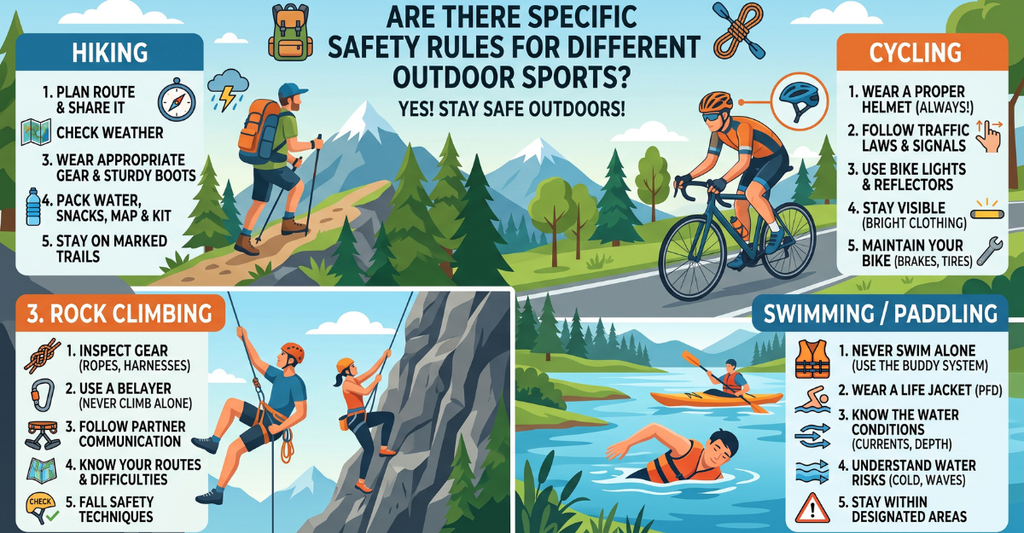
When you hit the trails, whether for a peaceful hike or an intense trail run, the terrain becomes your primary concern. Unlike the predictable surface of a treadmill or paved sidewalk, trails present constant variations that demand your full attention. Rocks, roots, mud, loose gravel, and steep inclines all require quick foot placement decisions and strong ankle stability. One of the most important safety rules specific to trail activities is maintaining situational awareness at all times—this means keeping your eyes on the path ahead, not just on your fitness tracker or phone.
Weather awareness takes on heightened importance when you’re miles from the trailhead. What starts as a beautiful sunny morning can transform into a dangerous situation if storms roll in and you’re exposed on a ridge or far from shelter. You should always check weather forecasts before heading out, but also learn to read cloud formations and recognize signs of changing conditions. Carrying extra layers, even on warm days, isn’t being overly cautious—it’s being prepared for the reality that temperatures drop as elevation increases and wet clothes can lead to hypothermia surprisingly quickly.
Navigation skills and tools are non-negotiable safety requirements for trail activities. Yes, your smartphone has GPS, but batteries die, signals disappear in remote areas, and technology fails. Carrying a physical map and compass—and knowing how to use them—represents a basic safety protocol that separates prepared outdoor enthusiasts from those who eventually need rescue. You should also always tell someone where you’re going and when you expect to return, creating a safety net if something goes wrong.
Proper footwear might seem obvious, but the specific type of trail shoe or boot you need depends on the terrain and distance you’re covering. Lightweight trail runners work great for maintained paths and shorter distances, but technical terrain or heavy packs require more substantial boots with ankle support. Your feet are your primary tool in these activities, and inadequate footwear is one of the most common factors in trail injuries.
Cycling and Mountain Biking Safety Protocols
The speed and mechanical nature of cycling introduce safety considerations that don’t exist in pedestrian activities. Your helmet isn’t optional gear—it’s the single most important piece of safety equipment you’ll use, and it needs to fit properly and be replaced after any significant impact. However, the type of helmet matters tremendously. Road cycling helmets prioritize aerodynamics and ventilation, while mountain biking helmets often include extended rear coverage and sometimes face protection for downhill riding.
When considering are there specific safety rules for different outdoor sports, cycling demonstrates how dramatically rules can vary even within subcategories of the same general activity. Road cycling safety focuses heavily on traffic awareness, hand signals, and riding predictably so motorists can anticipate your movements. You need to know traffic laws because in most places, bicycles are considered vehicles with the same rights and responsibilities as cars. Wearing bright, visible clothing and using lights isn’t just smart—in many jurisdictions, it’s legally required during low-light conditions.
Mountain biking, conversely, emphasizes trail etiquette, technical skill development, and equipment maintenance in ways that road cycling doesn’t. You need to understand right-of-way rules on multi-use trails, typically yielding to hikers and horseback riders. The technical demands of navigating obstacles, drops, and tight turns require specific skills that should be developed progressively, starting with easier terrain before advancing to more challenging trails. Your bike’s mechanical condition becomes critical when you’re miles from the trailhead—regular maintenance checks of brakes, tires, and suspension aren’t just about performance; they’re safety essentials.
Group riding introduces another layer of safety considerations regardless of cycling discipline. Communication through calls and signals keeps everyone informed about hazards, stops, and turns. Maintaining appropriate spacing prevents pile-ups if someone needs to brake suddenly. Riding with others who match your skill level reduces pressure to attempt features or speeds beyond your capability, which is particularly important when you’re helping your children develop their cycling skills.
Hydration and nutrition take on specific importance in cycling because the sustained nature of rides can deplete your energy stores faster than you realize. Bonking—the cyclist’s term for completely running out of energy—isn’t just uncomfortable; it’s dangerous because it impairs your judgment and reaction time. Carrying adequate water and quick-energy foods should be automatic whenever you’re planning rides longer than an hour.
Water Sports Safety Standards
The moment you enter the water for kayaking, paddleboarding, swimming, or any aquatic activity, you’re in an environment that’s fundamentally unforgiving of mistakes. Personal flotation devices (PFDs) represent the baseline safety equipment for virtually all water sports, yet many experienced swimmers skip them, overestimating their abilities or underestimating how quickly situations can deteriorate. Even Olympic-level swimmers can struggle if they’re injured, exhausted, or caught in unexpected currents.
Understanding water conditions requires specific knowledge that differs from any land-based sport. You need to recognize how wind creates waves and chop, how currents work differently in rivers versus lakes versus oceans, and how tides affect coastal paddling. Cold water immersion is particularly dangerous because it can incapacitate you through cold shock response within seconds, long before hypothermia becomes a factor. This is why water temperature should always influence your clothing choices, with wetsuits or drysuits required when water temperatures drop below certain thresholds, regardless of air temperature.
River activities introduce the concept of reading water, a skill set that takes time to develop but is absolutely essential for safety. You need to identify hazards like strainers (obstacles that allow water through but trap objects and people), hydraulics (recirculating currents that can hold swimmers or boats), and undercut rocks. River difficulty ratings provide guidance, but your personal skill level, fitness, and experience should always match or exceed the river classification you’re attempting.
Ocean and coastal activities bring tidal awareness, marine life considerations, and the possibility of being swept away from shore into the safety equation. Rip currents alone account for numerous drownings each year, yet many people don’t know how to identify or escape them. You should never paddle or swim alone in open water, and wearing brightly colored gear makes you more visible to other water users and potential rescuers.
The specific demands of different watercraft also require tailored safety approaches. Kayakers need to master wet exits and self-rescue techniques before venturing into challenging conditions. Stand-up paddleboarders should use a leash in most conditions to prevent separation from their board, which serves as a flotation device. Swimmers in open water need to account for the absence of pool walls and lane lines, making sighting skills and navigation critical for safety.
Rock Climbing and Bouldering Safety Requirements
Few outdoor sports demand the level of systematic safety protocols that climbing requires. The consequences of equipment failure or human error can be catastrophic, which is why the climbing community has developed extensive safety systems and culture. When people ask are there specific safety rules for different outdoor sports, climbing provides perhaps the clearest “yes” answer because the sport is essentially a series of safety checks and protocols.
Your rope system serves as your lifeline, making equipment inspection and proper use non-negotiable. Before every climb, you and your partner should perform mutual safety checks verifying that harnesses are properly fitted and doubled back, knots are correctly tied, belay devices are correctly loaded, and carabiners are locked. This redundant checking system exists because humans make mistakes, and catching those mistakes before they matter is what keeps climbers alive.
The specific techniques for rope climbing versus bouldering differ significantly enough that they’re almost separate sports from a safety perspective. Rope climbing emphasizes partnership, communication, and systematic belaying protocols. Your climber and belayer relationship requires absolute trust and attention—distractions while belaying can result in dropped climbers and serious injuries. The commands climbers use aren’t just tradition; they’re a communication system designed to prevent misunderstandings when you’re high off the ground with wind or distance making hearing difficult.
Bouldering eliminates rope systems but introduces different hazards centered around falls and landings. Crash pads are essential equipment, but pad placement and spotting techniques require specific knowledge. Your spotter isn’t there to catch you but to guide your fall toward pads and protect your head and spine from dangerous angles. The seemingly short falls in bouldering can still generate tremendous force, and awkward landings on ankles or wrists account for numerous injuries.
Outdoor climbing adds environmental factors that gym climbing eliminates. Rock quality assessment becomes critical—testing holds before committing your weight, recognizing loose rock, and understanding how moisture affects friction and hold integrity. Route finding is a skill unto itself, as outdoor routes aren’t marked with colored tape. Getting off-route can lead you into terrain beyond your skill level or create dangerous retreat scenarios.
Understanding climbing grades and honestly assessing your abilities prevents dangerous situations where you’re committed to moves or routes beyond your capability. The grading systems exist partly to help climbers make informed decisions about what’s appropriate for their skill level. Pushing your limits is how you improve, but there’s a significant difference between calculated progression and reckless overreaching.
Winter Sports Safety Considerations
Cold weather activities introduce physiological challenges that don’t exist in other seasons, making temperature management a primary safety concern. Your body loses heat much faster than it generates warmth, especially when you’re wet from sweat or precipitation. The layering system isn’t just for comfort—it’s a safety strategy that allows you to regulate temperature by adding or removing layers as your activity level changes. Base layers should wick moisture away from skin, mid layers provide insulation, and outer layers protect from wind and precipitation.
Frostbite and hypothermia represent real dangers that can develop surprisingly quickly, particularly in wet conditions or when wind chill factors dramatically lower the effective temperature. You need to recognize the early signs in yourself and others: excessive shivering, confusion, numbness in extremities, and loss of coordination. Your extremities are most vulnerable—fingers, toes, ears, and nose—so proper gloves, boots, and headwear aren’t optional accessories.
Snow and ice sports each have specific safety protocols that reflect their unique environments. Skiing and snowboarding safety emphasizes understanding slope ratings, maintaining control at all times, and yielding to downhill traffic. Terrain parks require progression through features matched to your skill level, and helmets have become standard equipment as awareness of head injury risks has grown. You should be able to stop or avoid obstacles at any point during your descent—if you can’t, you’re going too fast or the terrain is too advanced.
Avalanche safety represents a specialized knowledge area essential for anyone venturing into backcountry snow environments. This includes carrying and knowing how to use avalanche transceivers, probes, and shovels, but more importantly, it means understanding avalanche terrain, recognizing danger signs, and making conservative decisions about where and when to travel. Taking an avalanche safety course isn’t just recommended for backcountry skiing, snowboarding, or snowshoeing—it’s mandatory if you value your life and the lives of your companions.
Ice skating and hockey introduce their own considerations, particularly around ice thickness and quality. Natural ice should be at least four inches thick for individual activities and thicker for groups. Understanding that ice thickness varies across a single body of water, with areas near inlets, outlets, and pressure cracks being particularly dangerous, could save your life. You should never assume ice is safe just because others are on it.
Team and Field Sports Safety in Outdoor Settings
Organized outdoor sports like soccer, football, and ultimate frisbee combine athletic demands with contact risks and environmental factors. Field conditions play a huge role in injury prevention—uneven surfaces, holes, or excessively hard or slippery ground all contribute to ankle sprains, knee injuries, and falls. Before any game or practice, you should inspect the playing surface and address hazards where possible or adjust play style when necessary.
Heat-related illnesses become particular concerns in team sports because the competitive nature and social dynamics can push people to continue playing even when their bodies are showing warning signs. As a parent or coach, you need to enforce hydration breaks and recognize symptoms of heat exhaustion and heat stroke. Understanding that are there specific safety rules for different outdoor sports includes environmental awareness means adjusting practice intensity and duration based on temperature and humidity, not just following a predetermined schedule.
Contact sport participants need sport-appropriate protective equipment that fits properly and is maintained in good condition. Mouthguards prevent dental injuries and may reduce concussion severity. Shin guards, pads, and helmets for various sports need to meet safety standards and be replaced when damaged or outgrown. For parents, resisting the temptation to save money by using hand-me-down protective equipment that doesn’t fit properly is important—poorly fitting gear offers inadequate protection and can actually create hazards.
Warm-up and cool-down protocols specific to the demands of your sport help prevent muscle strains and other soft tissue injuries. Dynamic stretching before activity prepares muscles for explosive movements, while static stretching after activity aids recovery. The specific movements should mimic the sport’s demands—soccer players need to warm up legs and hips differently than baseball players warming up throwing arms.
Understanding concussion protocols has become increasingly important across all contact and collision sports. You need to recognize concussion symptoms, remove affected players immediately from activity, and follow proper return-to-play protocols that don’t rush recovery. The “shake it off” mentality has been proven dangerous, and second-impact syndrome—when someone sustains another concussion before fully recovering from the first—can be catastrophic.
Equipment Maintenance and Inspection Across Different Sports
Your safety equipment is only as reliable as your commitment to maintaining and replacing it. Different outdoor sports demand different inspection schedules and maintenance routines, but the underlying principle remains constant: your life depends on this gear functioning correctly when it matters most. For soft goods like ropes, harnesses, and personal flotation devices, you need to check for wear, damage, and age-related deterioration regularly, following manufacturer guidelines for replacement even when visible damage isn’t apparent.
Hard goods like helmets, carabiners, and bike components require inspection for cracks, deformation, and mechanical function. Your bike helmet should be replaced after any significant impact, even if no damage is visible, because the protective foam can compress in ways that compromise future protection. Climbing gear follows even stricter protocols, with many climbers maintaining detailed logs of when equipment was purchased and how it’s been used to inform replacement decisions.
Sport-specific maintenance knowledge prevents equipment failure during use. Your bicycle requires regular cleaning, lubrication, and adjustment of components subject to wear. Brake pads, tires, and chains need replacement at appropriate intervals. Your skis or snowboard needs edge maintenance and wax for proper performance and control. Kayaks and paddleboards need inspection for hull damage that could lead to leaks or structural failure.
Storage conditions also affect equipment longevity and safety. UV exposure, temperature extremes, moisture, and chemical exposure can all degrade materials even when equipment isn’t being used. Storing climbing ropes in hot car trunks, leaving bikes outside in the elements, or keeping PFDs in damp conditions all accelerate deterioration and compromise safety.
Emergency Preparedness Specific to Different Outdoor Environments
The emergency supplies and skills you need vary dramatically based on the outdoor sport and environment you’re engaging with. A first aid kit for trail running needs to address blisters, cuts, sprains, and possible fractures, while a kayaking kit needs to be waterproof and include items for hypothermia prevention. Understanding what emergencies are most likely in your chosen activity allows you to prepare specifically rather than carrying generic supplies that might not address your actual risks.
Communication devices appropriate to your environment are critical safety equipment. Cell phones work great when you have signal, but wilderness areas often don’t provide coverage. Personal locator beacons (PLBs), satellite messengers, and two-way radios fill this gap, but each technology has specific capabilities and limitations you need to understand. The key question when choosing communication equipment isn’t “what’s the coolest gadget” but “what will reliably work in the environments where I’ll be active and allow me to call for help if needed.”
Basic first aid and wilderness medicine skills should match the remoteness and risk level of your activities. A weekend warrior playing recreational soccer needs different medical knowledge than a backcountry mountaineer days from the nearest road. Wilderness First Responder (WFR) and Wilderness First Aid (WFA) courses teach you how to manage medical emergencies when professional help is hours or days away, a skillset that differs significantly from standard urban first aid training.
Your emergency action plan should be sport and location-specific. Before any outing, you should know the fastest route to professional medical care, whether that means the nearest hospital, ranger station, or location where helicopters can land. You should also understand the rescue resources available in your area—some regions have volunteer search and rescue teams, others have paid services, and some have virtually no organized rescue capability. This knowledge influences how conservatively you approach risk.
Teaching Safety Rules to Children in Different Outdoor Sports
As parents introducing children to outdoor activities, your approach to safety education needs to be age-appropriate while building a foundation for lifelong safe practices. Young children learn through repetition and modeling, so demonstrating safety behaviors consistently matters more than lengthy explanations. When you always wear your helmet, always check your equipment, and always follow protocols, your children internalize these behaviors as normal rather than optional.
The specific safety lessons vary by sport, but the meta-lesson remains constant: safety rules exist for reasons, not to take away fun but to enable long-term participation in activities we love. When teaching children cycling safety, you’re not just teaching them to wear helmets—you’re teaching them to assess risk, maintain equipment, and make smart decisions. These skills transfer across sports and into other life areas.
Progressive skill development keeps children safe while building confidence and competence. Rushing kids into advanced terrain or techniques before they’ve mastered fundamentals creates dangerous gaps in their abilities. A child who can barely control a bicycle on flat ground has no business riding trails with significant obstacles or descents. Taking the time to build solid basics might feel slow, but it prevents the injuries and frightening experiences that can turn kids off outdoor activities entirely.
Understanding that different children have different risk tolerances and physical abilities helps you tailor safety approaches individually rather than applying one-size-fits-all rules. Some kids are naturally cautious and need encouragement to push boundaries, while others lack fear and require firm limits. Your role as a parent includes helping children develop their own risk assessment capabilities so they eventually make good decisions independently.
Environmental Hazards Specific to Different Outdoor Activities
Wildlife encounters range from nuisance to deadly depending on the animals and your response. The safety protocols for different animals vary tremendously—what works when encountering a black bear could get you killed if you meet a grizzly. You need to research the specific wildlife in areas where you’ll be active and understand appropriate prevention and response strategies. Making noise while trail running prevents surprising bears, but staying quiet while wildlife watching protects both you and the animals.
Insects and arachnids present hazards that vary by region and season. Tick-borne diseases like Lyme disease require prevention through protective clothing, repellent use, and thorough post-activity checks. Bee and wasp stings can trigger life-threatening allergic reactions in sensitive individuals, making it essential to carry epinephrine auto-injectors if you have known allergies. Even non-allergic individuals should understand that multiple stings can be dangerous and that aggressive avoidance is smarter than trying to tough it out.
Plant hazards include everything from poison ivy causing painful rashes to thorny vegetation creating puncture wounds and eye injuries. Learning to identify and avoid problematic plants in your area is a basic outdoor skill that prevents miserable consequences. Some regions have plants with far more serious consequences—giant hogweed causes severe burns when sap contacts skin exposed to sunlight, and certain mushrooms can be fatal if ingested.
Give us a call today at 1-877-777-6086 or fill out our contact form to become a retail
distributor of our top-of-the-line safety lights