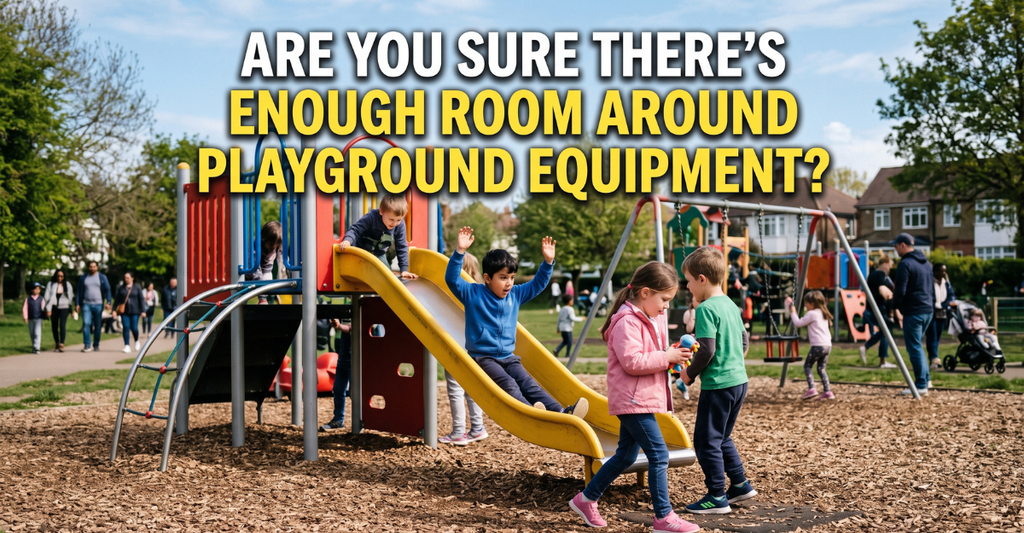
Picture this: you’re at the local park with your kids after a morning run, watching them scramble up the jungle gym with boundless energy while you catch your breath. Everything seems perfect until another child tumbles from the monkey bars, landing perilously close to a metal support beam. Your heart skips a beat. This scenario plays out more often than we’d like to admit, and it raises a critical question that many parents overlook: Is there enough room around playground equipment?
As fitness-minded parents, we’re vigilant about our children’s nutrition, their physical activity levels, and ensuring they develop healthy habits early in life. Yet, when it comes to playground safety, particularly the spatial requirements around equipment, many of us operate on assumptions rather than knowledge. We trust that playground designers and park managers have done their due diligence, but the reality is far more complex and concerning than most parents realize.
Understanding Playground Safety Zones and Fall Zones
When you evaluate whether there’s adequate space around playground equipment, you’re really assessing what safety experts call “use zones” or “fall zones.” These are designated areas surrounding each piece of equipment where children might land if they fall, jump, or dismount during play. The Consumer Product Safety Commission (CPSC) has established specific guidelines for these zones, yet compliance varies wildly from one playground to another.
Fall zones must extend in all directions from playground equipment, and the required distance depends on the height of the structure and the type of activity it’s designed for. For stationary equipment like climbers and slides, the fall zone typically needs to extend at least six feet from the perimeter. However, for equipment with moving parts—swings, in particular—the requirements become significantly more stringent.
Consider the physics involved when your child swings. The arc of motion creates a much larger danger zone than what’s immediately visible. A child can easily be propelled forward several feet upon jumping from a swing at full height, which is why safety standards require swing fall zones to extend forward and backward by a distance equal to twice the height of the swing beam. If you’re standing near a swing set, take a moment to pace out this distance. You might be surprised—and alarmed—at how much space is actually necessary.
The Overlooked Danger of Equipment Overcrowding
Many older playgrounds and even some newly constructed ones suffer from a critical flaw: equipment placed too close together. This overcrowding happens for various reasons, from budget constraints that lead to smaller playground footprints to poor planning that prioritizes aesthetics over safety. When manufacturers design catalog-perfect playground layouts, they often show equipment configurations that maximize visual appeal and play value within confined spaces, sometimes at the expense of adequate safety zones.
Walk through your local playground with fresh eyes, and you’ll likely notice areas where use zones overlap. Perhaps the slide’s exit point is too close to the swing set’s arc. Maybe the spinning equipment sits just feet away from a climbing structure. These overlapping zones create compound risks that multiply the chances of collision injuries. When children are actively engaged in play, their attention narrows to their immediate activity. A child focused on climbing won’t necessarily notice another child flying off a nearby swing.
The problem intensifies during peak usage times when multiple children occupy the same general area. As any parent who’s visited a crowded playground knows, chaos can erupt quickly. Children dart between equipment pieces, creating unpredictable movement patterns that even the most attentive parent struggles to monitor. In these situations, inadequate spacing between equipment transforms what should be a safe play environment into an obstacle course where injuries become increasingly likely.
Measuring Your Playground: A Practical Assessment
So how can you determine if your favorite playground has sufficient clearance? Start by becoming familiar with the basic spacing requirements. The CPSC recommends minimum six-foot use zones for most stationary equipment, measured from the equipment’s outermost edge. This means if you’re standing at the base of a climbing structure, there should be at least six feet of clear, unobstructed space in every direction before you encounter another piece of equipment, a fence, or any hard surface.
For swings, the calculation changes dramatically. Measure from the ground to the swing beam (the horizontal bar from which the swings hang). Take that measurement and multiply it by two—that’s the minimum distance required for the fall zone extending both in front of and behind the swing set. For example, if the swing beam is eight feet high, you need sixteen feet of clearance in both directions. Side-to-side clearance for swings requires a minimum of six feet from the support structure.
Here are the key measurements to check at your playground:
- Stationary climbing equipment: Six feet minimum clearance in all directions
- Slides: Six feet from the slide exit, with additional consideration for the arc of descent
- Swings: Two times the beam height front and back, six feet on the sides
- Merry-go-rounds and spinning equipment: Twelve feet diameter minimum for the use zone
- Spring rockers: Six feet minimum in all directions
- Overhead equipment like monkey bars: Six feet measured from below the equipment
Don’t just eyeball these distances. If you’re genuinely concerned about a particular playground, bring a measuring tape on your next visit. Pace out the distances (an average adult stride is roughly three feet), or use a long tape measure to get accurate readings. You might feel slightly conspicuous doing this, but other parents will likely appreciate your diligence, and you’re setting an excellent example of proactive safety awareness for your children.
Surface Matters: It’s Not Just About Distance
When considering whether there’s adequate room around playground equipment, distance is only part of the equation. The surface material within those use zones plays an equally critical role in injury prevention. A proper impact-absorbing surface must extend throughout the entire fall zone, not just directly beneath equipment. Many playgrounds fail this test, featuring appropriate surfacing under equipment but reverting to concrete, asphalt, or compacted dirt at the edges where fall zones should extend.
The depth and composition of protective surfacing directly correlate with the maximum fall height that surface can safely accommodate. Wood chips, engineered wood fiber, and rubber mulch must maintain specific depths (typically 9-12 inches) to provide adequate cushioning. Over time, these materials compact, get displaced during play, or scatter beyond the playground boundaries. What started as compliant surfacing can become dangerously inadequate within months without proper maintenance.
Rubber tiles and poured-in-place rubber surfaces offer more consistent protection but aren’t immune to degradation. Weather, heavy use, and time can cause these surfaces to crack, separate, or compress, reducing their shock-absorbing properties. When you’re assessing playground spacing, get down to ground level. Press your hand firmly into the surface. Does it give? Does it feel cushioned? Are there visible gaps, hard spots, or worn areas within the use zones?
The Active Parent’s Perspective on Playground Time
As someone committed to fitness and health, you understand that playground time serves multiple purposes for your children. It’s not merely about burning energy (though that’s certainly valuable). Playgrounds develop gross motor skills, spatial awareness, risk assessment abilities, and physical confidence—all qualities that lay the foundation for athletic capability later in life. The same coordination required to navigate monkey bars translates to better performance in organized sports, dance, martial arts, or any physical pursuit your child might later choose.
However, inadequate spacing around equipment undermines these developmental benefits. When children can’t safely explore the full range of motion that equipment allows, when they must constantly worry about colliding with other structures or children, their play becomes tentative and restricted. They learn caution in situations where they should be learning confidence. They develop anxiety around physical challenges rather than building the resilience that comes from mastering age-appropriate risks.
Think about your own athletic development. Whether you’re a runner, cyclist, swimmer, or CrossFit enthusiast, you likely built foundational physical literacy during childhood. The body awareness you now take for granted when navigating a trail run or adjusting your form mid-workout traces back to countless hours of unstructured physical play. When playground design compromises safety through inadequate spacing, it potentially compromises the next generation’s physical development.
Real-World Examples of Spacing Failures
Let’s examine specific scenarios you might encounter at playgrounds in your community. One common configuration places slides adjacent to climbing structures, seemingly efficient use of space but potentially dangerous. Children exiting slides often maintain momentum for several feet, yet the required six-foot clearance is frequently shortened to three or four feet before meeting another structure. A child running from the slide bottom can easily collide with someone climbing nearby equipment.
Another problematic design clusters multiple activity zones in a small footprint. Imagine a playground area of roughly 30 by 40 feet containing a swing set, a climbing structure, a slide, and a spring rocker. Mathematically, this space cannot accommodate appropriate use zones for all these elements simultaneously. The overlapping fall zones create a situation where safe play becomes nearly impossible when multiple children are present. Yet this exact scenario exists in countless school playgrounds, apartment complexes, and municipal parks.
Perimeter fencing presents another spacing challenge often overlooked. While fencing serves important purposes—containing young children, defining playground boundaries, creating a visual barrier from parking areas—it becomes a hazard when positioned too close to equipment. A chain-link fence just two feet from the outer reach of a swing set transforms that fence into a collision hazard. The same applies to benches, picnic tables, trees, and other fixed objects within or near use zones.
The Role of Equipment Age and Changing Standards
Safety standards evolve as research reveals new insights about injury patterns and prevention strategies. Playgrounds installed before current CPSC guidelines came into effect may have seemed perfectly safe at the time but fall short by today’s standards. If you’re visiting a playground that’s been in place for ten, fifteen, or twenty years, there’s a strong possibility that spacing doesn’t meet current recommendations, even if the equipment itself remains structurally sound.
This creates a dilemma for communities with limited budgets. Replacing or renovating playgrounds is expensive, often costing tens or hundreds of thousands of dollars. Consequently, many older playgrounds remain in use despite spacing deficiencies that would never pass inspection for new installations. As a parent and playground user, you can’t assume that because equipment is publicly accessible, it necessarily meets current safety standards. Due diligence falls partially on you.
Interestingly, home playground equipment often suffers from even more severe spacing issues than public installations. When families install backyard play sets, they typically work within the confines of their existing yard layout, which may not provide adequate space for proper use zones. The swing set gets positioned close to the fence to maximize yard space. The slide exits near the patio. Budget-conscious parents might add equipment piece by piece without considering cumulative spatial requirements. If you have or are considering home playground equipment, the same spacing standards apply, though enforcement is obviously nonexistent.
Advocating for Better Playground Design in Your Community
Once you’ve educated yourself about proper spacing around playground equipment, you’re equipped to become an advocate for improved playground safety in your community. Start by documenting specific concerns at playgrounds you and your family frequent. Take photographs showing tight clearances, overlapping use zones, or inadequate surfacing. Measure and record distances that fall short of recommended standards. This documentation provides concrete evidence rather than vague complaints.
Identify the appropriate authorities for the playgrounds in question. School playgrounds fall under school district facilities management. Municipal parks answer to city or county parks and recreation departments. Apartment or HOA playgrounds have property management oversight. Each organization has different processes for receiving and addressing safety concerns, but all should take documented safety issues seriously, particularly when presented with specific standard violations.
When you approach these entities, frame your concerns constructively. Rather than simply complaining that the playground is dangerous, present your findings alongside the relevant safety standards. Offer to participate in solutions, whether that means joining a playground safety committee, helping organize community fundraising for improvements, or assisting with surface material maintenance. Your expertise as someone knowledgeable about physical health and safety carries weight, especially when combined with a willingness to contribute to solutions.
Teaching Children Spatial Awareness on Playgrounds
While advocating for better playground design, you can simultaneously help your children develop better spatial awareness during play. Teach them to observe use zones and recognize danger zones around equipment, even if the playground layout is suboptimal. This serves dual purposes: it enhances their immediate safety while building cognitive skills that transfer to other physical activities and sports.
Start with simple concepts that young children can grasp. “See how far the swing can go? We need to stay outside that area when someone is swinging.” Demonstrate by walking the perimeter of the swing’s arc while the swing is in motion. For older children, involve them in the assessment process. Ask them to identify where someone might land if they jumped from the top of the climbing structure. Have them pace out distances and compare them to the spacing you’ve taught them should exist.
This educational approach transforms playground visits from passive supervision into active learning opportunities. Your children begin understanding that physical activity exists within a spatial context, that movement has consequences, and that being aware of surroundings is crucial for safety. These lessons directly translate to sports performance, trail running awareness, cycling safety, and every other physical pursuit that requires environmental consciousness.
The Intersection of Playground Safety and Overall Fitness Culture
For parents committed to raising healthy, active children, playground access and safety represent foundational elements of childhood fitness culture. If playgrounds feel dangerous or if children repeatedly witness or experience injuries, they develop negative associations with outdoor physical activity. Conversely, when playgrounds are properly designed with adequate spacing, appropriate surfacing, and age-suitable challenges, they become spaces where children build positive relationships with movement, risk-taking, and physical exploration.
Consider the parallel to your own fitness journey. You’re more likely to maintain a running routine if you have access to safe, well-maintained trails. You’ll stick with strength training if your gym has proper equipment spacing that allows safe movement. The same principle applies to children and playgrounds. The environment either facilitates or impedes the development of healthy physical habits.
Moreover, playground time offers unique benefits that organized sports and structured physical education can’t fully replicate. Unstructured play allows children to self-regulate intensity, experiment with movements, and develop intrinsic motivation for physical activity. They’re not following a coach’s instructions or completing assigned exercises—they’re moving for the pure joy of it. This intrinsic motivation is perhaps the most powerful predictor of lifelong physical activity, more influential than any structured program you might enroll them in.
Special Considerations for Different Age Groups
When evaluating whether there’s enough room around playground equipment, consider how different age groups use the same spaces. Toddlers move unpredictably and have limited awareness of their surroundings, requiring more supervision and potentially more clearance than recommended minimums would suggest. A three-year-old might wander directly into a swing’s path, completely oblivious to the danger, whereas an eight-year-old has better spatial awareness and can typically recognize and avoid such hazards.
Many modern playgrounds designate separate areas for different age groups—typically dividing spaces for children 2-5 and 5-12 years old. This separation helps address the different spatial needs and usage patterns of various developmental stages. However, these divisions only work if families respect them. When older children dominate equipment designed for toddlers, or when young children access equipment beyond their capabilities, the carefully planned spacing and safety features become less effective.
For preschool-aged children, look for playgrounds where equipment is scaled appropriately and where fall heights remain under six feet. The use zones around this equipment should be meticulously maintained because these younger children are still developing the motor control and judgment that older children possess. For school-aged children, appropriate challenges include greater heights and more complex movement patterns, but these must still exist within properly sized and surfaced use zones.
Weather, Seasons, and Spatial Requirements
An often-overlooked aspect of playground spacing involves how environmental conditions affect safety requirements. Wet surfaces become slippery, increasing the likelihood of falls and the distance children might travel when dismounting or losing their grip. Snow and ice can obscure surface materials, creating hard impact zones within areas that normally provide cushioning. Fallen leaves, particularly when wet, transform safe surfaces into slip hazards.
During spring and fall in many climates, morning dew makes playground equipment slick before drying mid-morning. If you’re visiting a playground early in the day, factor in reduced traction when assessing whether the existing clearances provide adequate safety margins. The six-foot minimum clearance assumes normal, dry conditions. When conditions are suboptimal, those margins shrink effectively because children are more likely to fall and may travel farther before landing.
Seasonal usage patterns also affect safety. Summer typically sees peak playground use, with more children present simultaneously and equipment in constant motion. This intensive use can quickly degrade surface materials, creating bare spots or compressed areas within fall zones that initially met depth requirements. If you’re a regular at a particular playground, you’ll notice how surfaces deteriorate over the summer and how maintenance (or lack thereof) affects safety as the season progresses.
Playground Equipment at Schools and Childcare Facilities
For parents of school-aged children, playground safety at educational facilities deserves special attention. School playgrounds often face unique challenges, including intensive use, limited budgets, and deferred maintenance. While schools are subject to safety regulations, enforcement varies by jurisdiction, and financial constraints often mean that known safety issues persist longer than they would at well-funded municipal parks.
Visit your child’s school playground when possible, ideally during recess when you can observe how many children use the space simultaneously. Count the number of children in proximity to each piece of equipment. Watch how they move between structures. Note whether adult supervision actively manages traffic flow or whether children navigate the space independently. These observations reveal whether the existing spacing is adequate for the actual usage patterns, which may differ significantly from design assumptions.
If you identify spacing concerns at your child’s school, understand that schools face complex liability considerations. Present your concerns to appropriate school administrators—typically the principal or facilities manager—with the same documented, standards-based approach you’d use for municipal playgrounds. Recognize that budget limitations may mean changes happen slowly, but that doesn’t diminish the importance of raising awareness about specific safety issues.
Making Equipment Spacing Part of Your Family Safety Routine
Just as you probably check your children’s bike helmets before rides or ensure they’re properly hydrated during sports activities, assessing playground spacing can become part of your standard safety routine. When you arrive at a new or unfamiliar playground, take two minutes to walk the perimeter. Observe the spacing between equipment. Check surface conditions. Identify potential problem areas where use zones overlap or where surfaces transition from appropriate materials to concrete or hard-packed earth.
Share your observations with your children in age-appropriate ways. Point out areas where they should exercise extra caution. Establish family rules about playground behavior that account for spacing issues you’ve identified. For example, if a particular playground has swings positioned too close to other equipment, your family rule might be that only one child at a time uses the swing area, or that children must wait until swings are completely stopped before crossing to other equipment.
This proactive approach models good safety habits without creating anxiety or limiting your children’s play experiences. You’re teaching risk assessment and management rather than risk avoidance. These skills serve children well beyond the playground context, helping them develop judgment that applies to all physical activities throughout their lives.
Give us a call today at 1-877-777-6086 or fill out our contact form to become a retail
distributor of our top-of-the-line safety lights.