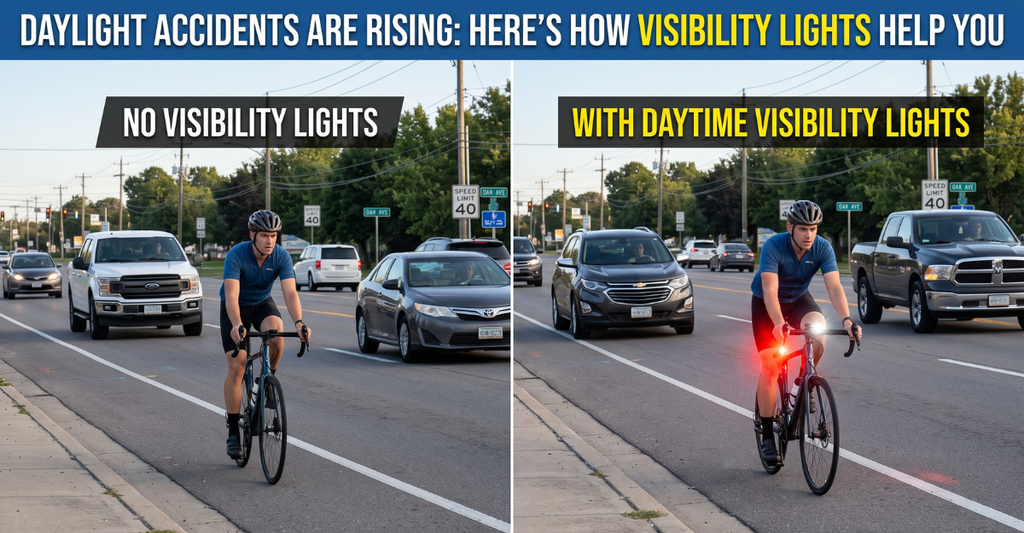
When you lace up your running shoes for a midday jog or head out for an afternoon walk with your kids, you probably feel pretty safe. After all, it’s daylight—drivers can see you clearly, right? Unfortunately, the statistics tell a different story. Daylight accidents are rising — here’s how visibility lights help save lives during what many consider the safest hours of the day. Recent data from the National Highway Traffic Safety Administration reveals that pedestrian and cyclist accidents during daylight hours have increased by nearly 18% over the past five years, a trend that has safety experts deeply concerned.
The assumption that visibility equals safety during daylight hours has created a dangerous false sense of security among runners, walkers, and cyclists. Modern life presents numerous distractions for drivers—from smartphones to in-car entertainment systems—that significantly reduce their ability to notice pedestrians even in bright sunshine. When you’re out there pushing through your workout or helping your children develop healthy exercise habits, you’re competing for drivers’ attention against countless digital diversions that didn’t exist a generation ago.
What’s particularly alarming is that many of these daytime accidents occur during what should be optimal visibility conditions. Clear, sunny days when you’d expect maximum safety can actually present unique challenges, including sun glare that blinds drivers temporarily, shadows that obscure pedestrians, and the visual clutter of busy urban environments where movement gets lost in the chaos. Understanding these risks is the first step toward protecting yourself and your loved ones during outdoor activities.
Why Traditional Safety Measures Aren’t Enough Anymore
You’ve probably been told to wear bright colors when exercising outdoors. Maybe you’ve invested in neon yellow shirts, reflective vests, or fluorescent running gear. While these measures certainly help, they’re increasingly insufficient in our modern traffic environment. The human eye naturally filters out static objects, especially in environments with visual complexity like city streets, suburban neighborhoods with parked cars, or tree-lined running paths where dappled sunlight creates confusing patterns of light and shadow.
Bright clothing blends into the background more easily than you’d think. Consider the typical urban or suburban landscape: colorful storefronts, painted vehicles, vibrant signage, and naturally bright elements like flowering trees or sunlit buildings. Your neon green running shirt might stand out in your closet, but on the street, it becomes just another splash of color in an already colorful world. This phenomenon, known as visual clutter or cognitive overload, means that even attentive drivers may genuinely not see you until it’s too late to react.
The speed at which modern traffic moves compounds this problem significantly. When a driver traveling at 35 miles per hour experiences even a two-second distraction, their vehicle covers more than 100 feet. That’s more than enough distance to fail to notice a runner crossing an intersection or a parent with a jogging stroller entering a crosswalk. Static bright colors simply don’t trigger the same rapid-response recognition in the human brain that moving or flashing lights do, which is where visibility lights become absolutely crucial.
Understanding How Visibility Lights Work With Human Perception
The science behind why visibility lights help during daylight hours is rooted in how our brains process visual information. Human vision evolved to detect movement and changing light patterns as potential threats or important stimuli requiring immediate attention. A flashing or pulsing light triggers what neurologists call the “orienting response”—an automatic, involuntary reaction that causes us to notice and focus on the light source. This biological programming happens faster than conscious thought, making it incredibly effective at grabbing drivers’ attention even when they’re distracted.
Visibility lights create what’s known as a “pop-out effect” in the field of vision. Unlike static reflective materials that only work when light hits them at the correct angle, active visibility lights generate their own illumination that works from multiple angles and in various lighting conditions. They don’t rely on external light sources, making them effective even in those tricky situations like shaded paths, overcast days, or when you’re running with the sun behind you and drivers are looking into glare.
Modern visibility lights designed for athletes and active parents use LED technology that’s specifically engineered for maximum daytime visibility. These aren’t the same as nighttime lights; they employ different wavelengths and flashing patterns optimized for daylight conditions. The best ones use high-intensity output combined with strategic flash patterns that the human eye simply cannot ignore, creating a distinctive visual signature that says “human in motion” rather than blending into the environmental background noise.
Types of Visibility Lights for Different Activities and Athletes
Finding the right visibility lights for your specific activities makes all the difference in both safety and comfort. Runners typically benefit most from lightweight, clip-on LED lights that attach to waistbands, arm bands, or shoe laces without adding significant weight or creating uncomfortable bouncing. These compact units can flash in multiple patterns—steady burn, slow flash, or rapid strobe—with the strobe pattern generally offering maximum visibility during daylight hours when you need to stand out against bright backgrounds.
For cyclists, spoke lights and frame-mounted visibility lights create a dynamic visual pattern that clearly identifies you as a moving vehicle on the road. When your wheels are spinning, these lights create circular patterns of light that are impossible for drivers to mistake for stationary objects. Combining these with handlebar-mounted and seat post lights creates 360-degree visibility that protects you from inattentive drivers approaching from any direction. Many competitive cyclists have started using these not just for early morning or evening rides, but for all daylight training rides after experiencing too many close calls.
Parents who run or walk with children need visibility solutions that protect the whole family. Stroller lights have become increasingly popular, with models that attach to stroller frames and create a wider visibility profile that alerts drivers to the presence of both adult and child. Visibility light vests designed for children come in adjustable sizes and feature multiple light points distributed across the torso, making your kids visible whether they’re on bikes, scooters, or just walking beside you. These family-oriented solutions recognize that protecting your children during outdoor activities is just as important as maintaining your own fitness routine.
The Data Behind Daytime Visibility: What Research Shows
Studies conducted by transportation safety researchers consistently demonstrate that visibility lights reduce accident risk by significant margins even during full daylight. A landmark study by the University of Wisconsin’s Traffic Operations and Safety Laboratory found that pedestrians wearing active LED lights were detected by drivers an average of 3.2 seconds earlier than those wearing only bright clothing—a difference that translated to an additional 150 feet of reaction distance at typical urban speeds. Those precious seconds represent the difference between a safe stop and a tragedy.
European research, where cycling and pedestrian safety have been studied extensively for decades, shows even more dramatic results. A Danish study tracking over 8,000 cyclists found that those using daytime running lights experienced 47% fewer accidents during daylight hours compared to cyclists without active lighting. The researchers specifically noted that the protective effect was strongest during what they termed “visual complexity conditions”—busy streets, mixed traffic, and situations with multiple simultaneous visual stimuli competing for drivers’ attention.
What’s particularly relevant for fitness enthusiasts is that these studies controlled for other safety behaviors. The cyclists and pedestrians using visibility lights weren’t automatically more cautious in other ways; the lights themselves provided the measurable safety benefit. This means that even if you’re already following best practices—using crosswalks, making eye contact with drivers, staying alert—adding visibility lights to your safety toolkit provides an additional, quantifiable layer of protection that works independently of your other precautions.
Choosing the Right Visibility Lights for Your Needs
Not all visibility lights are created equal, and understanding what features matter most helps you make informed choices for yourself and your family. Brightness measured in lumens is your first consideration, but for daylight use, you need significantly more output than nighttime lights. While 50 lumens might suffice for being seen at night, daytime visibility often requires 100-300 lumens or more, especially if you exercise in bright sunshine or areas with significant ambient light pollution from buildings and reflective surfaces.
Flash pattern versatility gives you options for different conditions and personal preferences. Some situations call for a steady burn that provides constant visibility, while others benefit from attention-grabbing strobe patterns. The most effective daytime visibility lights offer multiple modes so you can adapt to your environment—perhaps using a slower pulse for quiet residential areas where you don’t want to be overly disruptive, and switching to rapid strobe when navigating busy intersections or high-traffic corridors where maximum attention-getting power is essential.
Battery life and charging convenience matter tremendously when you’re maintaining a regular exercise schedule. USB-rechargeable lights eliminate the ongoing cost and environmental impact of disposable batteries, but you need sufficient battery capacity to last through your typical activities without constant recharging. Look for lights offering at least 4-6 hours of runtime in your preferred flash mode, and consider keeping a spare set so you always have a charged pair ready when it’s time for your workout. Weather resistance is equally critical—your visibility lights need IPX4 rating at minimum to handle sweat and rain without failing when you need them most.
Real-World Applications: Stories From Athletes Who’ve Been There
Marathon runner Sarah Chen credits her visibility lights with preventing what could have been a serious accident during a training run on a bright Saturday morning. Despite wearing a fluorescent pink shirt and running on a designated pedestrian path, a driver making a right turn on red didn’t see her approaching the crosswalk. “I had right of way and assumed they’d stop, but they were clearly looking left for traffic and never glanced right where I was coming from,” Sarah recalls. “The driver later told me that it was my flashing chest light that finally caught their peripheral vision just in time to brake. Without that light, they would have hit me at probably 15 miles per hour—more than enough to cause serious injury.”
Mike Rodriguez, a father of three who bikes with his kids most weekends, experienced a revelation about daylight visibility after a frightening near-miss. His family was riding on a bike path that crossed several residential driveways when a car backed out directly into their path. “We were all wearing bright jerseys and helmets, and it was 2 PM on a sunny day—perfect visibility, or so I thought,” Mike explains. “After that scare, I equipped everyone with spoke lights and clip-on LEDs. The difference in how drivers react to us is night and day. Now I see drivers actually stopping and waiting before we even reach driveways, clearly spotting us much earlier.”
Triathlete and busy mom Jennifer Walsh incorporates visibility lights into her daily routine after learning firsthand that daylight accidents are rising — here’s how visibility lights help combat this trend. “I do most of my training during the day while my kids are in school, and I always thought midday was the safest time,” she says. “But I started noticing more close calls, especially with distracted drivers on their phones at stoplights. Adding a belt with integrated LED lights made an immediate difference. Drivers now see me crossing in front of them at intersections instead of almost turning into me. It’s become as essential to my running gear as my shoes.”
Integrating Visibility Lights Into Your Existing Fitness Routine
Making visibility lights a consistent part of your exercise routine doesn’t require a complete overhaul of your current habits or gear. Start by identifying your highest-risk activities and situations—perhaps your morning commuter run through downtown intersections, or your family’s weekend bike rides through neighborhoods with lots of driveway crossings. These high-risk situations are where visibility lights provide the most immediate protective benefit and where you should prioritize implementation first.
Build a charging routine just as you’ve built your workout routine. Many athletes find success designating a specific location—perhaps near their phone charging station or in their mudroom—where visibility lights always get plugged in after each use. Treating the lights like your phone, with regular charging as automatic habit, ensures they’re always ready when you need them. Some families create a “safety station” where all outdoor exercise equipment, including helmets, reflective gear, and visibility lights, is stored and charged in one convenient location.
Involve your children in understanding why these safety measures matter. When kids understand that visibility lights help keep them safe just like helmets protect their heads, they’re more likely to remember and actually use them. Make it part of the pre-activity ritual: helmet on, lights activated, just like checking bike tires or tying shoes. For younger children, lights can even make safety fun—many kids love the attention and feeling of being “lit up like a superhero” during family activities, transforming a safety measure into something they actually look forward to using.
The Technology Evolution: What’s New in Visibility Lighting
The visibility lighting market has evolved dramatically in recent years, driven by growing awareness of pedestrian and cyclist safety concerns. Modern lights incorporate smart features that enhance both functionality and convenience. Motion sensors in some models automatically activate lights when you start moving and deactivate them after a period of stillness, conserving battery life and eliminating the need to remember to turn them on and off. This automatic operation makes them particularly appealing for athletes focused on their workouts rather than gear management.
Connectivity features are emerging in premium visibility lights, with Bluetooth-enabled models that sync with fitness apps to track not just your performance metrics but also your visibility status. These smart lights can send alerts to your phone if battery levels drop below safe thresholds, or even log the conditions during which you exercised—time of day, ambient light levels, duration with lights active—providing data that helps you refine your safety practices over time. Some models integrate with bike computers or running watches, giving you at-a-glance confirmation that your visibility systems are functioning during your activity.
Solar-charging capabilities are beginning to appear in high-end models, particularly those designed for ultra-distance athletes or anyone spending extended periods outdoors. While still nascent technology, solar-assist charging can extend battery life significantly during long training days, and the technology continues improving rapidly. Materials science advances have also produced more durable, lighter, and more weather-resistant housings that can withstand the punishment of serious athletic training—everything from trail running through brush to cyclocross racing in muddy conditions.
Breaking Down the Psychology of Driver Attention
Understanding why drivers fail to see clearly visible pedestrians and cyclists during daylight hours requires examining the cognitive psychology of attention and perception. The human brain processes an enormous amount of visual information every second, but conscious awareness captures only a tiny fraction of that input. Drivers navigate through something called “selective attention,” where their brains filter out most environmental stimuli to focus on what their driving experience has taught them to consider relevant—other cars, traffic signals, road signs, and obvious obstacles.
This selective attention creates a phenomenon researchers call “inattentional blindness,” where people literally don’t see things directly in their field of vision if those things don’t match what they’re actively looking for. In driving contexts, this means motorists scanning for vehicle traffic may genuinely not consciously register a runner or cyclist, even when looking directly at them. Their brains classify pedestrians as background information rather than relevant traffic, especially in areas where pedestrian activity is less common or expected. The insidious part is that drivers aren’t lying when they say they never saw you—their conscious awareness truly missed you, even though the image reached their eyes.
Visibility lights counteract inattentional blindness by triggering more primitive attention mechanisms that operate below conscious awareness. The movement and light variation created by flashing LEDs activates neural pathways evolved to detect potential threats or important changes in the environment. This biological programming overrides the learned filtering of selective attention, forcing the brain to consciously register the light source and, by extension, the person wearing it. You’re essentially using technology to hack the driver’s visual processing system, ensuring your presence registers at the unconscious level before the driver’s conscious mind might otherwise notice you.
Visibility Lights and Legal Liability Considerations
While the primary motivation for using visibility lights should always be personal safety, there are also legal and liability factors worth considering. In an unfortunate accident scenario, demonstrating that you took proactive safety measures beyond the legal minimums can significantly impact liability determinations and insurance claim outcomes. Pedestrians and cyclists wearing active visibility lighting establish a clear record of reasonable care for their own safety, which can be crucial if fault becomes disputed in accident investigations.
Several jurisdictions have begun incorporating daytime visibility lighting into their traffic codes and safety recommendations. While most don’t yet legally require lights during daylight hours, some progressive municipalities have added daytime lighting to their official safety guidelines for cyclists and runners. Being ahead of these regulatory trends demonstrates safety consciousness and can provide additional protection if you’re ever involved in a traffic incident. Insurance companies, too, are increasingly considering safety equipment use when evaluating claims, with some even offering premium discounts for cyclists who commit to using daytime visibility lighting.
For parents, the liability considerations extend to your children’s safety. Ensuring your kids use appropriate visibility lights during outdoor activities isn’t just about immediate physical safety—it’s also about establishing patterns of responsible safety behavior that protect them throughout their lives. Teaching children that safety is about making yourself visible rather than just following rules creates an internal safety orientation that serves them well as they become independent cyclists, runners, and eventually drivers themselves.
Addressing Common Objections and Concerns
Many athletes initially resist adding visibility lights to their daytime routine, citing various concerns that deserve thoughtful consideration. The “I don’t want to look silly” objection is perhaps the most common, reflecting legitimate concerns about appearing overly cautious or paranoid during what most people consider safe conditions. However, perspective matters here: Would you rather look slightly overcautious or end up injured because you prioritized appearance over safety? Moreover, as more athletes adopt this practice, the social stigma diminishes rapidly—in many running and cycling communities, daytime visibility lights are becoming the norm rather than the exception.
Weight and comfort concerns are valid for serious athletes where every ounce matters and any bouncing or chafing can ruin a long training run or ride. Modern visibility lights address these concerns effectively, with many models weighing less than an ounce and featuring secure mounting systems that prevent the annoying bounce that plagued earlier generations of running lights. Clip-on models with silicone grips, magnetic attachments, or integrated belt systems stay securely in place during even the most vigorous activities. If you’re training for a marathon or triathlon, test different mounting options during training runs to find what works for your body and movement patterns.
The cost consideration resonates especially with budget-conscious parents trying to equip entire families with safety gear. While quality visibility lights represent an investment, consider the cost relative to other safety equipment you purchase without question—bike helmets, quality running shoes with proper support, or protective gear for sports. A good set of visibility lights typically costs less than a single pair of running shoes and can last for years with proper care. Additionally, the tiered market offers options at multiple price points, so you can start with basic but effective models and upgrade as budget allows, making this safety enhancement accessible to families at all income levels.
Combining Visibility Lights With Other Safety Practices
Visibility lights work best as part of a comprehensive safety approach rather than a standalone solution. Continue practicing defensive running and cycling techniques—making eye contact with drivers before entering intersections, assuming drivers don’t see you until their behavior proves otherwise, and choosing routes with dedicated pedestrian and cycling infrastructure when possible. The lights enhance your visibility dramatically, but they don’t replace situational awareness and defensive movement strategies.
Reflective clothing and accessories still have value, especially in combination with active lighting. Reflective elements work through a different mechanism than visibility lights, returning light from vehicle headlights directly back to the driver. In varied lighting conditions—like dawn, dusk, or shadowed areas during daylight—this combination provides redundant safety systems. Think of it as similar to wearing both a seatbelt and having airbags in your car; each system offers protection through different mechanisms, and together they provide comprehensive coverage across various accident scenarios.
Route planning remains a crucial safety factor that visibility lights complement but don’t replace. Whenever possible, choose routes with lower traffic volumes, slower speed limits, and better pedestrian infrastructure. Well-maintained sidewalks, dedicated bike lanes, and marked crosswalks reduce your exposure to dangerous situations even as your lights make you more visible within those situations. Research local trails and paths using running and cycling apps that include safety ratings and user comments—fellow athletes often provide valuable insights about problem intersections, inattentive driver hot spots, or times of day when particular routes become more dangerous.
Special Considerations for Different Weather and Environmental Conditions
Weather dramatically impacts both accident risk and visibility requirements, making adaptable lighting strategies essential. Bright sunshine creates its own visibility challenges, counterintuitive as that may seem. Sun glare blinds drivers temporarily but continuously as they navigate, especially during morning and evening hours when the sun sits lower in the sky. During these conditions, maximum-intensity visibility lights become absolutely essential. Drivers struggling with glare have severely compromised vision, and only the strongest visual signals penetrate their impaired awareness—your fluorescent shirt certainly won’t do it, but a 200-lumen strobing LED has a fighting chance.
Overcast and rainy conditions require rethinking your visibility strategy even during midday hours. Reduced ambient light levels on cloudy days decrease the visual contrast that makes bright clothing noticeable, and rain creates visual noise that further obscures pedestrians and cyclists from drivers’ awareness. Wet conditions also increase vehicle stopping distances and reduce tire traction, meaning drivers need even more advance warning to react safely to your presence. In these conditions, use your highest-intensity light settings and consider adding redundant light sources—perhaps lights on both upper and lower body—to maximize your visibility profile.
Give us a call today at 1-877-777-6086 or fill out our contact form to become a retail
distributor of our top-of-the-line safety lights.