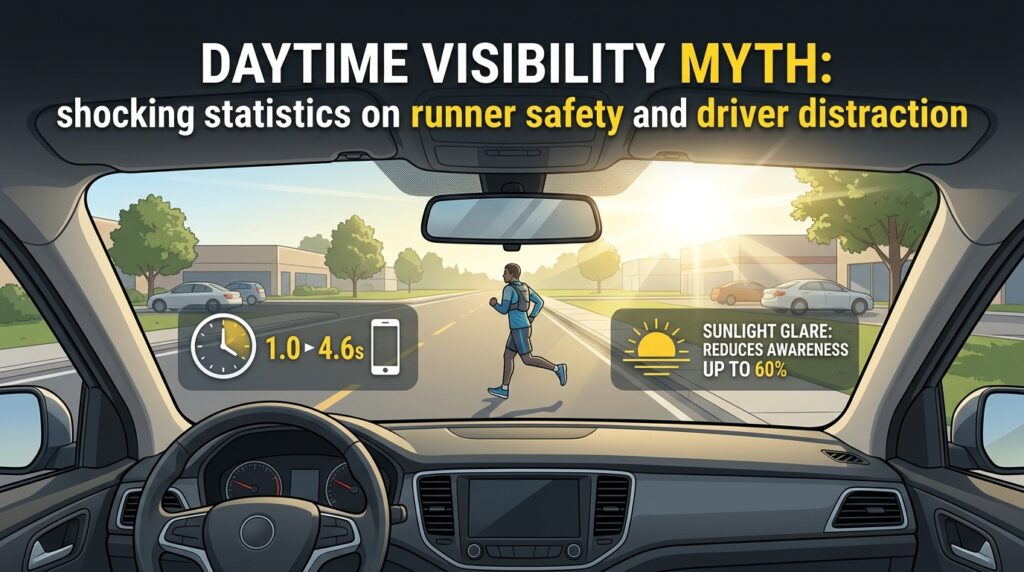
When you lace up your running shoes and head out for your morning jog or evening workout, you probably don’t spend much time thinking about whether drivers can actually see you. After all, it’s broad daylight, right? The sun is shining, visibility seems perfect, and you’re running on familiar roads in your neighborhood. However, what the data says about visibility and driver awareness during daylight might surprise you—and potentially save your life or the life of someone you love.
Research conducted by the National Highway Traffic Safety Administration reveals a startling truth: approximately 75% of pedestrian fatalities occur during daylight hours, not at night as most people assume. This counter intuitive finding challenges everything we thought we knew about runner safety. The problem isn’t simply about whether drivers can physically see you; it’s about whether they’re actually paying attention, processing what they’re seeing, and reacting appropriately to your presence on or near the roadway.
For busy moms juggling family responsibilities while trying to maintain their fitness routines, and for dedicated athletes who squeeze in training runs whenever their schedules allow, understanding these visibility dynamics becomes absolutely critical. You might be visible in the technical sense, but that doesn’t automatically translate to driver awareness or safety.
Breaking Down the Data on Daytime Visibility
The statistics surrounding pedestrian and runner safety during daylight hours paint a concerning picture that demands our attention. According to comprehensive studies analyzing traffic incidents involving pedestrians and runners, the peak danger times actually occur during what should be the safest periods. Between 6 AM and 9 AM, when many of us squeeze in our morning runs before work or after dropping kids at school, driver distraction rates spike by nearly 40% compared to mid-morning hours.
What makes these findings particularly relevant is that driver awareness doesn’t correlate directly with optimal lighting conditions. A study published in the Transportation Research Record found that even in perfect visibility conditions—clear weather, bright sunshine, and unobstructed views—drivers failed to notice pedestrians and runners in approximately 35% of observed interactions. This failure rate increased to over 50% when drivers were approaching intersections or making turns, situations that runners frequently encounter during their routes.
The data becomes even more nuanced when we examine different times of day. Morning commute hours see drivers who are often rushed, distracted by thoughts of their upcoming workday, or engaged with smartphones despite laws prohibiting such behavior. Research from Virginia Tech Transportation Institute, which equipped vehicles with sophisticated monitoring equipment, revealed that drivers take their eyes off the road for an average of 4.6 seconds during daylight hours when using phones—enough time to travel the length of a football field at residential speeds. During these moments of inattention, you could be running directly in a driver’s path and they simply wouldn’t register your presence until it’s potentially too late.
Environmental Factors That Compromise Driver Awareness
Sunlight, while generally considered a safety asset, actually creates specific visibility challenges that the data highlights with alarming clarity. Glare from low-angle sun during morning and evening hours reduces driver awareness by as much as 60%, according to studies from the Federal Highway Administration. When you’re out for your 6 AM run, enjoying the quiet streets and cool morning air, the sun rising behind you might be creating a blinding glare for oncoming drivers, rendering you essentially invisible despite perfect weather conditions.
Additionally, the phenomenon known as “motion-induced blindness” affects drivers more significantly during daylight hours than previously understood. This occurs when drivers focus on other moving objects—other vehicles, cyclists, or even environmental elements like swaying trees—causing stationary or predictably moving objects like runners to temporarily disappear from their conscious perception. You might be running at a steady pace, perfectly visible to anyone who looks, but a driver’s brain can actually filter you out of their awareness while they track other elements of the traffic environment.
The Psychology Behind Driver Inattention
Understanding what the data says about visibility and driver awareness during daylight requires delving into the psychological mechanisms that govern human attention and perception. Our brains aren’t designed to process every piece of visual information simultaneously—they’re selective, prioritizing certain stimuli while filtering out others. For drivers, this selective attention becomes particularly problematic when it comes to noticing runners and pedestrians.
Cognitive load research demonstrates that drivers operating in familiar environments—like their daily commute routes—actually pay less attention to their surroundings than when navigating unfamiliar areas. This phenomenon, called “automaticity,” means that the neighborhood streets where you regularly run might be precisely where local drivers are least attentive. Their brains have essentially automated the driving process, freeing up cognitive resources for other thoughts, which unfortunately often means they’re mentally rehearsing presentations, planning their day, or worrying about family obligations rather than actively scanning for runners.
The data also reveals a troubling pattern regarding expectation and awareness. Drivers tend to notice what they expect to see. On roads without sidewalks or designated running paths, where pedestrian traffic is less common, drivers are significantly less likely to notice runners even when visibility is optimal. A comprehensive study examining driver eye-tracking patterns found that in suburban and rural areas, drivers scanned sidewalk and shoulder areas only 12% as frequently as they scanned the roadway itself, even during daylight hours when runners are commonly present.
Technology’s Impact on Driver Awareness
Modern technology has dramatically altered the landscape of driver attention, and the statistics are sobering. Distracted driving incidents have increased by 400% over the past decade, with the majority occurring during daylight hours when drivers feel safer and more confident about multitasking. Your morning run now competes not just with natural visibility challenges but with smartphones, navigation systems, and increasingly complex vehicle infotainment systems that fragment driver attention.
Research tracking actual driving behavior through naturalistic studies—where drivers’ everyday behaviors are monitored over extended periods—shows that people engage in distracting activities during 52% of their daylight driving time. These activities include:
- Texting or reading text messages while driving
- Adjusting music or podcast settings on phones or vehicle systems
- Eating breakfast or drinking coffee during morning commutes
- Checking or applying makeup in the rearview mirror
- Programming navigation systems while the vehicle is in motion
- Having animated conversations with passengers or on hands-free phones
Each of these activities reduces a driver’s ability to notice you running along the roadside, regardless of how bright and sunny the day might be.
Critical Time Periods for Runner Vulnerability
When we examine the temporal patterns in the data, specific windows emerge as particularly dangerous for runners, and understanding these patterns helps you make more informed decisions about when and where to run. The hours between 3 PM and 6 PM consistently show elevated incident rates involving runners and pedestrians, a time period that many busy parents use for their workouts after picking up kids from school or finishing work responsibilities.
What makes this afternoon window so dangerous combines multiple factors. Driver fatigue accumulates throughout the workday, reducing reaction times and attention spans. The afternoon sun angle creates challenging shadow patterns and glare situations. Additionally, traffic volume increases as people begin their evening commutes, creating more potential conflict points between runners and vehicles. Studies analyzing accident data across multiple states found that runner-involved incidents during this period were 73% more likely to result in serious injury compared to incidents during mid-morning hours.
Weekend mornings present another interesting data point. While many runners assume weekend traffic is lighter and therefore safer, the statistics tell a more complex story. Weekend drivers are often less familiar with routes they’re traveling, more likely to be distracted by family conversations or entertainment systems, and operating on different sleep schedules that may affect alertness. Research from urban planning departments analyzing weekend pedestrian incidents found that Saturday and Sunday mornings between 8 AM and 11 AM actually see higher per-capita incident rates in residential neighborhoods compared to weekday mornings, despite lower overall traffic volumes.
Seasonal Variations in Visibility Challenges
The data on seasonal impacts reveals patterns that should influence your running schedule and safety strategies throughout the year. Spring and fall create unique visibility challenges during daylight hours due to rapidly changing sun angles and unpredictable weather conditions. During these transitional seasons, the sun’s position shifts noticeably week by week, creating new glare situations that drivers haven’t yet adapted to. Additionally, precipitation events become more variable—a sunny morning run can quickly become a wet, visibility-reduced situation where road spray and misted windows compromise driver awareness.
Summer brings its own set of challenges despite longer daylight hours and generally favorable weather. Heat-related driver fatigue increases, windows are often partially open allowing more distractions from outside the vehicle and reducing the sealed environment that might otherwise help maintain focus. Moreover, summer vacation periods see more unfamiliar drivers navigating residential neighborhoods, tourists traveling in areas they don’t know, and teen drivers on the roads—all factors that correlate with reduced pedestrian awareness according to traffic safety research.
Understanding the Contrast and Detection Problem
One of the most critical insights from visibility research involves how the human eye detects and processes objects against different backgrounds. Even in broad daylight with perfect weather conditions, if your running attire blends with the environmental background, driver awareness drops precipitously. Studies using driving simulators with eye-tracking technology have demonstrated that drivers detect high-contrast runners—those wearing bright colors that sharply contrast with their surroundings—3.2 seconds earlier than runners wearing colors that blend with the environment.
This detection delay might not sound significant, but at typical residential speeds of 25-35 mph, those few seconds represent the difference between a driver having adequate time to adjust their vehicle path and a dangerous close encounter. What the data says about visibility and driver awareness during daylight consistently emphasizes this contrast factor as one of the most controllable variables affecting your safety. The challenge is that optimal contrast colors change depending on your running environment and seasonal factors.
In urban environments with lots of gray concrete, gray or black running clothes—popular choices because they hide sweat and dirt—create minimal contrast. In suburban neighborhoods with abundant greenery, earth-tone athletic wear blends into the background. Even white or light-colored clothing can create problems against bright sky backgrounds during certain times of day. Research conducted across various environments found that fluorescent colors, particularly fluorescent yellow, lime green, and orange, provided the best contrast across the widest range of backgrounds and lighting conditions during daylight hours.
The Motion Detection Advantage
Beyond static visibility, the way drivers perceive motion plays a crucial role in whether they notice and appropriately respond to your presence while running. The human visual system has specialized neural pathways dedicated to detecting movement, an evolutionary adaptation that helped our ancestors notice both threats and opportunities in their environment. For modern runners, understanding how to leverage these motion detection mechanisms can enhance your visibility to drivers.
Data from cognitive psychology research shows that bilateral motion—movement that’s visible from both sides of an object—triggers faster recognition responses in observers. This explains why runners with reflective or bright elements on both sides of their body, particularly on moving parts like arms and legs, are noticed more quickly by drivers. Studies comparing detection times found that runners with bilateral markers were noticed an average of 1.8 seconds sooner than those with single-point visibility elements.
The speed and predictability of your movement also affects driver awareness. Runners maintaining steady, predictable pace patterns are more easily tracked by drivers than those with erratic movement. However, this doesn’t mean you should avoid interval training or speed work; rather, it suggests being extra cautious during workout segments where your pace or direction changes unpredictably. Additionally, research indicates that drivers have particular difficulty judging the speed and trajectory of runners when vehicles are making turns, with error rates in speed estimation exceeding 40% during turning maneuvers.
Geographic and Environmental Context Matters
Where you choose to run dramatically impacts your visibility and the likelihood that drivers will notice and appropriately respond to your presence. Urban, suburban, and rural environments each present distinct visibility challenges supported by different data patterns. Dense urban areas, while having higher overall traffic volumes, actually show better driver awareness of pedestrians and runners according to incident rate analysis. This likely occurs because urban drivers expect to encounter people on foot, maintain lower speeds, and navigate environments with more frequent stop signs and traffic signals that break up automaticity patterns.
Suburban environments present a middle ground with unique challenges. These areas often feature higher vehicle speeds than urban cores, less frequent traffic control devices, and a mix of sidewalks and shoulder running that creates ambiguity about where runners should be positioned. Data analyzing suburban runner incidents reveals that intersections and driveways account for 68% of all daylight hours conflicts between runners and vehicles in these environments. Drivers pulling out of driveways or side streets often focus exclusively on vehicular traffic approaching from the roadway, completely overlooking runners on sidewalks or shoulders.
Rural running environments show the most concerning statistics despite often being chosen specifically for their perceived safety and scenic qualities. Lower traffic volumes create a false sense of security, while higher speeds, limited shoulders, curves, and hills all compromise driver awareness. Research from state transportation departments indicates that rural roads account for a disproportionate percentage of serious incidents involving runners despite representing a smaller fraction of total running activity. The combination of higher speeds and reduced driver expectation of encountering pedestrians creates a dangerous situation where even excellent visibility conditions don’t translate to safety.
Infrastructure’s Role in Driver Awareness
The physical design of roads and surrounding infrastructure significantly influences driver attention patterns and awareness of runners. Streets with clearly marked sidewalks, visible crosswalks, and regular pedestrian signage train drivers to expect and watch for people on foot. Data from traffic engineering studies demonstrates that driver scanning behavior changes measurably on streets with strong pedestrian infrastructure cues—drivers look toward sidewalk areas more frequently and maintain slightly reduced speeds even without posted speed limit changes.
Conversely, roads designed primarily for vehicle throughput with minimal pedestrian infrastructure create environments where drivers simply aren’t primed to notice runners. Wide lanes that encourage higher speeds, limited visual breaks in the roadway, and absence of sidewalks all contribute to reduced driver awareness. Engineering analysis comparing similar roads with different infrastructure designs found that pedestrian-oriented features reduced close encounters between runners and vehicles by up to 45% during daylight hours, even when traffic volumes remained constant.
The presence of visual complexity in the environment also affects driver awareness in counterintuitive ways. While you might assume that simpler, less cluttered environments would make you more visible, research suggests that certain types of environmental complexity actually enhance driver attention and reduce speeds. Street trees, parked cars, and varied building setlines create what traffic engineers call “visual friction”—environmental cues that subconsciously signal to drivers that they’re in a space shared with other users, promoting more cautious driving and better awareness of surroundings.
Practical Applications for Different Runner Demographics
For busy moms trying to maintain fitness while managing family responsibilities, the visibility and awareness data offers specific guidance for safer running practices. Morning runs before kids wake up or during school hours represent common workout windows, but these times align with high-risk periods due to commuter distraction and specific sun angle challenges. The data suggests that if you’re running during these windows, treating every intersection and driveway as a potential conflict point becomes essential, regardless of how quiet the neighborhood appears.
Parents who run with jogging strollers face additional visibility challenges that research has specifically examined. The stroller itself creates a larger profile that should theoretically increase visibility, but data shows that drivers often misjudge the speed and space requirements of runners with strollers. Studies found that vehicles passed stroller-pushing runners with 23% less clearance on average compared to solo runners, suggesting that drivers either don’t accurately perceive the stroller dimensions or don’t adjust their passing behavior appropriately. This finding emphasizes the importance of high-visibility elements not just on your body but on the stroller itself.
Competitive athletes and serious runners who log high mileage face different visibility challenges related to route selection and training intensity. Long runs often extend into various neighborhoods and environments, some with better infrastructure and driver awareness than others. The data suggests that mapping routes to minimize time spent on high-speed roads without sidewalks or shoulders can reduce risk more effectively than any single piece of safety equipment. Additionally, high-intensity workouts that involve speed changes or interval training should ideally occur in controlled environments like tracks or trails where vehicle conflicts are eliminated entirely.
Age-Related Considerations
The 35-65 age demographic that includes many serious recreational runners experiences specific visibility advantages and challenges. On the positive side, this age group typically demonstrates better judgment about risk assessment and safety practices compared to younger runners. However, the data also reveals that drivers tend to underestimate the speed of older runners, potentially creating dangerous situations where drivers pull out in front of runners they perceived as moving more slowly than actual pace.
For parents running with children or teenagers, visibility becomes even more critical because younger runners may lack the experience to anticipate driver behavior and respond appropriately. Research on child pedestrian safety shows that children under 12 have difficulty accurately judging vehicle speeds and distances, skills that don’t fully develop until mid-adolescence. When running with kids, treating them as the visibility standard—ensuring they’re highly visible and positioned safely—provides better protection for the entire family group.
The data also indicates that driver age correlates with pedestrian and runner awareness patterns. Younger drivers, particularly those under 25, show higher distraction rates and reduced pedestrian awareness during daylight hours. Older drivers, while generally more cautious, may have reduced visual acuity or slower reaction times that affect their ability to notice and respond to runners. Understanding that driver capabilities vary widely means you can’t assume any particular vehicle operator will see you, regardless of visibility conditions.
Evidence-Based Visibility Enhancement Strategies
Armed with comprehensive data about visibility and driver awareness, we can identify specific, evidence-based strategies to enhance your safety during daylight runs. The most effective approach combines multiple visibility elements rather than relying on any single factor. Research testing various combinations of visibility enhancements found that multi-modal approaches reduced close encounters by up to 58% compared to standard athletic wear without special visibility features.
Color selection represents your first line of defense, and the data provides clear guidance. Fluorescent colors outperform all other options for daylight visibility across diverse environments and weather conditions. Specifically, fluorescent yellow-green shows the highest detection rates, followed by fluorescent orange and hot pink. These colors stimulate the eye’s color receptors more intensely than standard bright colors, creating stronger visual signals that penetrate driver inattention more effectively. Testing with driving simulators demonstrated that drivers noticed runners in fluorescent yellow-green an average of 130 feet sooner than runners in white clothing, translating to approximately 2.5 additional seconds of reaction time at 35 mph.
Beyond solid color choices, incorporating motion-highlighting elements enhances visibility by leveraging the visual system’s specialized motion detection pathways. Reflective trim on moving body parts—particularly lower legs and arms—creates distinctive motion signatures that the brain processes through different neural pathways than static visibility. Studies found that biological motion patterns, where reflective elements trace out human movement, triggered recognition responses even in drivers who weren’t consciously scanning for runners. This biological motion advantage works during daylight hours because the reflective elements create brightness contrast that enhances visibility even without active light sources.
Positioning and Route Selection Strategies
Where you position yourself relative to traffic dramatically affects both your visibility and driver response. The data consistently shows that runners who maintain maximum distance from traffic flow experience fewer close encounters and better driver behavior. On roads with sidewalks, using the sidewalk obviously provides the safest positioning. On roads without sidewalks, the traditional guidance to run facing traffic (on the left side in countries with right-hand traffic) receives strong support from incident data—it allows you to see approaching vehicles and take defensive action if necessary while also increasing the likelihood that drivers will notice you.
However, positioning involves more nuance than simple left-versus-right decisions. At intersections and driveways, positioning yourself where you’re most visible to turning vehicles becomes critical. Data shows that drivers making right turns (in right-hand traffic countries) have particularly poor awareness of pedestrians and runners in their path, with failure-to-yield rates exceeding 60% in observational studies. When approaching these situations, positioning yourself where you’re visible in a driver’s direct forward view rather than in their peripheral vision improves detection rates substantially.
Route selection based on infrastructure quality and traffic patterns can reduce your exposure to high-risk situations more effectively than any amount of visibility enhancement. The data suggests prioritizing routes with these characteristics:
- Dedicated sidewalks or multi-use paths separated from vehicle traffic
- Lower posted speed limits and actual traffic speeds below 35 mph
- Minimal hills and curves that could obscure sight lines
- Regular traffic control devices that break up driver automaticity
- Good road surface maintenance that doesn’t force you into traffic lanes
- Active pedestrian environments that prime drivers to expect people on foot
While this might mean sacrificing some of your favorite scenic routes or adding distance to reach safer running environments, the risk reduction data strongly supports prioritizing infrastructure quality in route planning.
Technology and Tools for Enhanced Awareness
Modern technology offers various tools aimed at improving runner visibility and driver awareness, though the data on their effectiveness varies considerably. Wearable lights designed for daylight use represent one category that shows promising results. While traditional reflective gear requires external light sources to provide visibility benefit, battery-powered LED systems create their own light output, generating contrast even in full daylight. Research testing various wearable light systems found that flashing LED patterns increased detection distances by 40-50% compared to static visibility elements, with the flashing pattern specifically designed to attract attention through movement and intermittent brightness changes.