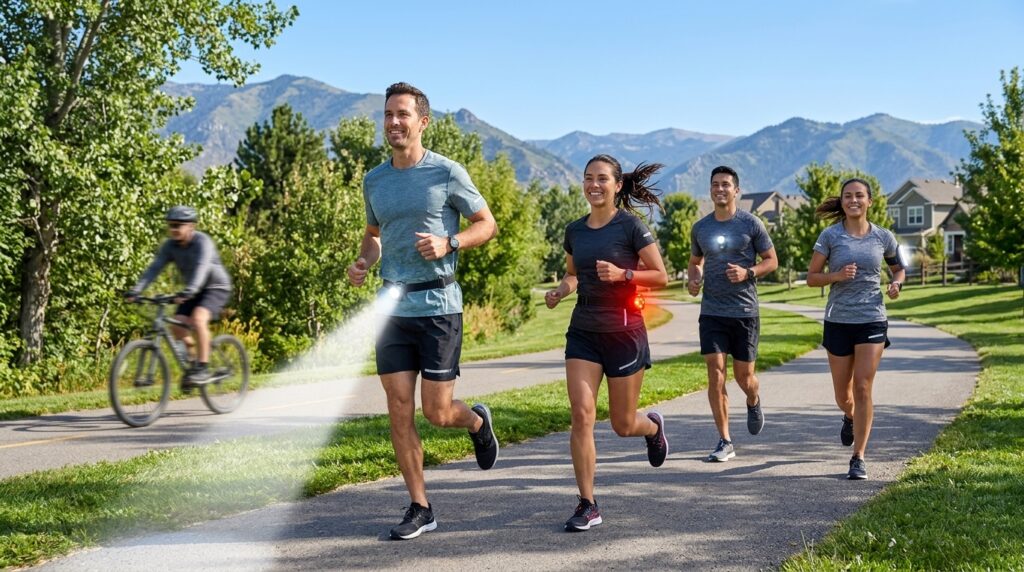
When you lace up your running shoes and head out for a midday jog, visibility probably isn’t the first thing on your mind. After all, it’s broad daylight—what could possibly go wrong? Yet the real risk of daytime running without safety lighting is far more significant than most runners realize, and it’s a hazard that affects everyone from seasoned marathoners to busy parents squeezing in a quick workout during their lunch break. The statistics paint a sobering picture: according to the National Highway Traffic Safety Administration, pedestrian fatalities occur throughout all hours of the day, with a surprising percentage happening during what we consider “safe” daylight hours.
Your brain naturally associates darkness with danger and assumes that daylight equals safety. This cognitive bias can lead to complacency about your visibility on the road, creating a false sense of security that puts you directly in harm’s way. The reality is that drivers face numerous visibility challenges during daytime hours, including sun glare, visual distractions, and the simple fact that human eyes don’t always register moving objects—especially those that blend into the background—as quickly as we’d hope.
The Science Behind Daytime Visibility Challenges
The human eye is remarkable, but it’s not infallible, and understanding its limitations helps explain why daytime running without proper safety lighting can be just as dangerous as nighttime exercise. When drivers navigate roads during the day, their eyes constantly adjust to varying light conditions, shadows, and bright spots created by the sun’s position. These adjustments happen automatically, but they create brief moments of reduced visual acuity that can make it difficult to spot runners, particularly those wearing colors that blend with their surroundings.
Sun glare represents one of the most underestimated hazards for daytime runners. During early morning and late afternoon hours—prime running times for many busy parents and working professionals—the sun sits low on the horizon, creating intense glare that can temporarily blind drivers. When you’re running during these golden hours without reflective gear or safety lighting, you essentially become invisible to drivers struggling with sun in their eyes. This isn’t a matter of careless driving; it’s simple physics and human biology working against your safety.
Research in visual perception demonstrates that movement detection relies heavily on contrast. If you’re wearing gray, black, or earth-tone running clothes against an asphalt road or concrete sidewalk, you present minimal contrast to drivers scanning the road ahead. The human brain processes visual information by identifying edges and contrasts, so when you fail to stand out from your environment, drivers’ brains may literally not register your presence until it’s too late. Adding active lighting to your running gear creates movement, contrast, and attention-grabbing elements that bypass these biological limitations.
Common Daytime Running Scenarios That Increase Your Risk
Picture yourself running through your neighborhood on a cloudy afternoon. The overcast conditions seem bright enough, but you’re actually facing one of the most dangerous visibility scenarios. Overcast days create flat, diffuse lighting that reduces shadows and depth perception, making it harder for drivers to judge distances and spot objects that aren’t actively illuminated. Without safety lighting, you’re relying entirely on drivers’ ability to distinguish your moving form from parked cars, mailboxes, trees, and all the other visual clutter lining residential streets.
Urban running presents its own unique set of challenges that amplify the real risk of daytime running without safety lighting. City streets are visual chaos—storefronts, pedestrians, traffic signals, construction zones, delivery trucks, and countless other elements compete for drivers’ attention. When you add in the modern plague of distracted driving, where even conscientious drivers glance at GPS systems or passenger conversations, your window of opportunity to be noticed shrinks dramatically. Runners who incorporate flashing lights or reflective elements increase their visual priority in this crowded landscape.
Weather Conditions That Compromise Daytime Visibility
Rain transforms daytime running conditions from challenging to genuinely hazardous. Water on windshields scatters light, creating distortions and reducing clarity even with wipers running at full speed. The road surface becomes reflective, creating mirror-like effects that confuse depth perception. Drivers naturally focus more intently on the road surface and other vehicles, narrowing their field of awareness. If you’re out running in rain without active lighting, you’re gambling with your safety in ways you might not fully appreciate until you’ve experienced a close call.
Fog and mist present similar challenges but with the added danger of giving runners a false sense of security. During foggy conditions, you might feel like you’re being cautious by running on familiar routes, but fog doesn’t just reduce how far drivers can see—it fundamentally changes how light behaves. Without your own light source cutting through the moisture-laden air, you remain a vague, indistinct shape that drivers might mistake for shadows, bushes, or optical illusions created by swirling fog.
Snow and winter conditions deserve special mention because they create a paradox: the bright white landscape makes you think visibility is excellent, when in reality, you’re facing some of the most challenging conditions of the year. Snow creates glare similar to sun glare but from all directions simultaneously. If you’re wearing dark running clothes against snow, you create contrast, but without active lighting, drivers may not process your movement quickly enough, especially at intersections where they’re focused on icy road conditions and maintaining vehicle control.
The Psychology of Driver Perception and Runner Safety
Your safety as a runner depends largely on factors completely outside your control—namely, the attention, skill, and reaction time of every driver who passes you. Understanding driver psychology reveals why the real risk of daytime running without safety lighting is so significant. Drivers operate in a state of continuous partial attention, constantly scanning for hazards while simultaneously managing speed, navigation, vehicle control, and often various distractions. In this mental juggling act, unexpected elements—like runners appearing from behind parked cars or emerging from shadows—simply don’t register quickly enough.
The phenomenon of “looked-but-failed-to-see” accidents has been extensively studied in traffic safety research. These crashes occur when drivers look directly at a motorcyclist, cyclist, or pedestrian but genuinely don’t consciously register their presence. The driver’s eyes may scan across you, but their brain doesn’t prioritize or process that visual information as relevant or threatening. Active safety lighting helps overcome this neurological filtering by creating movement, flashing patterns, or brightness levels that trigger the brain’s threat-detection systems, essentially forcing drivers to notice you whether they’re actively looking or not.
How Motion and Light Affect Driver Response Times
When a driver’s eyes detect movement combined with light, their brain processes this information through ancient survival circuits designed to spot predators and threats. This evolutionary programming works in your favor when you use safety lighting because flashing or steady lights trigger faster recognition and response than static visual elements alone. Studies have shown that reaction times improve by several hundred milliseconds when drivers encounter runners with active lighting versus those without—a difference that can mean several car-lengths of stopping distance at typical road speeds.
Your position relative to the driver also matters enormously. When you’re running on the side of the road facing traffic, drivers have maximum time to see and react to you. However, when you’re running with traffic behind you—sometimes necessary on roads without sidewalks—drivers approach from your blind side. Without rear-facing safety lighting, you’re invisible until drivers are dangerously close. This scenario is particularly risky during times when drivers are tired, rushed, or less attentive, such as morning and evening commutes.
Real-World Accident Data That Should Concern Every Runner
The statistics surrounding pedestrian-vehicle accidents tell a story that every runner needs to hear. While nighttime accidents receive more attention, daytime incidents account for a substantial portion of runner and pedestrian injuries. The National Safety Council reports that pedestrian fatalities occur throughout all daylight hours, with peak times corresponding to high-traffic periods when busy professionals and parents are most likely to be squeezing in their workouts. These aren’t just statistics—they represent real people whose lives changed in an instant because visibility wasn’t prioritized.
Intersection accidents represent a particularly deadly category for runners. Even at controlled intersections with crosswalks and traffic signals, drivers making turns often focus on other vehicles rather than pedestrians and runners. The phenomenon of “right turn on red” creates situations where drivers checking for cars from the left may never look right, where you’re crossing. Without active lighting to catch peripheral vision, you become a tragic statality waiting to happen. This risk multiplies during busy shopping hours, school drop-off and pick-up times, and rush hour traffic.
Rural running presents different but equally serious risks. Country roads often lack sidewalks and shoulders, forcing runners to share the roadway with vehicles traveling at higher speeds. Drivers on rural roads typically aren’t expecting to encounter runners and may be traveling faster than posted limits. The combination of higher speeds, limited escape routes, and driver inattention creates scenarios where the real risk of daytime running without safety lighting becomes statistically higher than in urban environments where drivers expect to see pedestrians.
What Counts as Effective Daytime Safety Lighting
Not all safety lighting provides equal protection, and understanding what actually works during daylight hours helps you make informed choices about your running gear. Reflective materials, while better than nothing, rely on light sources—like car headlights—to illuminate them. During bright daylight, reflective strips and vests provide minimal benefit because there’s no concentrated light source to reflect back to drivers. This is why active lighting—LED systems that create their own light—represents the gold standard for daytime visibility.
The most effective daytime safety lights use flashing or strobing patterns that create visual disruption in drivers’ field of view. Your brain is hardwired to notice changes and movement, so a steady light might fade into the background noise of urban visual clutter, but a flashing light repeatedly captures attention. Look for lights rated for daylight visibility, typically measured in lumens, with higher numbers indicating brighter output. For daytime running, you’ll want lights specifically designed with enough intensity to cut through ambient daylight.
Strategic Placement of Safety Lighting on Your Body
Where you position your safety lighting matters almost as much as the type of light you choose. Your torso represents your body’s largest visual target, making chest-mounted or vest-integrated lights highly effective for frontal visibility. However, don’t neglect rear-facing protection—lights attached to your waist, backpack, or clipped to the back of your shirt ensure drivers approaching from behind can see you. Consider that drivers may encounter you from any direction depending on intersections, driveways, and parking lots along your route.
Many experienced runners use multiple light sources to create 360-degree visibility. A headlamp or clip-on hat light increases your visible height, making you more noticeable in drivers’ sightlines, which naturally scan the horizon. Ankle or shoe lights add low-level visibility and create a distinct movement pattern that clearly identifies you as a runner rather than a stationary object. This redundancy ensures that even if one light is obscured by your arm swing or body position, others remain visible.
Color selection for your safety lighting deserves careful consideration. While white lights work well, studies suggest that red and amber lights may actually catch attention more effectively during certain conditions because they’re associated with warning signals and brake lights. Some advanced safety systems use alternating colors or patterns specifically designed to maximize noticeability across various lighting conditions and weather scenarios.
The Investment in Safety Equipment Versus the Cost of an Accident
When you start researching safety lighting for running, you’ll encounter products ranging from a few dollars to several hundred dollars for comprehensive systems. The temptation to skip this investment or choose the cheapest option is understandable, especially when you’re already spending money on quality running shoes, appropriate clothing, and perhaps race entry fees. However, the real risk of daytime running without safety lighting should be evaluated against the potential costs of even a minor accident, which can include medical bills, lost work time, permanent injury, or worse.
Quality LED safety systems designed for runners typically cost between twenty and sixty dollars, placing them well within the budget of most fitness enthusiasts. These systems often include rechargeable batteries, multiple brightness settings, and weather-resistant construction that withstands sweat, rain, and regular use. When you calculate the cost per run over the product’s lifespan, you’re investing pennies per workout for significantly enhanced protection. This represents one of the most cost-effective safety upgrades you can make to your running routine.
For busy parents balancing family budgets, consider the broader implications of your safety choices. Your children depend on you, and an accident that leaves you injured or worse doesn’t just affect you—it impacts everyone who relies on you. Teaching your kids about proper safety equipment also models responsible behavior that they’ll carry into their own athletic activities. When they see you consistently using safety lighting, you’re normalizing good habits that could save their lives as they grow into independent runners and cyclists.
Integrating Safety Lighting Into Your Running Routine
Making safety lighting a non-negotiable part of your running routine requires the same discipline you apply to your training schedule. Just as you wouldn’t head out for a long run without proper hydration or appropriate shoes, safety lighting should become automatic equipment that you grab before walking out the door. Create a dedicated spot near your running gear where you keep your lights charged and ready, eliminating the friction of searching for equipment when you’re already motivated to run.
For morning runners trying to fit in workouts before work or getting kids ready for school, simplicity matters. Choose lighting systems that attach quickly and securely without complicated straps or adjustments. Clip-on lights, magnetic attachment systems, and vest-integrated lights all offer quick deployment that doesn’t eat into your limited workout time. If your safety equipment is inconvenient, you’re more likely to skip it on days when you’re rushed—exactly the days when distracted drivers pose the greatest threat.
Making Safety Lighting Work With Different Running Styles
Trail runners face different visibility challenges than road runners, but the principle remains the same: other trail users, including mountain bikers traveling at high speeds, need to see you clearly. While trails may seem safer than roads, blind corners, headphone use among other trail users, and the simple chaos of natural environments create scenarios where active lighting prevents collisions. Many trail runners use headlamps even during daytime for both safety signaling and occasional moments under heavy tree cover where natural light diminishes.
Urban runners navigating city streets benefit from the most comprehensive lighting setups because they encounter the highest density of traffic, intersections, and potential conflict points. Consider using multiple light sources that remain visible even when you’re moving through the complex geometry of urban environments—lights that don’t get blocked by your arms, bags, or water bottles as you run. Some runners use both front and rear lights plus reflective gear as a belt-and-suspenders approach to city running safety.
Group runners and running club members should establish lighting standards for group runs, ensuring that every participant maintains visibility. While running in groups provides some safety benefits through increased visual presence, drivers still need to clearly see the full extent of your group to give appropriate space. Spacing your safety lights throughout the group, with particularly bright or flashing lights on the front and rear runners, creates clear visual boundaries that help drivers understand they’re encountering multiple runners.
Weather-Specific Strategies for Maintaining Visibility
Adapting your safety lighting approach to current weather conditions demonstrates the kind of situational awareness that separates safe runners from those taking unnecessary risks. On bright, clear days with excellent visibility, you might assume minimal lighting is sufficient, but remember that glare from the sun can blind drivers just as effectively as darkness. During the golden hour—roughly an hour after sunrise and before sunset—sun angle creates particularly challenging glare situations that warrant maximum lighting even though ambient light seems abundant.
Rainy conditions demand weather-resistant lighting with secure attachment systems that won’t shake loose or fail when exposed to moisture. Water droplets on lights can actually enhance visibility by creating a halo effect, but only if your lights are designed to handle wet conditions. Look for lights with IPX4 rating or higher, indicating protection against water splashing from any direction. Some advanced systems include covers or lenses specifically designed to prevent water accumulation that might dim your visibility.
Winter runners dealing with early darkness and challenging weather need the most robust lighting systems available. The combination of snow, ice, reduced daylight hours, and drivers struggling with poor road conditions creates a perfect storm of risk factors. During winter months, treat every run as a high-visibility situation requiring your full complement of safety equipment. The extra minutes spent gearing up with proper lighting could prevent the life-altering consequences of an accident that statistical probability suggests is more likely during winter conditions.
Teaching Your Children About Running Safety and Visibility
As a parent, you’re not just responsible for your own safety—you’re shaping the habits and awareness that will protect your children throughout their lives. When your kids see you consistently using safety lighting for daytime runs, you’re teaching them that visibility isn’t optional or only necessary after dark. This lesson translates directly to their own activities, whether they’re running, cycling, or walking to school during winter months when darkness encroaches on typical commute times.
The real risk of daytime running without safety lighting applies even more critically to children, whose smaller stature makes them less visible to drivers already struggling with adult-height detection. If your children participate in youth running programs, cross-country teams, or simply enjoy running around the neighborhood with friends, insisting on proper safety lighting establishes protective habits during their formative years. Many tragic accidents involve children whose parents assumed daylight and familiar neighborhoods provided adequate safety.
Creating a family culture around safety equipment removes the stigma some young people associate with looking “different” or “uncool” while wearing lights and reflective gear. When everyone in the family follows the same safety protocols, it normalizes proper equipment use and eliminates the arguments about fairness or necessity. Consider making the selection of personal safety lighting a family activity where each member chooses lights that reflect their personality while meeting your safety standards.
The Legal and Liability Aspects of Running Safety
While laws regarding pedestrian lighting vary by jurisdiction, an increasing number of municipalities are implementing requirements for reflective or illuminated gear during certain conditions. Even where not legally mandated, the question of contributory negligence can arise if you’re involved in an accident while running without reasonable safety precautions. Insurance companies and legal proceedings often examine whether the injured party took appropriate measures to ensure their own visibility, potentially affecting settlement amounts or liability determinations.
Understanding that drivers have a legal duty to avoid pedestrians doesn’t mean you should rely on that legal protection for your physical safety. Being legally right provides no comfort if you’re seriously injured or worse. The practical reality is that crashes happen faster than legal proceedings, and your best protection comes from preventing accidents rather than assigning blame afterward. Safety lighting represents a proactive measure that demonstrates your commitment to responsible road sharing, which can also influence how others perceive and respond to runners generally.
Some homeowners and auto insurance policies include provisions related to pedestrian behavior and safety equipment use. While rare, there have been cases where insurance coverage was affected by the pedestrian’s failure to take reasonable safety precautions. Beyond insurance considerations, the moral and ethical responsibility you carry—particularly as a parent or community member—means that your safety choices influence how seriously others take these same precautions.
Overcoming Common Objections to Using Daytime Safety Lighting
Many runners resist adding safety lighting to their daytime runs, citing various objections that deserve honest examination. The “I’ve never had a problem before” argument represents survivorship bias—the fact that you haven’t been hit yet doesn’t mean you haven’t been at risk, only that you’ve been lucky. Statistics work against all of us eventually, and the question isn’t whether daytime running without lighting is always fatal, but whether it’s worth gambling with odds that could catastrophically turn against you on any given run.
The comfort and convenience objection—that lights are annoying, heavy, or interfere with natural movement—held more validity a decade ago when safety lighting was indeed bulky and uncomfortable. Modern LED technology has produced incredibly lightweight systems that you’ll barely notice during your run. Many lights weigh less than an ounce and attach so securely that they become part of your running outfit rather than a cumbersome addition. If you’re willing to carry a phone, keys, or water bottle, the marginal inconvenience of a small safety light is negligible.
Cost concerns, while understandable, don’t withstand scrutiny when you consider the investment you’ve already made in your running habit. If you can afford quality running shoes that cost well over a hundred dollars and replace them every few hundred miles, a one-time investment in safety lighting that lasts years represents a fraction of your overall running expenses. Additionally, many sporting goods retailers offer budget-friendly options that provide substantial protection without premium price tags.
How to Evaluate and Choose Your Safety Lighting System
Walking into a sporting goods store or browsing online retailers reveals dozens of safety lighting options, which can overwhelm runners new to this category of equipment. Start by identifying your specific running environment and conditions—urban versus rural, early morning versus midday, fair weather only versus all conditions. Your individual circumstances should guide your selection toward products designed for your particular risk factors and running style.
Brightness ratings, typically measured in lumens, provide one metric for comparison, but higher isn’t always better for daytime use. Extremely bright lights drain batteries quickly and may be overkill for well-lit urban environments, while providing necessary visibility on rural roads or during marginal weather conditions. Look for lights offering multiple brightness settings, allowing you to adjust intensity based on current conditions while extending battery life when maximum output isn’t necessary.